
Description
What the pack is, and the household it suits
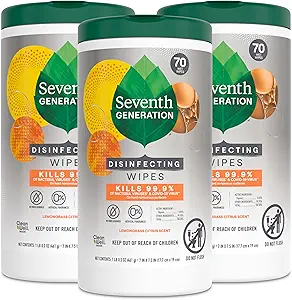
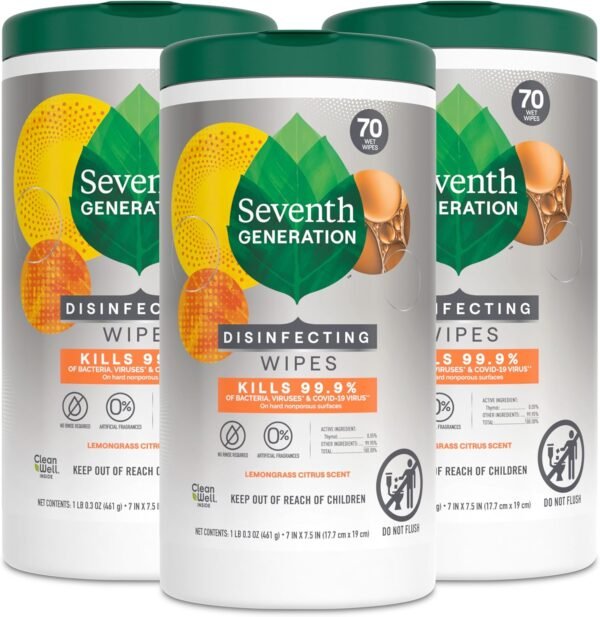
Seventh Generation Disinfecting Multi Surface Wipes are sold as a one step product, meaning the same wipe is meant to lift visible soil and carry the disinfecting active at the same time. The listing describes three canisters of 70 wipes in the Lemongrass Citrus scent. That reads as 210 wipes in total, though the product title writes it as “70 Count, Pack of 3” and never states a total anywhere, so a buyer who reads it as 70 wipes split across three packs would not be unreasonable. Unilever is named as the manufacturer, the model number is SG-068, and the listing dates the item to June 2016. Amazon places it 1,680th in Health and Household and 9th among household disinfectant wipes.
This is a canister that lives where the mess happens, on a kitchen counter, beside a changing table, on a bathroom shelf, or in the corner of a home gym. Wipes trade cost for convenience. They are good for a thirty second pass over a doorknob or a high chair tray, and expensive for anything with real surface area. A household that mostly needs floors cleaned is buying the wrong format.
The formulation and what actually does the work
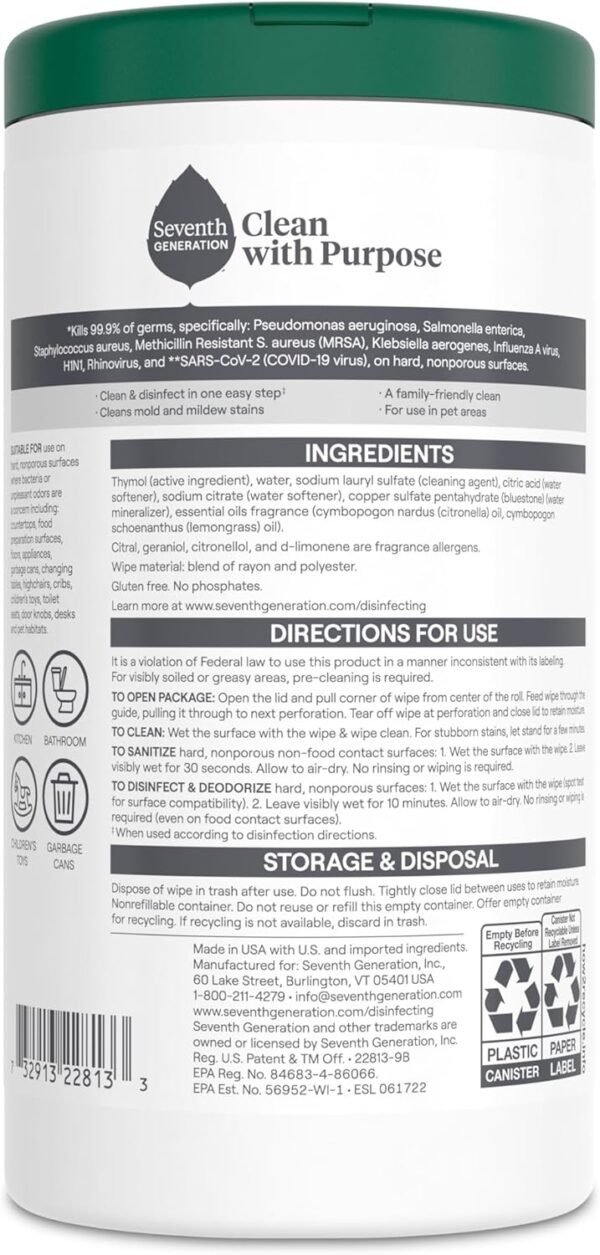
Seventh Generation names thymol, described on the listing as a component of thyme oil, as the active ingredient, and states that the disinfectant formula came from a partnership with the CleanWell Company. Thymol based disinfectants are a real product class, and the listing describes the product as EPA registered, which in the United States means a disinfection claim has been reviewed and a specific set of label directions approved. That registration is the reason the claim can appear at all.
What the listing does not publish is the thymol concentration, the full ingredient statement, or the EPA registration number. Any buyer who needs those, and anyone cleaning a food business or a childcare setting usually does, will have to read the canister itself. This site does not have that information and will not guess at it.
What the germ claim covers, and what it does not
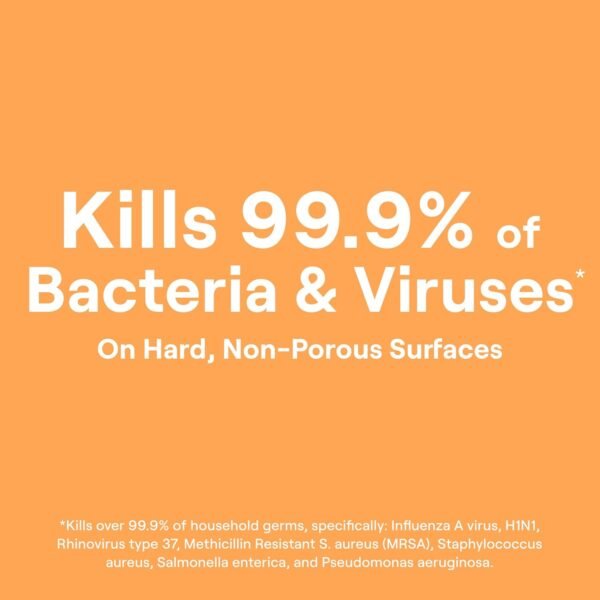
The listing states that the product kills over 99.99 percent of household germs and then names them: Influenza A virus, H1N1, Rhinovirus type 37, methicillin resistant Staphylococcus aureus, Staphylococcus aureus, Salmonella enterica and Pseudomonas aeruginosa, on hard non porous surfaces. That is Seventh Generation’s claim, made on its own label, and it is limited in two ways worth stating plainly. It applies to the organisms on that list and no others, and it applies only on hard non porous surfaces. It says nothing about anything porous, and it says nothing about any organism the label does not name.
Surfaces, and where to keep it away from
The manufacturer lists hard non porous surfaces throughout the house, and specifically names children’s toys, pacifiers, gym equipment, food contact surfaces, doorknobs and bathroom surfaces. It also states that no rinse is required, even on food contact surfaces. Take that as written on the label rather than as our recommendation, and note that a no rinse instruction is part of approved EPA label language, not a marketing flourish.
The listing is silent on the surfaces that usually cause trouble. It gives no guidance for natural stone such as marble, granite or travertine, none for unsealed or waxed wood, none for uncoated aluminum or brass, and none for painted or upholstered surfaces. A wipe is wet and it is not pH neutral, so treating an unlisted surface as approved is a guess. Test an out of sight corner first, and for a stone counter reach for a product formulated for it, such as the Bar Keepers Friend granite and stone cleaner, rather than a general disinfectant.
Using it correctly, which mostly means contact time
This is the part almost everyone gets wrong, and this listing makes it easy to get wrong. A disinfectant only performs to its label if the surface stays visibly wet for the full contact time. Spray, wipe and walk away, and you have cleaned the surface without disinfecting it. The listing publishes no contact time at all. It does not say ten seconds, thirty seconds or four minutes. The canister label carries that number, and a reader needs to look at it before the first use, because the difference between a compliant clean and a cosmetic one sits entirely in that figure.
Practical handling is simple otherwise. Wipe the soil off first, then use a fresh wipe for the disinfecting pass, because a wipe loaded with grease is not delivering much active to the surface. Keep the lid shut so the remaining wipes do not dry out. Do not flush used wipes, whatever the material feels like. Do not follow this with a chlorine bleach product on the same surface without rinsing in between, and never mix cleaning products together in a container. Store it out of reach of children and away from heat.
Running cost, and what else does this job
Cost per wipe is the honest way to compare this format. Three canisters is a bulk buy in a category usually sold one canister at a time, and bulk is where wipes make any financial sense at all. Even then, a wipe cleaning a countertop costs many times what the same countertop costs to clean with a diluted concentrate. The sensible pattern is wipes for touch points and a sprayer for surfaces.
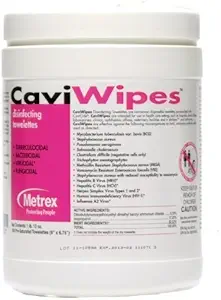
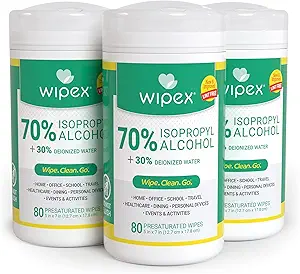
If the priority is a cheaper wipe for general grime rather than a registered disinfectant, the Rosmar WPS-300E sanitizing wipes sit in the same aisle at a different price point. For hard surface work where an alcohol flash off is wanted instead of a botanical scent, the Wipex isopropyl alcohol wipes are a different chemistry entirely. Clinical and gym settings often standardize on something like the CaviWipes disinfectant wipes, which are built around a longer registered claim list. The rest of the format is worth browsing under disinfectant wipes, and for larger areas the sprayer options under disinfectant sprays and liquids cover more ground per dollar.
Who should buy this and who should not
Buy it if you want an EPA registered disinfecting wipe with a plant derived active and a scent that is not the usual chlorine or quaternary ammonium smell, and if you will actually read the contact time on the canister. It is a reasonable default for kitchen touch points and bathroom fixtures.
Skip it if you need the registration number and the full ingredient statement before purchase, because the listing does not carry them. Skip it if your surfaces are mostly stone, unsealed wood or fabric, none of which the label addresses. And skip it if the reason you are buying is floor area, where a wipe is the most expensive way to solve the problem. One last data note: the listing’s own customer reviews field contains a sales rank rather than a star rating, so treat the ratings information on that page as unreliable.