

Description
A professional case pack that has wandered into a household catalog
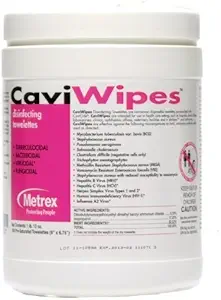
CaviWipes are made by Metrex Research and this listing is item 13-1100CS, a case of twelve canisters with one hundred and sixty wipes in each, so nineteen hundred and twenty wipes in total. The listed shipping weight is 23.65 pounds. That is not a kitchen product. It is a dental and medical office consumable bought by the case, and the listing describes it in exactly those terms, using trade language such as UNSPSC code, dispensing method and container type rather than anything a home buyer would recognize.
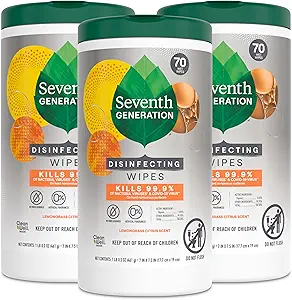
Being clear about that up front saves money and confusion. A household that wants to wipe a countertop is buying twelve canisters and a shipping pallet’s worth of packaging. The wipes are large, at a stated 6 by 6.75 inches, and they are designed to keep hard non porous surfaces wet for a defined period, which is a clinic workflow rather than a kitchen one. If you want a consumer sized tub, the disinfectant wipe listings carry several, and something like the Seventh Generation disinfecting wipes is the format a home is actually looking for.
The claims on this listing, and the three things it does not tell you
Metrex states that the wipes are effective against both TB and HBV, meaning tuberculosis and hepatitis B virus, and that the towels stay fully saturated and will not dry out during use, and that the non woven towelette is sturdy and will not bunch. Those are the manufacturer’s claims and they are repeated here as such. This site does not test products and makes no independent statement about what these wipes kill.
Three critical pieces of information are missing from the page, and all three are on the canister label:
First, there is no active ingredient disclosed anywhere on this listing. No chemical is named, no concentration is given, and there is no ingredient panel. Do not assume what is in these wipes from other products in the category.
Second, and this is the one that matters most, the listing gives no contact time. Every surface disinfectant claim in the United States is tied to a wet contact time on the registered label, which is the number of minutes the surface must stay visibly wet for the claim to hold. A wipe that is applied and then dried off immediately has not disinfected anything, whatever the canister says. If you buy these, read the contact time on the label and follow it, and expect to use more than one wipe on a larger surface to keep it wet for the full period.
Third, no EPA registration number appears on the listing. Surface disinfectants sold in the United States with kill claims are registered pesticides under federal law, and that registration number is the only way to look up what a product is actually approved to claim. It is on the container, not on this page.
What the specification block gets wrong
The specification block describes the shipping carton, not the product: 16 by 11 by 15 inches at 23.65 pounds. The description separately gives pack dimensions of 6 by 6.75 inches, which is the wipe size. The feature bullets consist only of “Actual Product May Vary” and “See Product Specifications for more detailed information”, which is filler rather than information. The listing also mentions a wall bracket, item 13-1175, sold separately, which again signals an institutional product. Amazon ranked this case fiftieth in Household Disinfectant Wipes when the data was captured, a household category the product does not really belong to.
Surfaces, and what to keep these away from
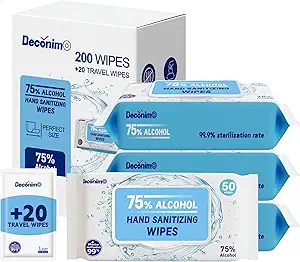
Surface disinfectants of this type are intended for hard, non porous surfaces. They are not intended for skin, and a surface disinfectant must never be used as a hand wipe. If hand cleaning is what you need, that is a different product entirely and the hand sanitizing wipe format is what to look at.
Because the listing publishes no ingredients, compatibility has to be treated as unknown and tested. Many clinical wipes are hard on soft plastics, acrylic, painted finishes, rubber seals and lens coatings, and repeated use can craze or cloud them. Test on a hidden area of any equipment, and check the manufacturer’s guidance for anything expensive. Do not use them on unsealed wood, natural stone, or any food contact surface unless the label specifically allows it, and where a label does allow food contact use it will usually require a potable water rinse afterward. Keep them away from upholstery and carpet, which need enzyme based spot treatments rather than a hard surface disinfectant.
Using them correctly, and storing a case safely
The order of operations decides whether a disinfectant works. Clean visible soil off first, because disinfectants are deactivated by organic matter. Then apply a fresh wipe and leave the surface visibly wet for the label contact time. Then let it air dry or rinse if the label says to. Wiping dry too early is the single most common misuse of every product in this category and it turns a registered disinfectant into an expensive damp cloth.
Ventilate the room while you work, keep the canister lid closed so wipes do not dry out, and store the case away from heat and away from children. Never combine a disinfectant wipe with another cleaning product on the same surface. Mixing cleaners is how people generate irritant or toxic gases at home, and the classic combinations to avoid are chlorine bleach with ammonia and chlorine bleach with any acid. Do not decant wipes into another container, and do not top up a canister with liquid, because that destroys the formulation ratio the label claims are based on.
Wipes go in the trash, never down a toilet. They are non woven and they do not break down in a drain.
What a case costs you over time
The arithmetic is the reason to buy this and the reason not to. Nineteen hundred and twenty wipes bought at once is a low cost per wipe, but it is a large amount of capital sitting in a cupboard and wipes have a shelf life once opened, because the towelette dries out as the canister is opened and closed. A clinic that opens one canister a week uses the case in three months. A household that wipes a counter twice a week will still be working through canister two years later, by which time the later canisters may be past their date.
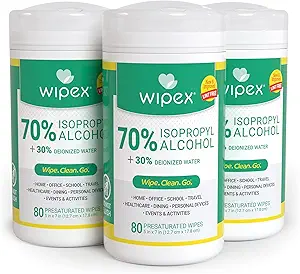
For a home, an alcohol wipe such as the Wipex isopropyl alcohol wipes or a consumer disinfectant spray from the disinfectant spray listings is usually the more sensible buy, both on cost and on how much you can realistically use before it dries out.
Who should buy this and who should not
Buy this if you are equipping a dental practice, a clinic, a tattoo studio, a gym or a laboratory, you already know the label contact time and the registration number, and you will get through twelve canisters while they are fresh. In that setting a case pack is exactly right.
Do not buy this for a home. The quantity is wrong, the wipes will dry out before you finish them, and the listing gives you no ingredient list, no contact time and no registration number to work from. If a household surface needs disinfecting rather than cleaning, buy a consumer product whose label you can read before purchase, and follow the contact time printed on it.