
Description
A narrow tool for a specific job
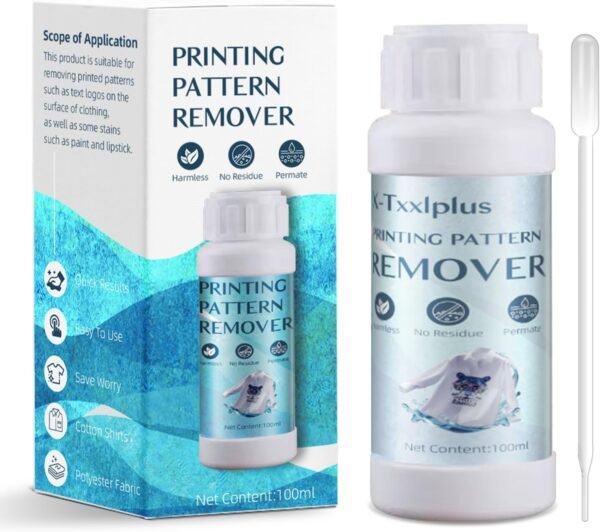
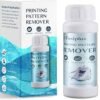
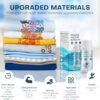
This is a 100 milliliter bottle of heat transfer vinyl remover with a dropper, made by Dongguan Jiexin Cleaning Agent Company under model number JJJ-100. The listing dates to March 2025, the package measures 4.57 by 1.89 by 1.85 inches at 3.53 ounces, and Amazon places it 79,746th in Health and Household and 34th among household fabric and upholstery cleaners.
The job is narrow and real. Heat transfer vinyl is the printed film pressed onto t shirts, uniforms, tote bags and team wear. It is held on by an adhesive activated by heat, and it does not wash off. People want it off for three reasons: a print has cracked and looks worse than a plain shirt, a garment carries a name or a logo that no longer applies, or a reseller wants to strip a branded blank and reuse it.
Nothing in a normal laundry cupboard removes it. A stain remover works on soil, not on a cured adhesive film. This is a solvent product for a solvent problem, and that is what makes it worth having and what makes it worth handling carefully.
What is in it, which is the serious gap
No ingredient is named anywhere on this listing. There is no solvent named, no concentration, no pH, no flash point, no safety data reference and no hazard statement. The description field is empty. Everything on the page is in five feature bullets.
That matters more here than on a general cleaner, because a liquid that dissolves cured adhesive is doing it with a solvent, and solvents differ enormously in flammability, in what they do to plastics and finishes, and in what happens if you breathe them in an enclosed room.
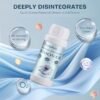
One claim on the page makes the gap worse rather than better. The title and the bullets emphasize that the product has no irritating smell. That sounds reassuring and it is not. Odor is the warning system people rely on to know when a room needs more ventilation, and a solvent you cannot smell is one you will keep working with for longer than you should. Read a low odor claim as a reason to be more careful about airflow, not less.
To the manufacturer’s credit, the third bullet does say to use the product in a well ventilated area or outdoors. Follow that, add gloves and eye protection, and keep it away from open flame, heaters and cigarettes, because with no flash point published the safe assumption is that it might be flammable.
The directions, which are genuinely useful
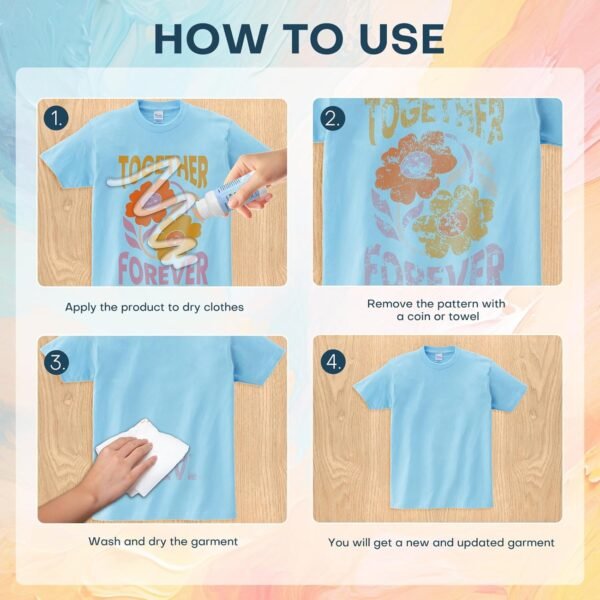
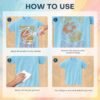
The bullets give a workable method: pour the remover onto the printed area, wait five to ten minutes, then lift the design. If a stubborn piece resists, scrape it with a hard edge, and the listing suggests a coin. The dropper is included so the liquid can be applied to the print rather than to the whole garment.
The most useful line on the page is a distinction most sellers would not bother to draw: heat transfer printing and screen printing are different, and screen printing needs several washes before it clears. Screen ink is bonded into the fibers rather than sitting on top of them, so a buyer expecting to strip a screen printed shirt in ten minutes is going to be disappointed. Saying so on the listing is honest.
Fabrics, and what to test before committing
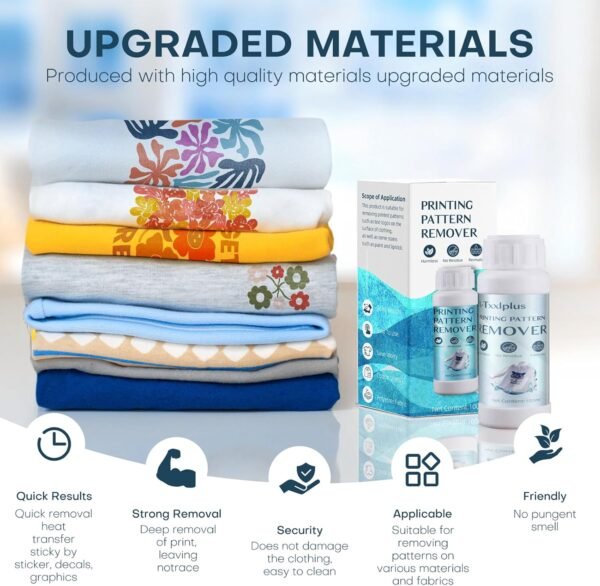
The listing says the product works gently on cotton, polyester and various materials without damaging the clothing surface coating. Read that as the seller’s claim and test regardless, because a solvent does not distinguish between the adhesive you want gone and other things it can dissolve.
Test an inside seam or a hem first, on every garment, and let it dry fully before judging. Watch for three failures. The first is dye lifting: a solvent can pull color out of a dyed fabric and leave a pale patch exactly where the print was. The second is elastane damage: the stretch fiber in activewear, waistbands and blends is far less solvent tolerant than cotton or polyester. The third is coating damage on technical garments, where a waterproof membrane, a durable water repellent finish or a printed lining can be destroyed while the outer fabric looks fine.
Do not use it on leather, suede, vinyl or anything with a laminated or bonded construction. Do not let it run onto a plastic table or a painted surface while you work: put the garment on a scrap board.
The bullets also mention price tags and product stickers on other materials. That is plausible for an adhesive remover, and the same testing rule applies, particularly on painted, printed or plastic items where a solvent can craze or dull the finish.
Handling, disposal and storage
Work outdoors or by an open window with air moving through the room. Wear nitrile gloves rather than latex, since latex is porous to many solvents. Keep it off skin and out of eyes, and wash any splash off immediately with soap and water.
Do not decant it into an unlabeled container, and never mix it with any other cleaning product, especially chlorine bleach. Wash the treated garment afterward, on its own, before wearing it, so that solvent residue is not sitting against skin.
Store the bottle upright and capped, out of reach of children and pets, in a cool place away from heat and sunlight. Dispose of leftover product and solvent soaked rags according to local rules for chemical waste rather than in a household bin, and never leave rags balled up.
Cost and the alternatives
One hundred milliliters is a small bottle, roughly three and a half fluid ounces, and it is applied by dropper onto a print rather than poured, so it goes further than the size suggests. Judge it per garment rather than per ounce. For a crafter fixing occasional mistakes, one bottle covers a lot of shirts. For a reseller stripping stock in volume, it is a consumable to be costed properly.
There is no direct substitute in this catalog, because this is an unusual specialty. The nearest relative by chemistry is the GiGi Sure Clean wax residue remover, another solvent product for a sticky residue that water based cleaners cannot touch. For ink and marker on fabric, the Amodex ink stain kit is the specialist. For ordinary staining before or after this treatment, a pretreat such as the Vanish pretreat gel or a laundry product like the Attitude laundry stain remover covers the everyday work. Browse the wider range under stain removers and all purpose cleaners.
Who should buy it and who should not
Buy it if you press or resell garments and you need vinyl off without ruining the shirt underneath. The dropper, the stated five to ten minute dwell and the honest note about screen printing all point at a product designed by someone who has actually done the job.
Do not buy it if you need to know what solvent is in a bottle before it touches a garment or your hands, because nothing is named. Do not use it on stretch fabrics, technical garments or laminated materials without testing a hidden area. And do not treat the low odor claim as a safety feature, since it removes the cue that tells you to open a window.