Description
Read the bag before you read the listing
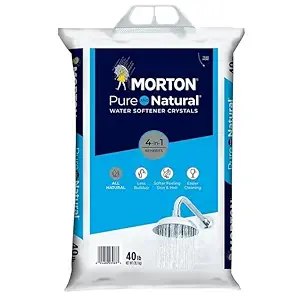
This item is a 40 pound bag of Morton Pure and Natural Water Softening Crystals, offered by a seller trading as LuxeLeaf. The product itself is one of the most familiar things in American hardware retail: crystalline salt sold by the sack for the brine tank of a whole house water softener. The listing on this page describes something else. It calls the crystals a fabric softener in powder form and instructs the buyer to add half a cup to the washing machine for regular loads.
Those two descriptions are not compatible, and the gap between them is the most important thing on this page. We do not remove products from the catalog and we are not going to quietly pick the version that reads better. What follows sets out what the bag is, what the listing claims, and what a buyer should confirm before pouring anything into an appliance.
What water softening crystals are and how they work
A whole house water softener is an ion exchange vessel. Water passes over a resin bed that swaps the calcium and magnesium ions responsible for hardness for sodium ions, and the water leaving the vessel is soft. The resin eventually fills up with hardness minerals and has to be regenerated, which is what the salt is for: the unit draws a strong brine from a tank of these crystals, flushes it through the resin, strips the calcium and magnesium off, and sends them down the drain. The crystals never touch your laundry. They sit in a tank in a basement or a utility room and get topped up every few weeks.
Why softened water genuinely helps laundry
There is a real connection between this product and soft fabric, which is probably how the listing copy drifted. Hard water reduces detergent performance, because calcium and magnesium react with surfactants and with soap to form insoluble deposits. Those deposits build up in fabric over many washes and are a major reason towels go stiff and whites go gray. Soften the incoming water and detergent works better at a lower dose, rinsing is cleaner, and clothes do come out softer. But that effect comes from the softener unit treating the whole supply, not from adding salt to a drum.
The instruction in the listing, and why it deserves scrutiny
The description says to add half a cup to the washing machine for regular loads, and one bullet repeats it. No Morton use direction to that effect appears in the listing, and no ingredient statement, purity grade or laundry testing is published anywhere on the page. Before following that instruction, read the printed bag: the manufacturer’s own directions are on the packaging and they govern, not a seller’s product description.
The practical concerns with putting a coarse mineral salt in a washer drum are worth stating plainly. Undissolved crystals are abrasive against a drum, a door seal and garment fibers. Chloride salts in solution are corrosive to some stainless and to the metal fittings in a machine over time. And appliance manufacturers list what may be added to a wash in the manual, which is the document that decides whether a warranty survives. If soft water is the goal and you do not have a softener unit, the products designed for that job in a wash are laundry water conditioners and boosters, not brine tank salt. The one product in this catalog that is genuinely a purpose milled softening salt for an appliance is Aromasong dishwasher salt, and even that goes into a dedicated salt reservoir in the dishwasher rather than into the wash itself.
Handling, storage and the sheer weight of it
Forty pounds is the practical fact that dominates ownership. The bag measures 18 by 14 by 4 inches and the units field gives 640 ounces, which is consistent with the stated weight. Lift it with your legs, and if the softener tank is down a flight of stairs, decant into a smaller pail rather than carrying the sack.
Store it dry and off a concrete floor. Salt is hygroscopic; a bag left on damp concrete draws moisture, and the crystals fuse into a solid mass that has to be broken up with a tool. In a brine tank the equivalent failure is bridging, where a crust forms above the water line and the unit stops drawing brine while the tank still looks full. Keep the bag closed, keep it away from any household chemical, and keep it out of reach of children and pets, because a large open sack of white crystals in a utility room is exactly the kind of thing a curious child or a dog will investigate. Never mix it with a cleaning product. Salt is chemically simple, but chloride salts and acids or oxidizers do not belong in the same bucket.
Cost, and what to buy for the job you actually have
Bought as what it is, softener salt is one of the lowest cost consumables in a house on a per pound basis, and a 40 pound sack is the standard unit for a reason. Bought as a fabric softener at half a cup per load, the same sack becomes a strange purchase: heavy to ship, awkward to store, and doing a job that products a fraction of its weight are formulated for.
If you want softer laundry, the direct routes are a rinse cycle softener such as Snuggle liquid fabric softener or Downy Ultra soft liquid fabric softener, both of which coat fibers directly, or a mechanical option like wool dryer balls that adds no chemistry at all. If your real problem is hard water scaling the machine rather than stiff towels, a descaling treatment such as the Lemi Shine washing machine cleaner targets the deposits directly. Related options sit in liquid fabric softener and across the wider laundry shelf.
Other oddities in the record: the listing describes a bag of mineral salt as cruelty free and vegan, terms that carry no meaning for an inorganic mineral and that are certification language used loosely here, with no certifying body named. It also calls the crystals a powder, which they are not; the product name says crystals and the format is coarse granules. No gallery images were captured for this item at all, and the product appears on this site under the general laundry category rather than under any softener or water treatment heading. It currently ranks 1,753rd in the retailer’s laundry supplies chart.
Who this bag is for
Buy it if you own a whole house water softener and you need brine tank salt, in which case this is a mainstream product from a well known manufacturer at the standard sack size. Do not buy it as a fabric softener on the strength of this listing’s description, and do not add it to a washing machine without checking both the printed Morton directions and your appliance manual first.