
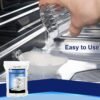
Description
Check your dishwasher before you buy this bag
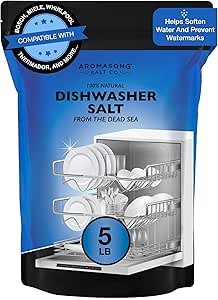
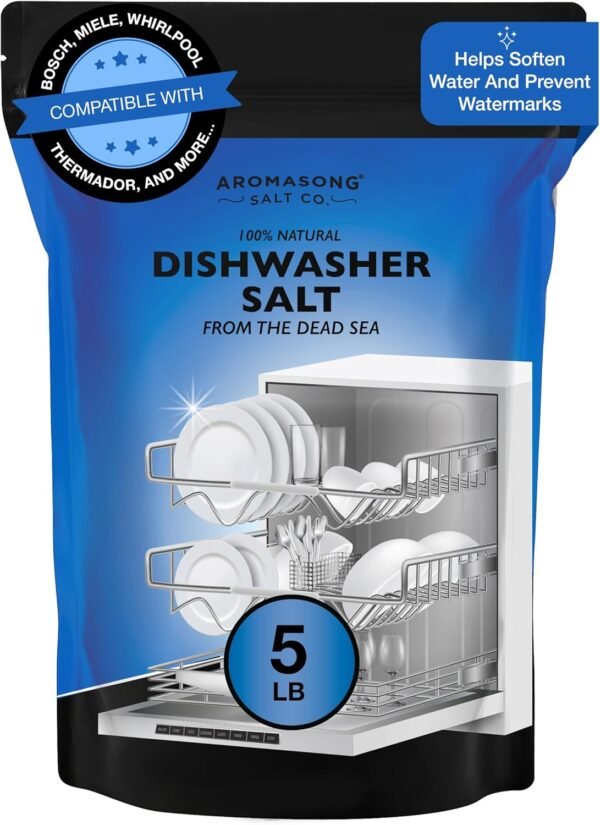
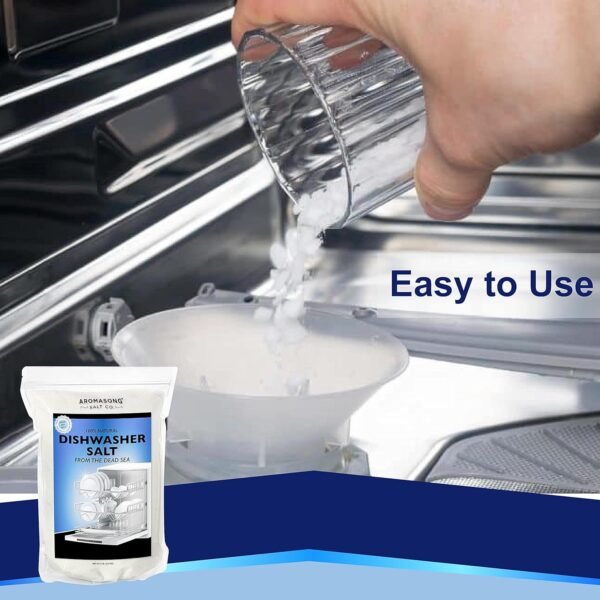
Aromasong sells a 5 pound bag of coarse salt for the built in water softener that some dishwashers contain. The single most important thing to establish first is whether your machine has one, because a great many dishwashers sold in the United States do not. A dishwasher with an integrated softener has a screw cap reservoir in the floor of the tub, usually under the lower basket, and you unscrew it and pour salt directly into the water beneath. If your machine has no such cap, this product has nowhere to go, and salt tipped into the detergent cup or the tub floor of a machine without a softener is a way to damage the appliance rather than to improve it.
The listing does not lead with that check, and its own compatibility statement is muddled. The title names Bosch, Miele, Whirlpool and Thermador, while a bullet narrows it to all dishwasher brands that require salt. Those are different claims. Bosch, Miele and Thermador models frequently do have softener reservoirs; many mainstream American machines, Whirlpool included, commonly do not. Look in the tub, or check the manual, before ordering.
How a dishwasher softener works, and why salt is involved
A built in softener is a small ion exchange unit inside the appliance. Incoming water passes through a resin bed that exchanges the calcium and magnesium responsible for hardness for sodium, so the water reaching the spray arms is soft. Soft water lets detergent dissolve and work at lower doses, and it stops the white film and spotting that hard water leaves on glassware.
The salt does not touch your dishes
The resin eventually saturates, and the machine regenerates it by drawing a strong brine from the salt reservoir, flushing the calcium and magnesium off the resin and sending them to the drain. The salt is a regenerant. It never enters the wash. That distinction matters because the listing describes the product in one bullet as a “salt rinse aide”, conflating two entirely separate consumables. Rinse aid is a surfactant that goes in its own dispenser inside the door and changes how water sheets off dishes so they dry without spots. Salt goes in the softener reservoir. They are different products in different compartments doing different jobs, and a machine with a softener typically needs both. Rinse aid options sit under rinse aids, including the Ginger Lily Farms rinse aid.
What is in the bag, and the purity question
Aromasong states the product is 100 percent natural water softening agent made of pure Dead Sea salt, containing no additives or preservatives. The description field on the listing is empty, and no purity percentage, no grain size and no analysis appears anywhere.
Purity is not a marketing detail in this application; it is the specification. Dishwasher salt is conventionally supplied as high purity coarse sodium chloride, deliberately free of the other minerals found in unrefined salts, and free of the anti caking agents added to table salt. The reason is direct: the softener’s job is to strip calcium and magnesium off the resin, so a regenerant that itself contains magnesium and other hardness minerals works against the purpose, and fine grained salt can bridge or block the reservoir. Dead Sea salt is not pure sodium chloride; it is notable for its magnesium and potassium content, which is what the cosmetics industry markets it for. The listing publishes no figure that would settle whether this particular product has been refined for the application. If your appliance manufacturer specifies a salt grade in the manual, follow that specification rather than the marketing on the bag, because a softener is a warranty item on the machines that have one.
Filling the reservoir, and handling five pounds of salt
The published instruction is short: fill your dishwasher’s salt reservoir, and do it occasionally. The practical routine on machines that have one is to unscrew the cap under the lower basket, use the funnel supplied with the appliance, pour until the reservoir is full, wipe any spilled grains out of the tub, and run a rinse cycle straight away. That last step is the one people skip. Spilled salt sitting on a stainless tub floor is corrosive, and running an empty cycle flushes it out. Expect water to overflow from the reservoir as you pour; that is normal and it is not a fault. Many machines have a hardness setting that controls how often regeneration runs, and setting it to match your local water is what makes a bag last.
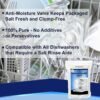
Aromasong notes that the packaging has an anti moisture valve that keeps the salt free of clumps, which is a useful feature because salt is hygroscopic and a bag left open in a humid kitchen fuses solid. Store it sealed, dry, off a concrete floor, and away from other cleaning chemicals. Keep it out of reach of children and pets: five pounds of white crystals in a kitchen cupboard is not food, and it is not table salt. Never mix it with any cleaning product, and never add it to the detergent compartment or to a laundry machine.
What it costs, and where the money actually goes
Softener salt is a low cost consumable and a 5 pound bag is a small quantity by the standards of the product; households with a softener equipped machine and hard water may go through it in a few months. The cost that matters is not the bag, it is what happens without it: on a machine that expects salt, running the softener dry produces exactly the cloudy glassware and white film that people then try to fix by buying stronger detergent.
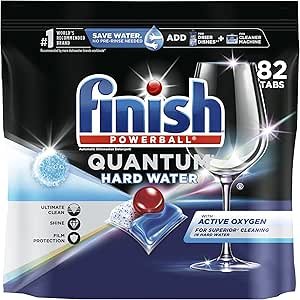
Which is the comparison to make. If your machine has no softener reservoir, the correct answer to hard water is not salt at all; it is a detergent formulated for hard water, such as Finish Quantum hard water detergent, or a conventional product like Finish Classic tablets paired with rinse aid, plus periodic descaling with a machine cleaner such as the Anhui Greenland dishwasher cleaner. Note also the difference between this product and the 40 pound sacks sold for whole house softeners, such as the Morton water softening crystals, which are for a brine tank in a utility room and are a different grade and grain size again. The rest of this shelf is under dishwasher detergent.
Two more oddities. This product is a regenerant salt rather than a detergent, yet it is filed under dishwasher detergent by the retailer and on this site, which is a placement that could easily lead somebody to use it as one; it currently ranks 88th in that chart. And the environmental and safety framing in the bullets, sourced from nature and a safe cleaning product, is the manufacturer’s own wording with no certification behind it.
Who should buy this bag
Buy it if your dishwasher has a salt reservoir, you live with hard water, and your appliance manual does not specify a salt grade this product would fail. Do not buy it if your machine has no reservoir, in which case the answer is a hard water detergent and rinse aid, and check the manual first if your manufacturer states a purity or grain requirement, because this listing publishes neither.