

Description
The job, and how this fits into a wash
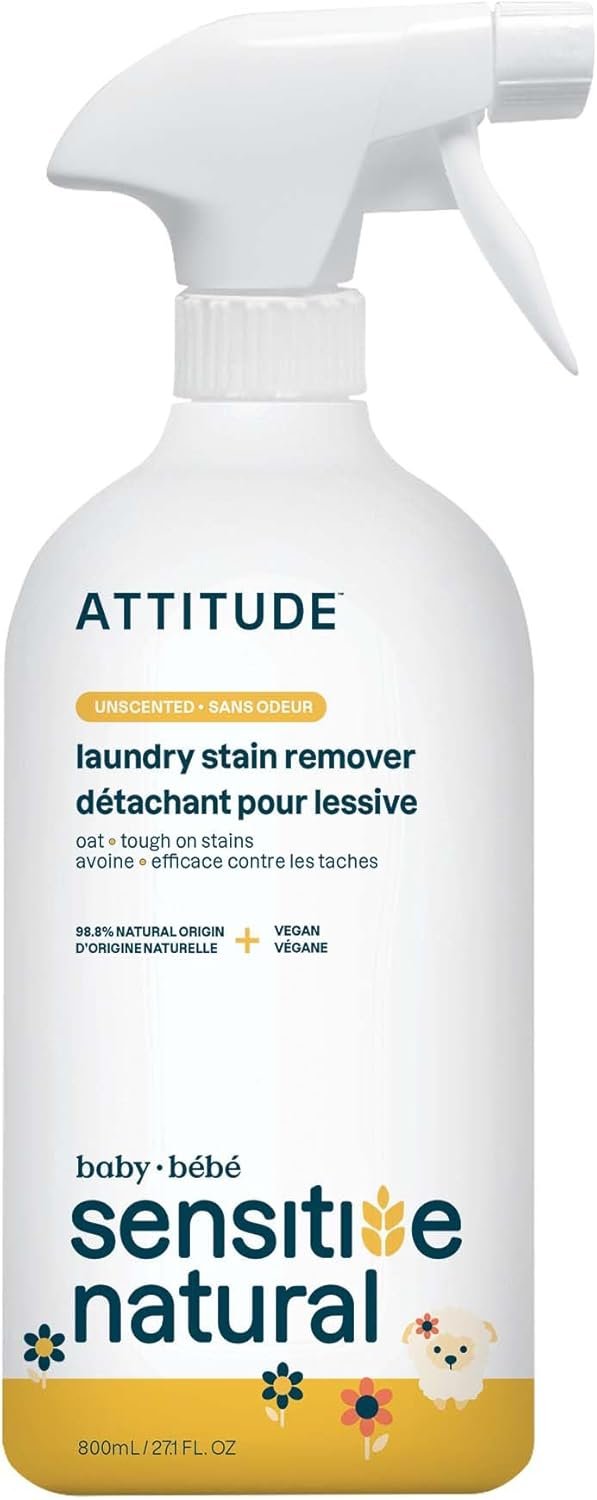
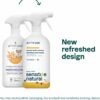
ATTITUDE’s laundry stain remover is a 27 fluid ounce trigger spray aimed at stains on baby and children’s clothing. The most important operational detail is in the product description rather than the title: the manufacturer states that it is used with your laundry detergent. This is a pre treatment, not a detergent and not a substitute for one. You spray the mark, then wash the garment normally.
That places it in a specific slot in a laundry routine, and the household it suits is one dealing with the stains children actually produce: food, milk, formula, grass, mud and the general contents of a mealtime. ATTITUDE describes the spray as suitable for all washable fabrics and all temperatures, which is a broader claim than most pre treatments make and worth reading alongside the garment’s own care label rather than instead of it.
What ATTITUDE publishes, and what each claim actually means
This listing carries an unusual number of specific, checkable claims, and they are worth separating because they say different things.
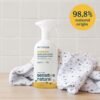
The formulation figure is 98.8 percent naturally sourced ingredients. That is a precise number rather than a vague adjective, and it is to the manufacturer’s credit that it is stated with a decimal place. Naturally sourced describes where a raw material originates, not what it does or how it behaves on skin, and it is a Federal Trade Commission environmental marketing area rather than a defined chemical description. Read it as a sourcing claim.
The one actual ingredient named is oat. ATTITUDE says the vegan formula contains oat and credits its stain removal to what it calls powerful stain removal agents, which are not identified. So one component is disclosed and the working chemistry is not: no enzyme is named, no surfactant, no oxidizer, no pH. For a stain treatment, that is the part that matters most, and it is missing.
Dermatologically tested is not the same as hypoallergenic
ATTITUDE states that the formula is dermatologically tested and has no added fragrance. Both are useful, and the second is the more concrete: no added fragrance is a formulation statement you can rely on, and fragrance is one of the commonest causes of contact reaction in laundry products. Dermatologically tested means a skin test was carried out. It is not a claim about the result, it is not a guarantee for any individual, and it is not the same as a claim of being suitable for sensitive skin. We are not in a position to make any statement about how a product will behave on a child’s skin, and neither is a listing.
The remaining claims are third party ones: PETA certified as vegan and cruelty free, which addresses animal testing and animal derived ingredients, and a bottle made from HDPE number 2 plastic, which ATTITUDE describes as the easiest plastic to recycle. Whether it is actually recycled depends on your local program rather than on the resin code.
Fabrics, and the testing step to do first
ATTITUDE names all washable fabrics and all temperatures. That covers a lot of ground and it should still be tested. Spray a hidden area, an inside seam or a hem, let it dry, and check for color change before treating the front of a garment. Pre treatments are applied undiluted and left in contact with the fabric, which is the highest exposure the fabric gets, and dye behavior varies far more between garments than any listing can account for.
Wool and silk deserve the usual caution. They are protein fibers and are damaged by protease enzymes, and since no enzyme information is published here, there is no way to rule that out from the page. Baby clothing in wool is common enough that this matters. Test, or use a product that states wool suitability.
The listing gives no dwell time, which is the other gap. Pre treatments usually specify how long to leave the product before washing, and too short achieves nothing while too long risks the treatment drying onto the fiber. Read the bottle for that number, and in the absence of one, wash the garment reasonably soon after treating rather than leaving it in a hamper for a week.
Using it and storing it
Work the product onto the mark rather than over the whole garment, and use enough to wet the stain rather than saturating the area around it. On a set in stain, gently agitating with a soft brush or a fingertip helps more than more product does. Then wash according to the garment’s care label with your usual detergent.
Do not put a treated garment through a hot dryer if the stain is still visible after washing. Heat sets what remains, and a mark that survives one wash is far easier to remove on a second attempt than after it has been baked in.
Store the bottle capped, upright and out of reach of children, which applies to every laundry product regardless of how it is described. Keep it out of eyes and off skin in its undiluted form, and rinse with water on contact. Never combine it with another laundry product on the same stain: do not layer it with an oxygen booster, do not follow it with bleach, and do not mix it into a detergent cap. Because the formulation is undisclosed, no interaction can be predicted, and layering two pre treatments on one mark is a reliable way to set the stain rather than lift it.
Cost structure and the alternatives
Twenty seven ounces of a trigger applied pre treatment is a large bottle for a targeted product, and the cost picture depends entirely on how many stains you actually treat. A household with a toddler will empty it. A household spot treating occasionally will not, and a smaller bottle would be better value. There is no published shelf life on this listing, so an old bottle at the back of a cupboard is an unknown.
Comparisons worth making: the Dreft baby stain remover occupies exactly the same slot from a mainstream brand, and the Vanish pre treat stain remover is the general purpose equivalent. For older or heavier stains on colorfast fabric, an oxygen bleach soak such as the sodium percarbonate stain remover works by a different mechanism and often does more on organic marks than any spray. If you want the same brand’s approach across the whole wash, ATTITUDE also makes a baby laundry detergent. Browse the stain removers category and the liquid detergent category to see how the pre treatment and the wash fit together.
Who should buy it, and who should not
Buy it if you want a fragrance free pre treatment for children’s clothing, you value the specific 98.8 percent sourcing figure and the PETA certification, and you already have a detergent you are happy with. Skip it if you expected a detergent rather than a pre treatment, if you need the full ingredient list or an enzyme statement before putting a product on baby clothing, or if you need a stated dwell time. And read dermatologically tested as what it says: a test was done, and the listing does not tell you what it showed.