Description
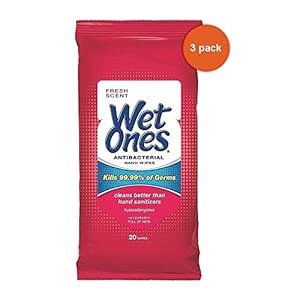
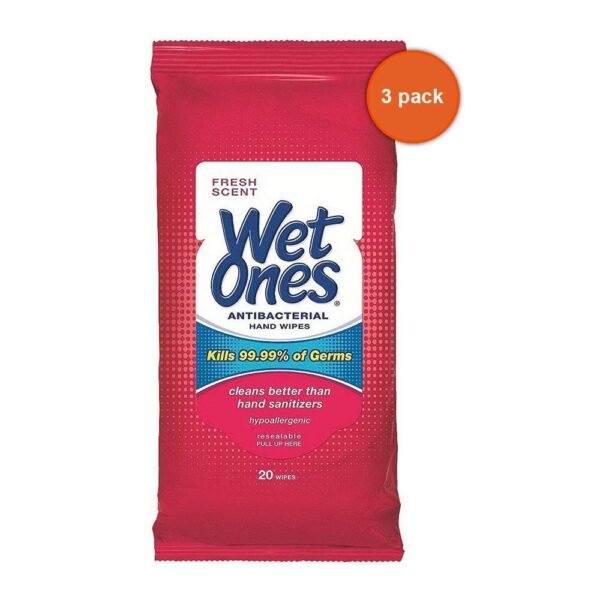
This listing is three packs of Wet Ones wipes, twenty wipes to a pack, sixty wipes in total, shipped in a carton weighing a little under nine ounces. That is very nearly the whole of what the page tells you. The title reads twenty count Wet Ones wipes, pack of three, the description repeats the title, and the two feature bullets say product of Wet Ones and pack of three. Everything else has to be read from the specification block, and the specification block contains dimensions, a model number, a barcode and ranking data.
What a personal cleansing wipe is for
A personal cleansing wipe is a portable substitute for a sink. It exists for the moments when hands need cleaning and there is no water: after handling a shopping cart, before eating in a car, after a playground, at a desk, on a flight, in a bag that lives in a stroller. The job is removing visible soil and residue from skin, and the useful properties are how wet the wipe is, how strong the substrate is, and whether the pack reseals so wipe number twenty is as usable as wipe number one.
The three pack format is aimed at distribution rather than bulk. Twenty wipes is a pouch that fits in a bag or a glove box, and three of them lets you keep one in each of the places you actually need it. That is a genuinely sensible way to buy this category, because a wipe left at home is a wipe you do not use. Households that go through wipes at the kitchen counter should be buying a canister instead, since sixty wipes across three small pouches is not a kitchen supply.
What this listing does not tell you, and why it matters here
The gap on this page is unusually serious for this product type. Wet Ones is sold in more than one formulation, and the versions differ in ways that decide whether a wipe suits your household. There is no ingredient list on this listing, no active ingredient field, no scent, no statement about alcohol content, and no indication of which variety is in the box. The name Wet Ones appears as the manufacturer and nowhere is the specific line identified.
That matters because some wipes in this general category are marketed as antibacterial with a registered active ingredient, and others are sold purely as cleansing wipes with no such claim. This listing makes no antibacterial, sanitizing or germ related claim at all, and so neither will this review. Do not assume a Wet Ones pouch is an antibacterial product because you have seen an antibacterial version on a shelf. If germ reduction is the reason you are buying, you need a listing that names the active ingredient and its concentration, and this one does not.
Read the pouch, not the page
The practical instruction is short. When the box arrives, read the pouch. The printed panel will carry the ingredient list, any drug facts panel if one applies, and any warnings about use around the eyes or on broken skin. Anyone in the household with a fragrance sensitivity or a skin condition should treat the pouch as the only source, because the page provides nothing. This review will not name an ingredient the listing does not name.
Where these wipes belong, and where they do not
These are wipes for skin. That is the category, and the ranking data confirms it: the listing sits 38th among personal cleansing wipes. Skin wipes and surface wipes are formulated differently, and the substitution runs badly in both directions. Using a skin wipe on a kitchen counter leaves whatever moisturizing or conditioning agents it carries on the counter, and using a surface disinfectant wipe on hands puts a chemical designed for hard surfaces on skin, which is exactly what those products warn against.
Around the home the sensible boundary is hands, faces and quick cleanups on a person. They are not a hand sanitizer, because a cleansing wipe removes soil mechanically rather than acting chemically on microbes, and they are not a replacement for soap and running water when water is available. Washing hands properly at a sink remains the method with the strongest support, and a wipe is the fallback for when that is impossible.
Using them properly, and storing sixty wipes
The one habit that makes or breaks a wipe pouch is closing the lid. A pouch left open dries from the top down, and the last wipes in a dried pouch are useless. With three separate pouches the failure is easy to spread across all of them, so keep two sealed in their packaging and open one at a time. Store them out of direct sun and away from a hot car dashboard in summer, where evaporation works fastest.
Dispose of used wipes in the trash. Nothing on this listing describes them as flushable, and the general rule for wipes of every type is that they do not break down in a drain line the way toilet paper does. On a septic system that rule is firmer still. Keep the pouches out of reach of small children, as with any product intended for external use only, and stop using them if skin reacts, which is standard advice for any wipe whose ingredients you have not read.
Do not use a cleansing wipe on an open wound, in the eyes, or on a mucous membrane unless the pouch specifically says it is intended for that. The listing gives no directions of any kind, no age guidance and no warnings, so the printed pouch is the only instruction set available. That is worth repeating because the ranking data shows this is a high volume product, and volume is not the same thing as documentation.
Cost over time, and the alternatives worth comparing
The cost structure of wipes is measured per wipe, and small pouches are usually the least efficient way to buy them. Sixty wipes across three pouches buys convenience and distribution, not volume. A household that uses wipes daily is better served by a canister at home plus one small pouch in a bag, and that combination usually costs less per wipe than three pouches alone. The other cost is invisible: every pouch that dries out because a lid was left open is a pouch bought twice.
If the actual requirement is germ reduction rather than cleaning, the products to look at name their active ingredient. Our reviews of the Cleanze hand sanitizing wipes and the Deconimo hand sanitizing wipes cover that group, and both should be read for what they state on their own labels rather than for anything assumed. The personal cleansing wipes category lists the skin products together.
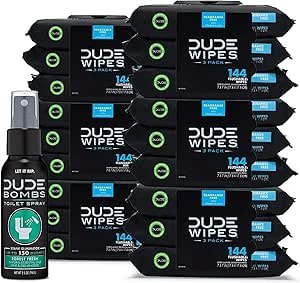
For hard surfaces, a wipe built for the job is the right tool, and the difference is not marketing. An alcohol wipe such as the Wipex isopropyl alcohol wipes is designed for equipment rather than hands, and the disinfectant wipes category collects the surface products where they belong. For bathroom use specifically, a flushable format such as the Dude flushable wipes answers a different requirement again.
Who should buy it, who should not
Buy this three pack if you want portable cleansing wipes in more than one bag and you are comfortable reading the ingredient panel when it arrives. Skip it if you need to know before ordering whether the wipes are alcohol based, fragranced or antibacterial, because this listing answers none of those questions. Skip it also if you are stocking a kitchen or a workshop, where a larger canister of a surface product is the correct purchase.