

Description
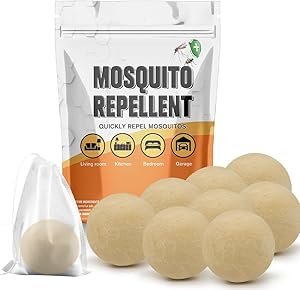
These are mosquito repellent balls, sold eight to a pack, described by the manufacturer as formulated with plant based ingredients including citronella and peppermint. Each ball is said to last up to 90 days and cover up to 120 square feet. There is no setup and nothing to plug in: you place a ball where you want it and leave it there.
What a passive scent repellent is and is not
A repellent ball works by slowly releasing a volatile oil into the air around it. The mechanism claimed is that the scent interferes with an insect’s ability to locate a target, so mosquitoes avoid the area rather than being killed in it. That is a fundamentally different thing from a zapper, which attracts and kills, and from a skin repellent, which protects the person rather than the space.
The household this fits wants something passive in a small defined space: a porch corner, a bedside table, a closet, a camper compartment. It is not a treatment for a yard, whatever the coverage figure suggests, and it is not personal protection. If you are going somewhere mosquitoes carry disease, a skin applied repellent with a recognized active ingredient and proper protective clothing is the measure that matters, and no passive ball substitutes for it. That point is important enough to state plainly rather than leaving to inference.
The claims, and the evidence behind them
Every performance figure on this page is the manufacturer’s own. Ninety days of protection and 120 square feet of coverage are stated without any test method, condition or measurement behind them, and no independent data of any kind appears on the listing. Coverage claims for scent based products are particularly difficult to evaluate, because outdoors any breeze disperses a volatile oil quickly and the effective area becomes whatever is directly downwind of the ball.
The safety claims need the same treatment. The manufacturer states the balls are safe for use around humans and pets, and elsewhere that they are made with all natural ingredients safe for people, toddlers, pets, plants and the environment when used as directed. Natural is not a defined regulatory term, and safe around toddlers and pets is a statement about people and animals that this site does not endorse. The specification block on this listing is entirely empty, no full ingredient list is published, no concentration is given, and no registration number appears. If anyone in the household has a fragrance sensitivity or asthma, or if you keep cats, birds or small mammals, note that concentrated essential oils are not automatically benign to animals and a veterinarian is the right authority.
The packaging contradicts the listing, and the seller says so
The first bullet opens with an admission that is worth reading twice. It states that previous packaging says indoor use, and then asserts in capital letters that the product works outdoors too, with the same formula. In other words the printed label on the item you receive may restrict it to indoor use while the online listing markets it for patios, decks, yards, boats and camping.
Where a listing and a label disagree, the label is the version that counts. This review will not extend a use the packaging may not support. If the pack you receive says indoor use, treat it as an indoor product, and if you want outdoor mosquito control, buy something whose own label states that.
Placement, and what actually reduces mosquitoes
If you do use these, placement is everything for a passive product. Scent concentration falls off quickly with distance, so a ball needs to be close to the space you want protected: beside a doorway, near a seat, in a small enclosed area such as an RV compartment or a closet. In an open yard the scent disperses and the product is doing very little.
The measures with the strongest support cost nothing and are worth doing regardless of what else you buy. Mosquitoes breed in standing water, and emptying anything that holds it for more than a few days, including plant saucers, gutters, buckets, bird baths and the folds of a tarpaulin, reduces the local population directly. Screens on windows and doors keep them out of the house. A fan on a patio disrupts flight more reliably than most products, because mosquitoes are weak fliers. Those three things do more than any repellent in a bag.
Handling and storage
Treat these as scented chemical products rather than as ornaments, which is exactly what the shape invites. Keep them out of reach of children and pets: a small ball is the right size and shape for a child or a dog to pick up and put in a mouth, and the listing publishes no ingredient information that would tell you what that means. Do not open, crush or cut one, and wash hands after handling.
Do not place them on painted, varnished or plastic surfaces without checking first. Concentrated essential oils can soften or mark finishes over time, and a ball left on a wooden nightstand for ninety days is a long exposure. A saucer or a dish under the ball avoids that entirely. Keep them away from food preparation areas and out of drawers where food or dishes are stored.
Store unopened packs sealed, cool and out of direct sun, since heat and light accelerate the release of the very oils the product depends on. And do not combine them with anything: never spray a cleaning product onto or near a ball, never add oil to try to refresh one, and never place one inside a container with another chemical product. Mixing household chemicals is a hazard, and a scented product gives no warning smell when something else is present.
Cost, and the alternatives
The cost structure is straightforward: eight balls at up to ninety days each is a season or two of use if the duration claim holds, and there is nothing to power and nothing to replace in between. That is genuinely low effort. The question is not cost but whether the product works, and the listing offers no evidence either way.
For a different scent based approach aimed at a different pest, our review of the MightyMint peppermint oil rodent repellent spray covers a sprayed oil product, and the repellents category lists the passive options together.
For devices rather than scent, our write ups of the PIC solar insect killer torch and the rechargeable fly swatter and bug zapper cover the attract and kill approach, which gives visible results but works far better on moths and flies than on mosquitoes. The bug zappers category covers those. Our review of the NexKey ultrasonic pest repeller covers another passive category where the evidence is similarly thin, and it should be read with the same caution.
Who should buy it, who should not
Buy the pack if you want a low effort, low cost thing to try in a small enclosed space and you accept that the listing provides no evidence it works. Do not rely on it for protection against mosquito bites where disease is a concern, do not treat it as yard coverage, and check the printed packaging before using it outdoors, because the seller states the label may say indoor use only. Emptying standing water remains the measure with the strongest support and it costs nothing.