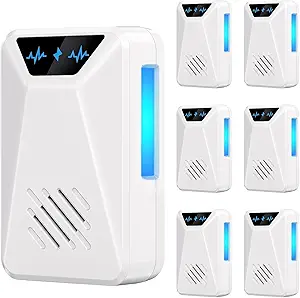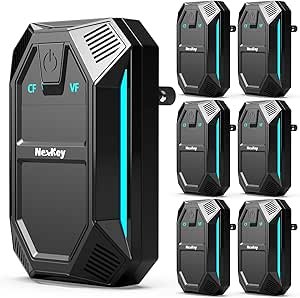


Description
This is a six pack of plug in ultrasonic pest repellers from NexKey, molded in black ABS plastic, drawing a stated three to five watts each and switching between two ultrasonic modes across a claimed range of fifteen to seventy five kilohertz. The listing names roaches, rodents, mice, mosquitoes, spiders and ants. Before any of that matters, the effectiveness question has to be dealt with honestly, because it is the only question that decides whether this purchase makes sense.
What the manufacturer says the device does
NexKey describes the working principle directly: ultrasound stimulates the brain neurons of pests, and long term stimulation is said to damage those neurons, driving the pests away. The listing states that typical results take one to two weeks depending on how bad the infestation is, that most users see results within three to four weeks, and that continued use is recommended to stop pests returning. It also states that the ultrasound is inaudible to humans and household pets and describes the approach as a green alternative to poisons and traps.
Those are the manufacturer’s statements, and this review repeats them as such rather than endorsing them. No test data, no study, no laboratory result and no third party assessment appears anywhere on the listing. A described mechanism is not evidence that the mechanism works, and a three to four week window before results are expected is a claim structure that is very difficult for a buyer to evaluate, because pest activity varies over that period for many reasons that have nothing to do with a plug in device.
The evidence question, stated plainly
Independent research into ultrasonic pest repellers has broadly not supported the claims made for them, and regulators in the United States have taken an interest in this product category and the marketing around it over many years. That context belongs in any honest review of one of these devices. This site is not in a position to test the product, and nothing here should be read as saying the device will or will not reduce pests in your home. What can be said fairly is that the listing offers no evidence, and that a buyer should treat the outcome as uncertain rather than expected.
The practical consequence is about what you buy alongside it. If you have an active rodent problem, an ultrasonic device should not be the only thing standing between you and the problem. Sealing entry points, removing food sources and cleaning up harborage are the measures with real support, and they cost nothing but effort. A serious infestation, and particularly any evidence of rodents in a kitchen, is a job for a pest control professional.
Contradictions in the listing itself
The page argues with itself in several places. The title advertises a 2025 upgraded version while the feature bullet describes functional upgrades in 2024. The specification block lists a single target species, spider, while the title names roaches, rodents, mice, mosquitoes, ants and bugs. The product dimensions are given as roughly four tenths of an inch on every side, which is smaller than the plug it would have to contain and is plainly a data error. None of these change what arrives in the box, but they show how much of this page should be treated as unverified.
Where these can and cannot be placed
These are plug in devices for indoor sockets, and the physics of ultrasound sets the placement rules regardless of whether you believe the mechanism. High frequency sound does not pass through walls, furniture or doors, and it is absorbed readily by soft materials such as carpet, curtains and upholstery. That means one unit covers, at most, the open part of one room, which is why the product is sold in a six pack. Behind a sofa or a bookcase, a unit is doing nothing at all.
Do not use them in place of a working socket you need, do not plug them into a socket behind heavy furniture, and do not run them through extension leads bundled with other high draw appliances. Keep them out of bathrooms and other damp locations unless the printed manual says otherwise, since no ingress rating is published. Households with pet rodents, rabbits, guinea pigs or hamsters should think carefully: the listing states that the sound is inaudible to household pets, but small mammals hear well into the ultrasonic range, and a device intended to disturb mice has no way to distinguish between a wild mouse and a pet one.
Running them safely
These are mains powered electronics, so ordinary electrical caution applies. Do not use a unit with a damaged casing or bent pins, do not cover one, and unplug it before cleaning with a dry cloth. Three to five watts each is a small draw, but six units running continuously is still six devices left on around the clock, so use sockets that are in good condition and not already loaded.
Children should not be able to reach or remove them, and a unit at floor level in a hallway is exactly where a small child will find it. Choose sockets above worktop height where you can. If anyone in the household reports headaches, discomfort or hearing sensitivity after installation, unplug the devices and see whether it resolves, since hearing ranges vary between people and some people, particularly children and young adults, hear higher frequencies than the manufacturer’s inaudible claim assumes.
One point in the product’s favor is worth stating: there is no chemical here. Nothing is sprayed, nothing is left as residue, there is nothing to keep away from food preparation surfaces and nothing that can be mixed with another cleaning product. For households that want to avoid pesticides indoors, that is a genuine advantage, and it is the strongest honest argument for trying one.
Cost, and what else to consider
The running cost is small but not nothing: six devices at a few watts each, on continuously, is a permanent addition to a household electricity bill, and the manufacturer’s own advice is continued use rather than a fixed treatment period. So the purchase price is the smaller half of what this costs over years. Weigh that against the absence of any published evidence that it works.
For a comparison in the same category, our review of the Lickoon ultrasonic repeller covers another device of this type, and the ultrasonic repellers category collects them together. Read them all with the same caution about efficacy.
For flying insects, a device that physically catches them gives you visible results rather than an inference, and our write ups of the PIC solar insect killer torch and the Lulu Home bug zapper cover that route, with more in the bug zappers category. For rodents specifically, a scent based product such as the MightyMint peppermint oil rodent repellent spray is a different approach, though it also should not replace sealing entry points.
Who should buy it, who should not
Buy it only if you want a chemical free device to try alongside proper exclusion and cleaning, and you accept that the listing provides no evidence it will work. Do not buy it as the answer to an active rodent or cockroach problem, do not buy it if you keep small pet mammals, and do not rely on it in a kitchen or anywhere food is stored. The absence of chemicals is real. The pest control is unproven on this page, and the page contradicts itself on several basic details.