

Description
What is in the box
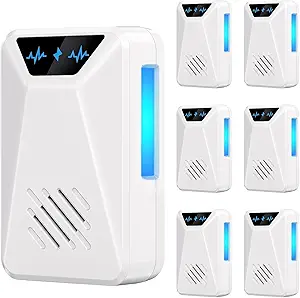
Lickoon sells this as a six pack of plug in ultrasonic pest repellers in white ABS plastic, model number 710W, ASIN B0F62HT7WW. Each unit draws 3 to 5 watts, the pack weighs 10.2 ounces, and the listing carries 305 ratings at 4.4 stars, sitting 24,781st in Health and Household and 21st among indoor ultrasonic insect and pest repellers. The manufacturer field reads Wednesday while the brand reads Lickoon, which is one of several inconsistencies on this page. The model number 710W also reads like a wattage and is not, since the stated draw is 3 to 5 watts.
The proposition is simple and appealing: plug a small device into an outlet in each room, and pests leave without traps, poison or spraying. The listing names fleas, rodents, roaches, mice, insects, mosquitoes, ants, rats and bed bugs as targets, and says the units emit ultrasonic waves that act on the auditory systems and nervous structures of those animals.
The evidence question, which has to come first
This is a product category with a documented history of regulatory attention in the United States. The Federal Trade Commission has warned marketers of ultrasonic pest control devices that efficacy claims must be supported by scientific evidence, and has brought enforcement actions against sellers who could not support them. Independent studies over several decades have generally not found ultrasonic devices effective against rodents or common household insects, and where any effect is observed on rodents, habituation follows within days.
Bed bugs are worth naming specifically because they appear on this listing. Bed bugs locate hosts by carbon dioxide, heat and chemical cues, and published work has not shown them to respond to ultrasound. An infestation of bed bugs is a problem for heat treatment or a licensed pest professional, and a plug in device is not a substitute for either.
None of that means the units do nothing in every case. It means the claims on this page carry no evidence, and a buyer should treat them as claims. Nothing here is presented as a test result, a trial or a citation.
The claim that cannot be disproven
One bullet deserves separate attention. The listing states that it is normal to see an increase in pest activity during the first days of operation, because pests are attempting to escape the affected area, and advises the buyer to remain calm and keep the device running.
Look at the structure of that. If pests decrease, the device worked. If pests increase, the device is also working. There is no observation a buyer could make that would count as evidence of failure, and a claim built that way is not a testable one. The related timeline, one to two weeks for noticeable results and three to four weeks for full effectiveness, has the same shape: it pushes any judgment far enough out that other seasonal or environmental changes can explain whatever happens.
The coverage figures do not agree with each other
The listing states that each unit covers up to 1,600 square feet. The same bullet then says that ultrasonic waves cannot penetrate walls or solid objects and strongly recommends one unit per room, with two or more in bad cases.
Those two statements cannot both be operative. Sixteen hundred square feet is larger than almost any single room in a house, so if the waves do not pass through walls, the coverage figure describes an open space nobody has. The realistic reading is the second half: line of sight, one room, and blocked by furniture, curtains, carpet and anything soft. That also tells you where placement guidance comes from. The listing recommends mounting 30 to 50 inches from the floor for flying pests and 10 to 30 inches for crawling ones, and an outlet behind a sofa is doing nothing at all.
The safety claim, and who it leaves out
The listing states that the device is one hundred percent safe for children, pets and pregnant women, and contains no toxic substances, odors or chemical agents. The second half of that is straightforwardly true: there is no chemistry here, which is a genuine advantage over a spray or a bait in a household with small children.
The blanket safety claim is the manufacturer’s own and this site does not repeat it as fact. One gap in it is worth pointing out plainly. The same listing says the device targets the auditory systems of mice, rats and other rodents. Pet hamsters, gerbils, guinea pigs, rabbits, mice and rats are those animals. A device sold on its ability to make rodents uncomfortable should not be running in a room with a pet rodent, and the listing does not mention this anywhere. Rabbits, dogs and cats also hear well above the human range. If a pet becomes restless or avoids a room after installation, unplug the unit.
Ordinary electrical care applies too: do not cover the units, do not run them behind fabric, and do not use them in a damp location. A rodent problem in a home is also a hygiene issue rather than only a nuisance, and a real infestation warrants traps, exclusion work sealing entry points, or a professional, rather than waiting three to four weeks on a plug in device.
Cost and the alternatives worth weighing
The cost structure is favorable in one way: there is no consumable at all, and 3 to 5 watts running continuously is a small electricity cost per unit. A six pack covers a small house on the one per room reading. Against that, the entire value depends on whether the devices do anything, which is the part the listing does not establish.
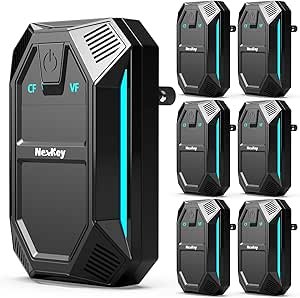
Compare it against approaches that have a visible mechanism. A light trap such as the Raindot bug zapper or the cordless rechargeable zapper at least shows you what it has caught, with its own limits on which insects it attracts. A scent based rodent repellent such as the MightyMint peppermint oil spray works on a different principle again. For outdoor mosquito nuisance, a product like the mosquito repellent ball is the passive option. The other device in this format is the Nexkey ultrasonic repeller. Browse the category under ultrasonic repellers or the trap based approach under bug zappers.
Who should buy it and who should not
Buy it if you want a chemical free device to try in a home with children, you are treating it as an experiment rather than a solution, and you would not be disappointed if nothing changed. The absence of any chemistry is a real benefit and the six pack is the right quantity for whole home placement.
Do not buy it as an answer to bed bugs, a rodent infestation or anything that is already a health problem, because those need traps, exclusion or a professional. Do not run one in a room with a pet rodent or rabbit. And do not read the coverage figure or the one hundred percent safe claim as established, since neither is supported anywhere on the page.