
Description
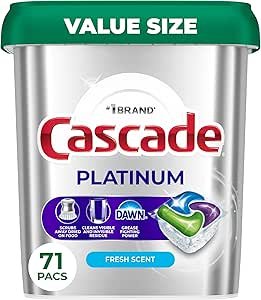
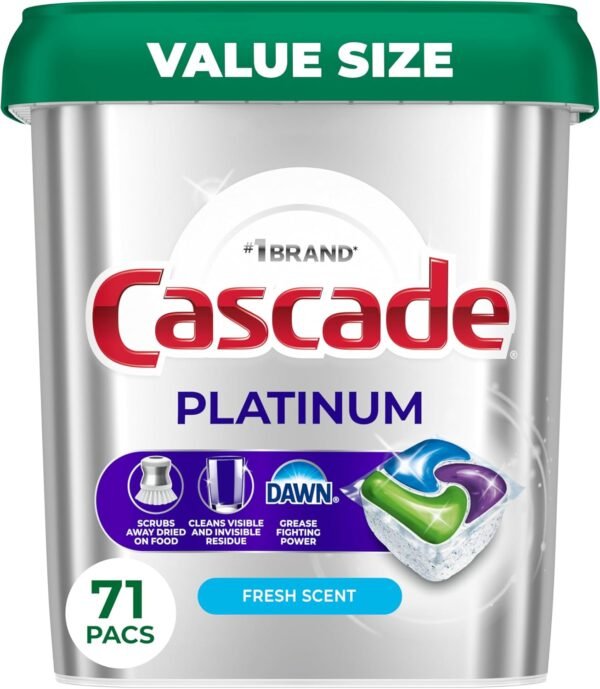
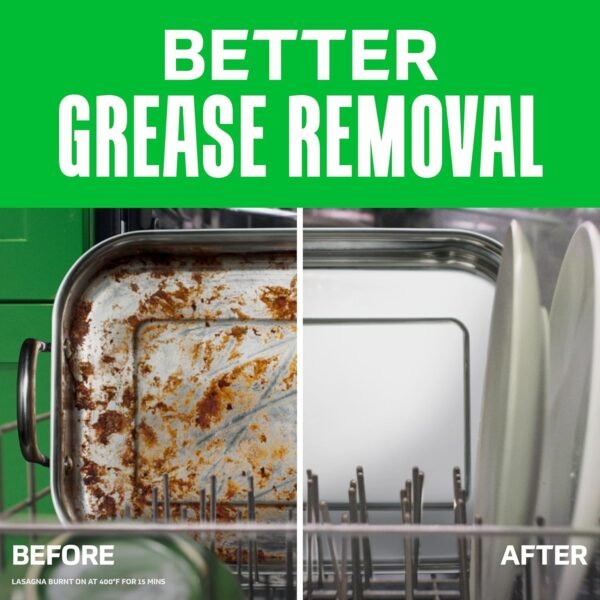
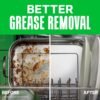
Cascade Platinum ActionPacs come 71 to a tub in the Fresh scent. Each pac is a premeasured dose of automatic dishwasher detergent, and Procter and Gamble states that it cleans burnt on messes in one wash with no pre wash needed. As with any pac product, the format brings a safety requirement that belongs at the top rather than buried at the end.
The safety point that comes first
Dishwasher detergent pacs are a poisoning hazard for young children, and in one respect they deserve more caution than laundry pacs: automatic dishwasher detergent is strongly alkaline, and alkaline chemistry causes burns to mouth and throat tissue rather than simply irritating it. The pacs are small, colorful and soft, which is exactly what makes a child pick one up.
Handle a tub of 71 accordingly. Keep it closed and latched, stored high and out of sight rather than in the cupboard under the sink where a child can reach. Take out one pac and close the lid before loading the machine. Handle pacs only with completely dry hands, since the film starts dissolving on contact with moisture. Never leave a pac sitting in the open dispenser door of a machine that is standing open, which is where a toddler finds one at eye level. If a pac is swallowed or the contents reach eyes, treat it as an emergency and get medical advice immediately.
What is in the pac, as far as the listing says
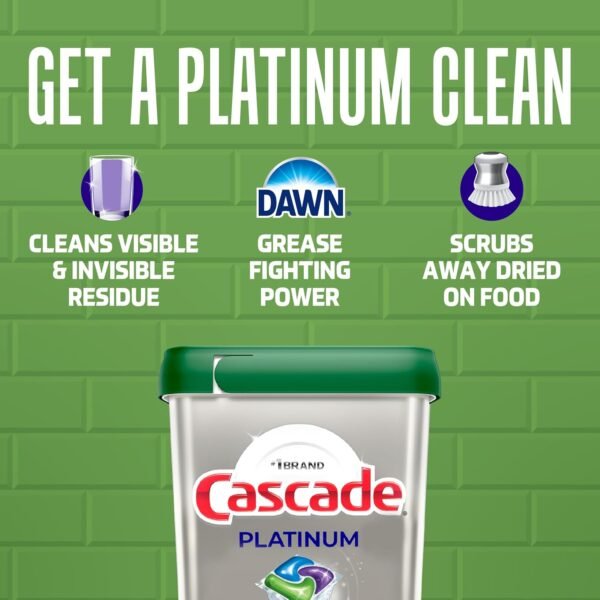
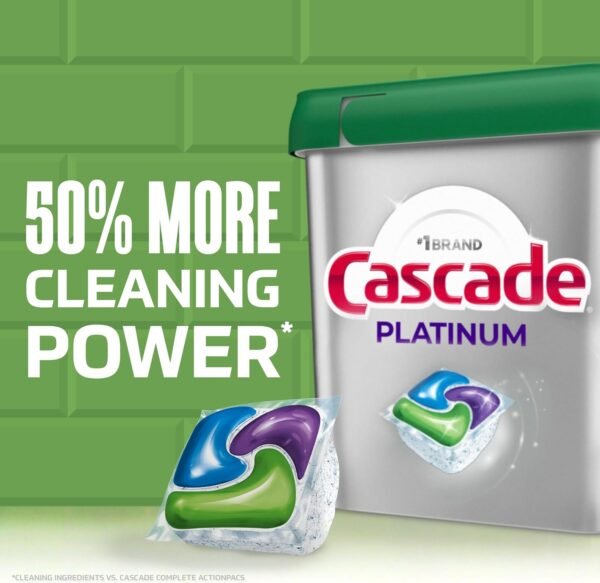
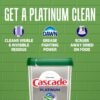
The description gives more mechanism than most. Procter and Gamble states that the pac dissolves fast to release the grease fighting power of Dawn, and that food seeking enzymes latch on and break food into particles small enough to flow down the drain. That describes two of the three things a dishwasher detergent does: a surfactant stage for grease and an enzyme stage for food residue. It also states the formula is phosphate free, and that it helps prevent hard water spots and filming.
What is not published is everything quantitative. No enzyme is named, no surfactant is identified, no percentage appears and there is no ingredient panel. The specification block is entirely empty, so even the usual dimensions and model number are missing. Procter and Gamble publishes ingredient information through its own channels and on the tub, and that is where to look if a particular component matters to you.
Two claims with footnotes worth reading
The listing carries two claims that come with their own explanations, and the explanations are more interesting than the claims. The first states that Cascade is the number one recommended brand in North America, footnoted as meaning more dishwasher brands recommend Cascade based on co marketing agreements than recommend other detergents. In other words the recommendation reflects commercial arrangements between companies, not an independent assessment, and the footnote says so plainly.
The second states that running the dishwasher daily saves water, up to 20 gallons per load, footnoted against an Energy Star certified dishwasher using four gallons per cycle versus running a tap for eleven minutes while hand washing. That comparison is a fair one for a full machine and it does not hold for a half empty one, since a dishwasher uses much the same water whatever is in it. Run it full and the saving is real.
Loading, machines and what not to do
Put the pac in the closed detergent dispenser rather than loose in the bottom of the machine. The dispenser opens partway through the cycle, which is when the detergent is meant to be released, and a pac lying in the tub dissolves during the pre rinse and is largely gone by the time it is needed. That single habit accounts for a great many complaints about dishwasher detergent performance.
The no pre wash claim is worth taking at face value with one caveat: scrape large solids into the trash, because a filter clogged with food is what actually causes poor results and smells. Do not rinse plates spotless first, since the enzymes in a modern detergent need soil to work on, but do not put half a dinner in either. The listing states the formula is safe for plumbing and safe for machines, which is Procter and Gamble’s statement.
Two more limits. Automatic dishwasher detergent is not hand dish soap and must never be used in a sink for washing up, because it is far more alkaline and is not formulated for skin contact. And nothing on this page makes any germ or sanitizing claim, so none is made here.
Storage and the mixing rule
Store the tub closed, dry and at room temperature. Humidity is the enemy of a water soluble film, and a tub kept under a sink next to a leaking trap or in a damp garage will produce pacs that stick together, which is exactly the situation where one splits as you separate them. Keep it out of direct sun and never decant pacs into a jar or an open bowl.
The mixing rule applies with force here. Never add chlorine bleach to a dishwasher along with a detergent pac, never combine a pac with any other cleaning product, and never put a pac in a bucket to make a soaking solution. Alkaline detergent combined with bleach or with an acidic descaler is a genuine hazard, and a closed dishwasher is a confined space. If you are descaling a machine, run that cycle separately and empty, then run a normal cycle afterward.
Cost per load, and the alternatives
Pacs are the easiest format in this catalog to compare, because the dose is fixed: 71 pacs is 71 loads. What you pay for above a powder or a gel is the premeasured convenience and the packaging, and what you give up is the ability to use less on a light load. Since a dishwasher uses the same water and energy whatever is inside, the way to make any detergent cheaper per plate is to run the machine full.
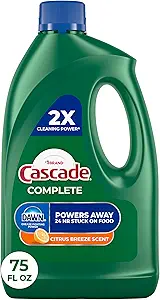
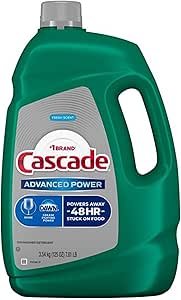
For comparison inside the same brand, our reviews of the Cascade dishwasher detergent and the Cascade Complete gel cover the tiers and the gel format, and the Finish Classic dishwasher detergent is the main competing brand. The dishwasher detergent category lists them together.
If spotting is your complaint rather than cleaning, the detergent is usually not the variable. A rinse aid changes how water leaves the dishes, and our write up of the TrulyFree dishwasher rinse aid covers that, with more in the rinse aids category.
Who should buy it, who should not
Buy the tub if you run a full dishwasher regularly, you want dosing removed as a decision, and you have a high closed storage spot well away from children. Skip it if there are young children in the house and nowhere secure to store them, since dishwasher pacs are among the more hazardous things in a kitchen cupboard, and skip it if you run half empty loads, where a fixed dose is expensive. The two footnoted claims on this page are worth reading in full before they influence a purchase.