

Description
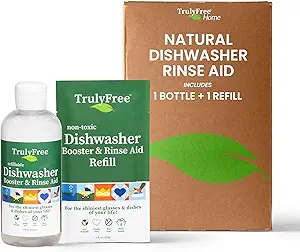
The TrulyFree dishwasher product arrives as an empty reusable twelve ounce bottle plus one refill sachet, with a total shipping weight of just under five ounces. You fill the bottle with warm water to a marked line, add the refill contents, cap it and shake. That refill model is the whole idea: you buy the bottle once and the concentrate thereafter, and the water comes from your own tap.
What a rinse aid does, and what a booster does
These are two different jobs, and this listing describes both under one name. A rinse aid is a surfactant that goes into the dedicated rinse aid reservoir in a dishwasher and is released during the final rinse. Its purpose is to lower the surface tension of the water so it sheets off rather than beading, which is what prevents spots and streaks and helps dishes dry. A detergent booster is a different thing: it goes into the wash with the detergent and adds cleaning power against food residue and hard water.
The product name calls it a booster and a rinse aid together, and the description mixes the two: it says the product removes caked on food, water spots, streaks, rust and limescale. Caked on food is a wash stage job and water spots are a rinse stage job, and where the liquid actually goes decides which of them it can affect. Nothing on this page states whether it belongs in the rinse aid reservoir or in the wash. That is the most important operational question about the product, and it is unanswered. Read the printed instructions on the bottle before adding it to a machine.
The claims, and who is making them
The title describes the product as natural and non toxic. TrulyFree makes those claims. Neither is a defined regulatory term, non toxic in particular is a term regulators treat carefully in advertising, and no supporting definition, test or standard appears anywhere on this listing. The bullets add that the formula is made from natural ingredients, is gentle on the environment and your household, is free of harsh additives and artificial fragrances, and is a sustainable choice. Every one of those is the seller’s positioning rather than a measurement, and this review repeats none of them in its own voice.
Nothing is disclosed about the formulation itself. There is no ingredient list, no concentration, no pH and no indication of what the refill sachet contains. On a product whose entire pitch is what is and is not in it, that is the notable gap, and the printed label on the bottle is the only place to look for it.
The refill model is the genuinely interesting part
Setting the language aside, the packaging logic is sound and worth stating plainly. A conventional rinse aid bottle is mostly water, and shipping water in plastic is the least efficient part of any cleaning purchase. Sending a small sachet of concentrate to be mixed at home with tap water removes most of that weight and most of the plastic, and the bottle is designed to be refilled indefinitely. The shipping weight of under five ounces for the whole package is the evidence: a comparable ready mixed bottle would weigh close to a pound.
Machines, water and what to watch
Rinse aid behavior depends heavily on your water. In hard water areas, spotting is a mineral problem and a rinse aid reduces it by helping water leave the surface rather than drying in place, but it does not remove the minerals. If your dishes come out with a persistent white film rather than droplet spots, that is scale rather than a rinse aid problem, and a descaling cycle or dishwasher salt addresses the cause.
Two practical cautions. First, mixing your own means the concentration is only as accurate as the fill line, so fill to the line rather than by eye, and use warm water as instructed so the concentrate dissolves fully. An under dissolved concentrate can settle in a rinse aid reservoir and block the metering slot. Second, most dishwashers meter rinse aid automatically with an adjustable setting, so if dishes come out streaky the answer may be turning the machine’s dosage down rather than changing product.
Handling and storage
Treat the refill sachet as a concentrate. Mix over a sink, keep it off skin and out of eyes, wash your hands afterward, and do not open a sachet with wet hands. Because no ingredient information is published, there is no way to judge the hazard from the page, so the printed label is the reference and the sensible default is caution.
Store the mixed bottle closed, upright, at room temperature and out of reach of children and pets. A refillable bottle raises one specific risk worth naming: an unlabeled or partly labeled bottle of clear liquid under a sink is exactly the sort of thing that gets misidentified later. Keep the original label intact and legible, and never decant into a drink container.
The mixing rule applies here too. Never combine this with chlorine bleach, with an acidic descaler or with any other cleaning product in the bottle or in the machine. Do not mix it with a second rinse aid to make one bottle, and do not top up a partly used bottle with a different brand. One product at a time, in the reservoir the machine provides for it.
Cost over time, and the alternatives
The cost structure is the strongest argument here. Once the bottle exists, you are buying only the active material, and refill sachets are cheap to ship and cheap to store. Over a few years that adds up in both money and packaging, provided the refills remain available. That is the risk with any proprietary refill system: the bottle is only useful while the company keeps selling the sachets that go in it.
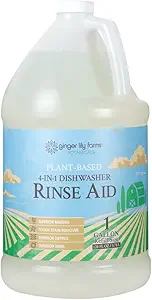
For a conventional rinse aid comparison, our review of the Ginger Lily Farms rinse aid covers a ready mixed bottle, and the rinse aids category lists the options together.
If spotting is really a hard water problem, the fix is upstream of the rinse aid. Our write ups of the Aromasong dishwasher salt and the Rutledge Brands dishwasher cleaner cover water softening and machine descaling respectively, both of which do more for spotting than any rinse aid. For the detergent itself, our review of the Finish Classic dishwasher detergent and the dishwasher detergent category cover the wash stage.
Who should buy it, who should not
Buy it if you want to stop shipping water and plastic across the country for a rinse aid and you are comfortable mixing your own from a sachet. Skip it if you need to know what is in a product before it goes into a machine that washes your plates, if you want a definitive instruction on whether it belongs in the rinse aid reservoir or the wash, or if your real problem is hard water scale rather than spotting. The refill idea is good and the listing is unusually vague about the two things that matter most, which are the ingredients and where the liquid goes.