

Description
A repellent, not a rodenticide, and the difference matters
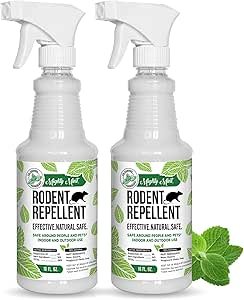
Mighty Mint Peppermint Oil Rodent Repellent Spray is sold as a two pack of 16 ounce ready to use trigger bottles. The listing describes it as a plant based, extra strong formula for indoor and outdoor control of mice and rats, applied to baseboards, entryways, patios, kitchens, bathrooms and living spaces.
The category distinction is the first thing to be clear about. This is a repellent. It is intended to make an area unattractive to rodents. It is not a rodenticide, it does not kill anything, and it does not remove an existing population. If you already have mice in a wall cavity, a repellent sprayed on a baseboard is not going to evict them, and the listing does not claim that it will.
What actually resolves a rodent problem is exclusion: finding and sealing the gaps they enter through, since a mouse gets through a gap the width of a pencil, and removing food sources. A repellent has a supporting role at best, discouraging use of a route or a storage area. Buy it with that expectation and it may be useful. Buy it as a solution and it will disappoint.
The claims, and the regulatory position behind them
The listing states that the extra concentrated peppermint oil formula is a proven deterrent for mice, rats and other rodents. No study, test, protocol or result is cited anywhere for the word proven, and no concentration is published for the peppermint oil.
The regulatory context is worth explaining because it is not obvious. Products that claim to repel pests are pesticides under federal law and are ordinarily registered with the Environmental Protection Agency, which assigns a registration number that appears on the label. There is also a minimum risk exemption under which products formulated from a specific list of ingredients, which includes certain plant oils, can be sold without federal registration. No EPA registration number appears anywhere on this listing, and the listing does not state whether the product is registered or exempt.
That distinction matters to a buyer for one specific reason: an exemption is an exemption from registration, not a verification of effectiveness. Federal registration involves review of efficacy data. A product sold under the minimum risk route has not been through that review. Neither position is improper, but neither is evidence that the product works, and the listing offers no evidence of its own.
The pet and family safety claim
The listing describes the formula as pet friendly and family safe, safe to use around dogs, cats and kids when applied as directed, with no harsh fumes or dangerous chemicals. That is the seller’s statement, and it is made with no ingredient list, no concentration and no toxicological information published anywhere on the page.
Concentrated plant oils are not automatically benign, and cats and birds in particular are more sensitive to airborne and absorbed compounds than dogs are. This review is not in a position to say whether this product is or is not appropriate around a particular animal, and neither is the listing, because it publishes nothing to judge it by. Anyone with cats, birds or small animals should read the label on the bottle and, if in any doubt, ask a veterinarian rather than relying on a marketing bullet. Keep animals out of a treated area until it has dried and the room has been ventilated.
The claim of being free from synthetic fragrances and common allergens, described as a gentle option for scent sensitive households, sits oddly alongside a product whose entire mechanism is a strong peppermint smell. This is a heavily scented product by design.
Where to spray it and what to keep it off
The listing names baseboards, entryways, patios and general high traffic areas, and states that it does not stain surfaces. Test that claim yourself on anything you care about: an oil bearing spray on a painted baseboard, a fabric surface or an unsealed wood floor can leave a mark, and oil residues attract dust.
Keep it off food preparation surfaces, food itself, and anywhere it can drip into an open container. Keep it away from unsealed stone, unfinished wood and upholstery. Do not spray it into electrical outlets, appliance vents or a fuse box, which is a common instinct when chasing a rodent route and a bad one.
Do not spray it near a live insect zapper or any spark source, and ventilate the room while you work. Avoid spraying at head height, since a trigger sprayer puts mist at eye level.
Reapplication, storage and safe use
Scent based repellents fade. That is inherent to the mechanism, and outdoors, rain and sun shorten the life further. The listing gives no reapplication interval at all, which is a real gap: without one, buyers either under apply and conclude the product does nothing, or over apply and fill the house with peppermint. Follow the bottle, and expect to reapply regularly rather than once.
Store the bottles capped, upright, out of reach of children and away from heat and food. Do not decant into an unlabeled container, and never into a drink bottle. Wash hands after use and avoid skin and eye contact. If the spray reaches an eye, rinse thoroughly with water and seek medical advice.
Never combine it with another product. Do not spray it onto a surface that has just been cleaned with bleach or an acidic cleaner without rinsing and drying first, and never mix chlorine bleach with ammonia or with an acid anywhere in the home, since both produce toxic gases.
One more point that belongs in any rodent review: if there are droppings, do not sweep or vacuum them dry, since that puts particles into the air. Public health guidance is to ventilate the area first, wet the material, wear gloves, and dispose of it sealed. That guidance is worth following regardless of which product you use.
Cost, and the alternatives
Two 16 ounce ready to use bottles is thirty two ounces of spray, and at a reapplication cadence that a scent repellent requires, that is not a large quantity for a whole house. Ready to use also means you are paying to ship water, which is the standard cost of convenience in this category.
Within the catalog, the mosquito repellent balls take a passive scent approach for a different target, while devices such as the Nexkey ultrasonic repeller and the Lickoon ultrasonic repeller claim a different mechanism again, one whose evidence base is likewise thin. For flying insects rather than rodents, a unit such as the Reogle bug zapper is the relevant product. The repellent listings and the ultrasonic repeller listings cover the non lethal approaches together.
Who should buy this and who should not
Buy it if you want a scent based deterrent for a storage area, a vehicle, a shed or a route you have already sealed, you accept that it needs regular reapplication, and you treat it as one part of an approach rather than the whole of it.
Do not buy it expecting it to clear an established infestation, which needs exclusion and, if necessary, professional help. Do not treat proven as evidence, since nothing is cited. And do not read pet friendly as a veterinary assessment, because the listing publishes no ingredients, no concentration and no toxicological information at all.