

Description
What a 1000 count carton of clear liners is for
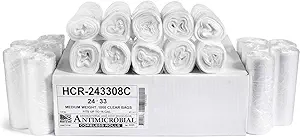
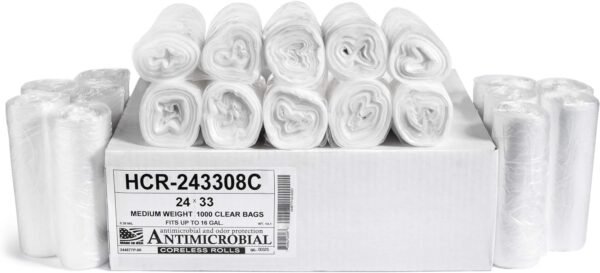
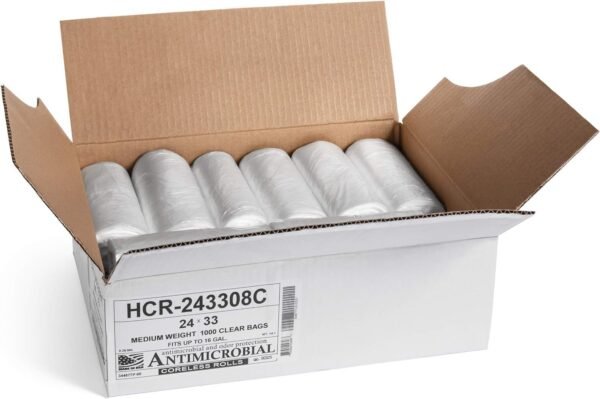
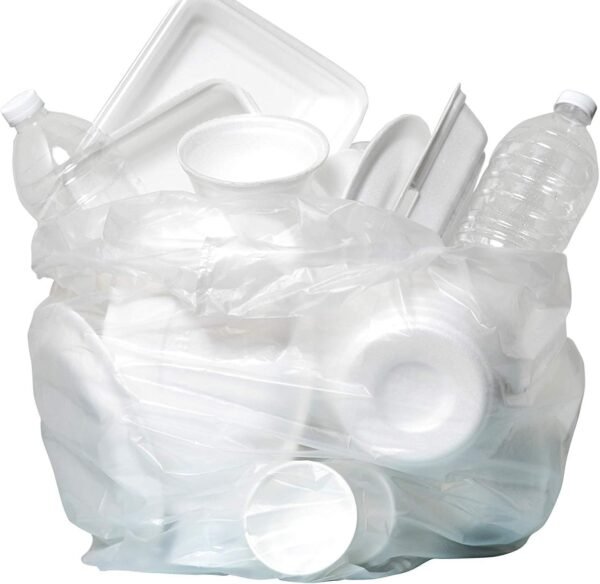
Aluf Plastics sells these as high density clear can liners, 24 by 33 inches, described as 8 micron equivalent, in a carton of 1000 on coreless rolls. The part number is HCR-243308C, the listing dates to January 2018, and it carries 1,195 ratings at 4.1 stars, sitting 2,614th in Health and Household and 39th among trash bags.
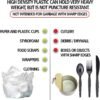
This is a commercial product that happens to be sold to households. A thousand liners is roughly three years of daily use in a single bathroom bin, and the listing names offices, industrial and janitorial settings, municipal work and recycling before it names anything domestic. The clear film is the tell: clear liners exist so that someone can see what is inside without opening the bag, which matters for recycling streams, for security screening in offices and schools, and for janitorial contracts where waste is inspected.
The other thing the format tells you is fit. At 24 by 33 inches, a bag is described as 12 to 16 gallons depending on which part of the listing you read, and that suits a slim office bin, a bathroom can or a recycling tote rather than a kitchen step can.
Gauge and construction, which is the real specification
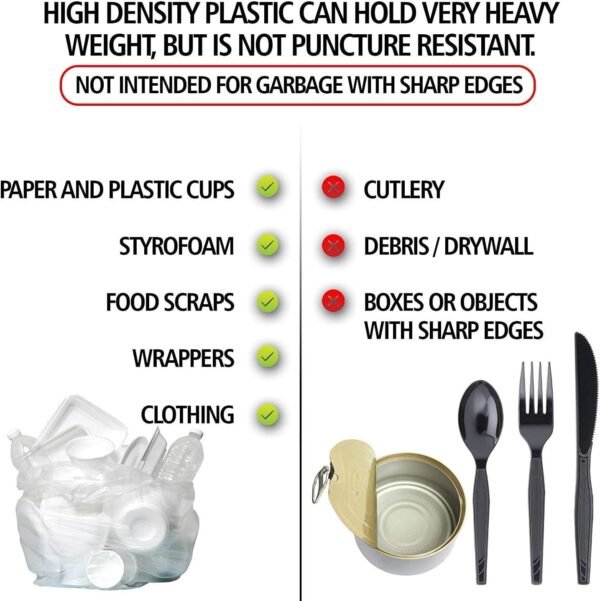
High density polyethylene is a different material from the low density film used in most kitchen bags. HDPE is thinner for the same strength in tension, it crinkles rather than stretching, and it resists tearing along a line very well while resisting puncture poorly. In practice that means a high density liner handles paper, packaging, cans and dry office waste efficiently, and splits when a chicken bone or a broken jar presses on one point.
Eight micron equivalent is a thin gauge, roughly a third of a mil, which is consistent with a light duty office liner rather than a kitchen or contractor bag. Read the word equivalent carefully: it signals a gauge comparison rather than a measured film thickness, which is standard in this trade but is not the same as a specification.
The star seal, which is the one real feature bullet
The listing lists a leak proof star seal, and this is worth explaining because it is the genuine engineering difference between liner types. A gusseted bag is folded and sealed so that the bottom forms corners, and those corners are where liquids collect and where the seal fails. A star seal has no gussets: the bottom is sealed in a star pattern that distributes load across the whole base and leaves no channels for liquid to pool in a corner. It is why commercial liners hold liquid better than the shape suggests.
The other three feature bullets are not features. They read, in full, “Competitive”, “Coreless rolls” and “Nominal gauge”. Coreless rolls is a real property, meaning the rolls have no cardboard tube. The other two are internal catalog notes that were never rewritten for a customer facing page.
Where the listing data falls apart
This specification block is one of the least reliable in the catalog and it deserves listing plainly rather than smoothing over.
Capacity reads 16 gallons in the spec block, while the title and description both say 12 to 16 gallons. Item Weight reads 0.01 ounces and Net Content Weight reads 0.02 pounds, on a carton holding a thousand bags, which is off by several orders of magnitude. Number of Items reads 1 while Unit Count reads 1000. The item dimensions field, 5.1 by 16.5 by 11.9 inches, describes the carton and not the 24 by 33 inch bag. The thickness field reads “8 Micron equivalent Inches”, mixing two units of measurement in one entry.
One field matters more than the rest. Material Feature reads Antimicrobial. Nothing else on the listing supports that. There is no antimicrobial agent named, no registration number, no explanation of what it would be treating. In the United States a product sold with a claim to control microbes is regulated, and a stray one word field on a plain clear liner is not something to rely on or repeat. Treat the bag as an untreated polyethylene liner, which is what everything else on the page describes.
Using them, and the safety points
Match the bag to the waste. These are for paper, packaging, light dry refuse and recycling. Double bag anything sharp, wrap glass and can lids, and do not use a thin high density liner for wet food waste in a heavy can, which is what the low density kitchen bags exist for. Fill to the shoulder of the bin, not above it, since a thin film loaded past the rim tears at the top when it is lifted.
Coreless rolls store more compactly than cored ones, and a thousand liners is a bulk carton that needs a dry storage spot. Keep the carton out of direct sunlight, since ultraviolet exposure degrades polyethylene over time, and off a damp floor.
Two safety points apply to any film product. Keep loose bags away from infants and small children, because thin plastic film is a suffocation hazard and a carton of a thousand liners is a lot of film in one place. Never put hot ashes, coals or anything smoldering into a polyethylene liner, which softens and fails well below the temperature of fireplace ash.
Cost per liner and the alternatives
The cost logic of a thousand count carton is straightforward: it is the cheapest way to buy a liner per unit, and the trade is storage space and commitment to one size. If the bin is 12 to 16 gallons and stays that way for years, that trade is easy. If the bin might change, it is not.
Compare it against the formats built for other jobs. For a kitchen can with wet waste, a low density drawstring bag such as the Hefty kitchen bags or the Amazon Basics 13 gallon liners is the correct material. For a fitted step can, a custom size such as the Plasticplace Code J liners matters more than gauge. For another commercial bulk option, the Reli SuperValue liners sit in the same aisle. Yard waste needs a different bag again, which is what the lawn and leaf bags section covers, and the full range of sizes is under trash bags.
Who should buy it and who should not
Buy it if you are stocking an office, a rental property, a workshop or a recycling area with bins in the 12 to 16 gallon range, and you want the lowest cost per liner with a star sealed base. The material and the clear film suit that work well.
Do not buy it for a kitchen bin taking wet or sharp waste, where a thin high density film is the wrong material. Do not buy a thousand of anything until you have confirmed the bag fits your bin, since the capacity figure on this listing appears two different ways. And do not read the stray antimicrobial field as a product property, because nothing else on the page supports it.