






Description
A slightly oversized kitchen liner, and who that helps
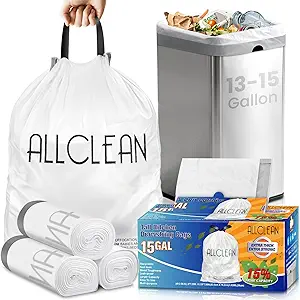
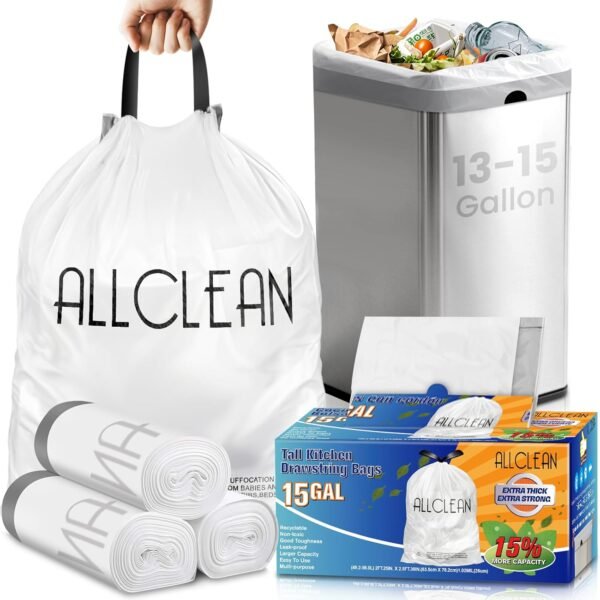
ALLCLEANbags sells this as a thirty count pack of fifteen gallon drawstring kitchen bags in white, stated to fit bins in the thirteen to fifteen gallon range. That sizing is the point of the product. The standard American tall kitchen bin is thirteen gallons, and a bag cut for thirteen gallons exactly is the one that strains at the drawstring and pings off the rim when the bin is full. A bag cut a size larger gives you extra material at the top to tie, at the cost of a little more film hanging inside the can.
The listing also names bathroom, office, industrial, garden and lawn use, which is a wider set of jobs than a kitchen liner usually claims and is worth treating skeptically. A kitchen film and a yard waste film are different products, and stretching one listing across both is a marketing decision rather than an engineering one.
The bags are stated as scent free, which is a genuine plus for anyone who dislikes perfumed liners. Fragrance in a trash bag masks odor rather than reducing it, and if smell is the real complaint the answer is emptying more often and rinsing the can.
Construction, and the number the listing does not give
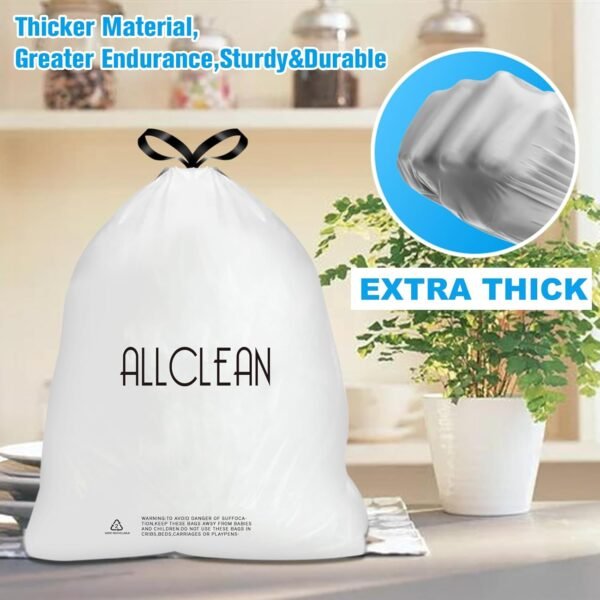
The listing describes thick drawstring handles, double side seals and a reinforced bottom, and the title claims extra strong and leak proof performance. Leak proof is an absolute, and no consumer polyethylene bag is absolutely anything, so treat it as advertising rather than a specification.
The specification data captured for this listing does not include a film gauge. Gauge, measured in mils, is the one number that lets you compare trash bags honestly, because it describes film thickness directly rather than through adjectives. Without it, the strength claims cannot be weighed against another product at all. Check the pack for a mil figure before comparing this against a rival, and be aware that a thinner film in a larger size can feel flimsier in use than a thicker film cut smaller.
The title also describes the bags as recyclable. Household polyethylene film is not accepted in most curbside recycling programs in the United States, and some grocery stores run film drop off schemes that take clean bags only, never bags that have held waste. A used trash liner goes to landfill with its contents whatever the packaging says. These are not compostable either, and should not be confused with the certified products in the compost bag listings.
The specification block is close to unusable
This listing carries some of the worst import data in the catalog and the contradictions should be named rather than tidied away. Item dimensions are given as 0.39 by 0.39 by 0.79 inches, which describes nothing. The number of pieces field reads 2 while the unit count reads 30 and the size field reads 30 count. There is a batteries field stating “2 A batteries required” and a separate batteries required field answering No, on a box of trash bags. There is a horsepower field reading 2 hp. Four different UPC codes are listed in one field. The feature bullet text in the captured data is truncated mid sentence. None of this changes what arrives, but the only figures worth any confidence are thirty count, fifteen gallons, white and unscented. Amazon ranked this pack two hundred and thirteenth in Trash Bags when the data was captured.
What to put in them and what to keep out
A fifteen gallon drawstring liner suits ordinary household waste: kitchen scraps in a sealed inner bag, packaging, paper and bathroom waste. Because the listing invites yard use, it is worth saying that garden waste is heavier and sharper than kitchen waste, and a kitchen weight film loaded with wet leaves or prunings will fail at the seam. Yard work wants a purpose made bag such as the Home Depot lawn and leaf bags.
Three things should never go into a household liner. Hot ashes from a grill or fireplace, which melt polyethylene and can start a fire in a bin, and which need a metal container until completely cold. Broken glass and blades, which should be wrapped or boxed first, because a drawstring bag is carried against the leg. And liquid cleaning chemicals, which matters most in a catalog like this one: never pour leftover bleach, drain opener, oven cleaner, toilet cleaner or an ammonia based product into a bin liner. Chemical residues meeting inside a warm closed bag is precisely the mixing scenario every label warns against, and chlorine bleach with an acid or with ammonia produces toxic gas. Leftover chemicals go to household hazardous waste collection.
Keep the pack away from infants and toddlers, since plastic film is a suffocation hazard.
Using them well
Fit the liner, hook the drawstring over the rim, and press the air out before closing the lid, because trapped air is what makes a bag balloon and lift off. Do not fill past the drawstring line: the drawstring is the weakest point on any bag and lifting at capacity puts the whole load there. Support the base with your free hand when you lift.
If your bin gets wet or greasy at the base, a sheet of newspaper underneath the liner absorbs it and stops the bag welding itself to the can. Wash the can itself occasionally with a general cleaner such as the Zep multi purpose cleaner and let it dry before fitting a fresh liner.
Cost per bag and the alternatives
Compare liners on cost per bag at a stated gauge, which is exactly what this listing makes hard by not publishing a gauge. Thirty bags is a small pack by category standards, where fifty to two hundred count boxes are common, so the cost per bag here is unlikely to be the lowest available.
For direct comparisons in the same size class, the catalog carries the Reli SuperValue thirteen gallon bags, the Hefty kitchen bags and the Amazon Basics thirteen gallon bags, all in much larger counts. The wider trash bag listings let you compare pack sizes directly.
Who should buy this and who should not
Buy it if your thirteen gallon bin keeps tearing bags at the drawstring and you want a slightly oversized liner with room to tie, and you want an unscented bag. Thirty count is also a reasonable quantity to try the fit before committing to a large box.
Do not buy it for yard waste, renovation debris or anything heavy, where a thicker contractor grade film is the right product. Do not rely on the leak proof wording, which is an absolute claim no consumer liner can meet. And do not use the specification block on this listing for anything at all, because it contains a horsepower rating and a battery requirement for a box of trash bags.