

Description
Two rackets, two modes
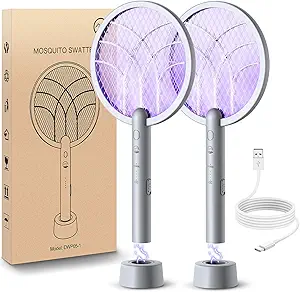
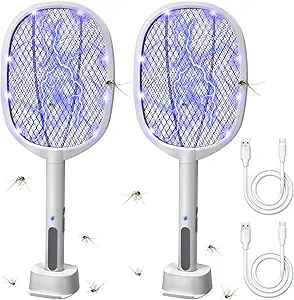
Lulu Home sells this as a two pack of electric bug zapper rackets, model BZ122, oval shaped in white, with a stated grid voltage of 3000 volts. Each racket measures 21.7 by 8.7 by 3.5 inches, the pack weighs 1.65 pounds, and it charges over USB through a base that also serves as a stand. The manufacturer of record is a Jieyang electrical appliance company, and the listing carries 1,202 ratings at 4.2 stars, sitting 7,342nd in Patio, Lawn and Garden and 105th among bug zappers.
The two mode design is the actual idea here. In handheld mode you press and hold a button, wave the racket, and the grid electrocutes whatever it touches. In automatic mode the racket sits in its base, eight blue lamps emitting light at 360 to 400 nanometers switch on to attract flying insects, and the grid runs at a lower voltage so the unit is quieter. Lulu Home notes it can run in automatic mode while charging.
That combination suits a patio, a tent, a caravan or a kitchen in summer: swat what you can see, leave it standing overnight for what you cannot. The base doubles as somewhere to put the racket down, which matters more than it sounds, since a live grid left lying on a table is the way people get a surprise.
The EPA number on this listing, and what it actually means
The first bullet opens with “EPA Est. No. 94733-CHN-1”, and this deserves explaining because it is very easily misread as an approval.
An EPA establishment number identifies the facility where a pesticidal product or device was produced. It is a registration of the place, not of the product. Devices such as electric zappers and ultraviolet traps are not registered the way a chemical pesticide is, and no efficacy review sits behind an establishment number. Seeing one on a listing tells you the producing facility is registered with the agency. It does not tell you that the device has been assessed for how well it works, or for safety, or for any claim made about it.
Displaying the number is correct and required, and the company deserves credit for putting it on the page. It simply does not mean what a shopper might assume.
The mosquito question
In handheld mode, effectiveness is not in doubt: the racket kills what you hit with it, and that is a mechanical outcome rather than a claim. Automatic mode is a light trap, and the same caveat applies here as to every light based device in this category. Published research on ultraviolet traps and mosquito control is mixed, mosquitoes orient primarily on exhaled carbon dioxide, body heat and skin odor rather than on light, and this listing offers no independent data. What a light trap reliably attracts is moths, midges and other night flying insects. Repellent products such as the mosquito repellent ball work on a different principle entirely, and the wider chemical free options sit under repellents.
The safety instructions, which are better than most
This listing does something unusual for the category: it gives real, specific safety instructions, and they are worth restating because they are correct.
Do not touch the net immediately after releasing the button. A charged grid holds residual energy after the trigger is released, and that is exactly the moment people reach in to brush off a dead insect.
Use the racket only when the grid is completely dry. Avoid rain, high humidity and wet surfaces. If the racket buzzes loudly, release the button at once and let it dry fully before using it again, because that buzzing is moisture bridging the grid.
Keep the switch off while assembling the handle to the head.
Two more that the listing does not give. A high voltage arc is an ignition source, so do not use the racket near a barbecue, a gas grill, a camping stove, fuel or aerosol vapors, despite the listing recommending it for barbecuing. And do not swat over open food or a set table, since an electrocuted insect breaks up.
The three layer mesh, an inner grid sandwiched between two outer nets on an insulating frame, is the feature that makes a handheld racket reasonably safe to hold, but it is not childproof. Keep both rackets out of reach of children, and do not let a child use one. Charge it with the supplied cable, do not charge it wet, and stop using it if the housing or the lithium ion pack is damaged or swollen.
Where the specification is loose
Material reads Metal on a racket that is mostly molded plastic with a metal grid. The Batteries field reads “1 Lithium Ion batteries required (included)”, which is a template artifact. The brand on the page and the manufacturer of record are different companies, which is normal for this category and worth knowing when it comes to warranty questions. The 21.7 inch length in the dimensions is the assembled racket including the handle, not the head.
Nothing on the page states the battery capacity, the runtime in either mode, or how long a full charge takes. There is also no replacement path given for the lithium ion pack, which on a sealed appliance usually means the battery life is the product life.
Cost, and what else does this job
The running cost is close to nothing: no consumable, no cartridge, no chemical, and a USB charge. A two pack means one indoors and one outside, or one in a bag for camping, which is the sensible use for a second unit.
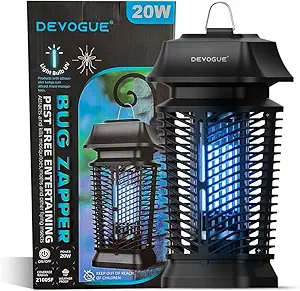
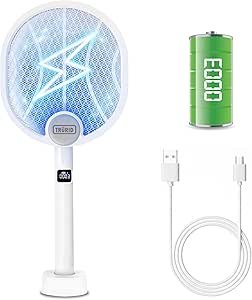
Compare it against the alternatives by how much control you want. Other handheld units such as the Minimoon electric fly swatter and the Mosiller fly swatter are the direct comparisons. A passive mains trap such as the Raindot zapper covers a room without you holding anything, and a cordless unit like the rechargeable outdoor zapper hangs where a socket is not. Browse the category under bug zappers.
Who should buy it and who should not
Buy it if you want a handheld swatter that also works as a small standing trap overnight, and you like the idea of two units. In handheld use the outcome is not a matter of claims, and the safety instructions on this listing are more responsible than most in the category.
Do not buy it on the strength of the automatic mode as a mosquito solution, since no data supports that. Do not treat the EPA establishment number as an approval of the device or its claims. And do not use it near a grill, near fuel, or over food, whatever the listing suggests about barbecues.