
Description
Cells built for one job, not for every device
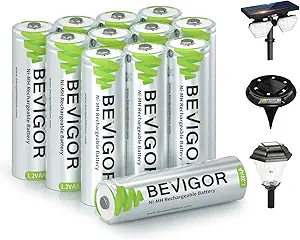
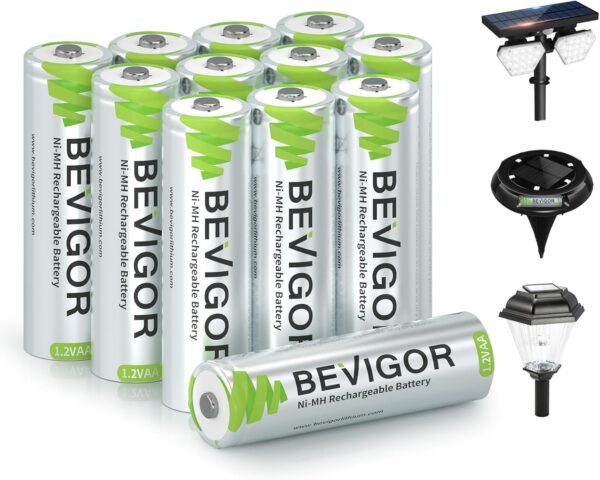
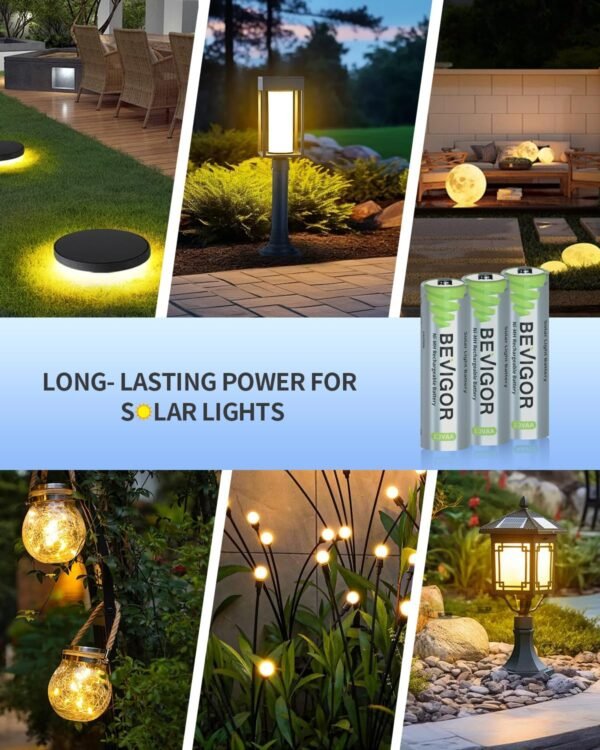
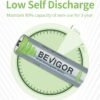
BEVIGOR sells these as twelve rechargeable AA cells, nickel metal hydride chemistry, rated at 1000 milliamp hours and 1.2 volts. The listing names the target applications repeatedly and consistently: garden solar lights, pathway lights, landscape lights, lawn lights and string lights, with television remotes, toys and flashlights mentioned alongside. That focus is the key to understanding the specification, because on paper 1000 milliamp hours looks low for an AA cell and in context it is a deliberate choice rather than a shortfall.
A solar garden light charges its cell from a small panel through a single day of sun and discharges it through an LED overnight. A very high capacity cell in that role never reaches a full charge on a short winter day, so it drifts down over weeks and the light dims. A lower capacity cell reaches full charge and cycles cleanly. The listing’s own headline calls this a high capacity battery, which is the wording to read carefully: against general purpose AA rechargeables, which commonly run from around 1900 to 2500 milliamp hours, 1000 is at the low end. Against the solar lights this product is aimed at, it is the appropriate size.
The specification, and the voltage detail that catches people out
NiMH cells sit at a nominal 1.2 volts, while a disposable alkaline AA is 1.5 volts. That difference is the most common source of disappointment with rechargeable AAs and this listing does not mention it. Many devices tolerate it happily, and some do not: a device with a low voltage cutoff may report a fresh NiMH cell as flat, and an item that depends on brightness, such as a flashlight, will run dimmer. Devices with a wide input range, remotes, clocks, wall thermometers and solar lights, are the ones that never notice.
What the cycle life and temperature claims mean
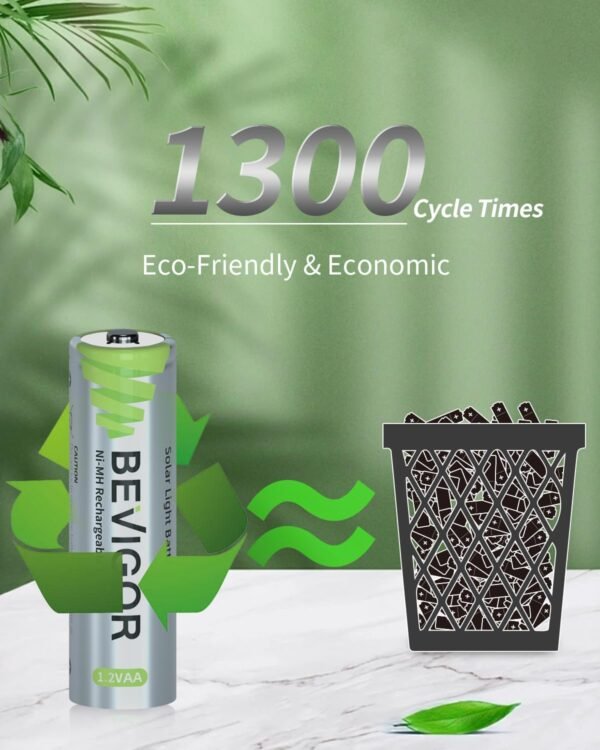
BEVIGOR states the cells can be recharged up to 1300 times, and that they can be used from minus 4 to 140 degrees Fahrenheit. Neither figure comes with a test standard, a discharge depth or a capacity retention threshold, which are the three things that make a cycle life number comparable between brands. Read 1300 cycles as a manufacturer’s headline. The temperature range is the more useful of the two for anyone leaving cells outdoors through a real winter, and cold always reduces usable capacity regardless of the range printed on the pack.
The listing also states the cells have passed six safety tests, naming leakage, anti explosion, drop, short circuit and high and low temperature testing, and says they did not explode or burn during those tests. No standard, laboratory or certification mark is cited, so this is a manufacturer’s statement about its own testing.
Devices these suit, and the ones they do not
Solar path, lawn, landscape and string lights are the natural home for these cells, and BEVIGOR names them first for good reason. Television and audio remotes, wall clocks, wireless doorbells, weather stations, kitchen scales and children’s toys all draw current slowly enough that 1000 milliamp hours lasts a sensible time between charges, and none of them care about the lower nominal voltage.
The poor matches are the high drain and precision cases. Digital cameras, flash units, powerful flashlights and motorized toys will drain a 1000 milliamp hour cell quickly and will show the difference against a 2000 milliamp hour cell immediately. Smoke alarms are a separate matter entirely: alarms are designed around a primary cell with a long, predictable decline, and a rechargeable that self discharges quietly in a ceiling is the wrong component for a life safety device, so use the battery type the alarm manufacturer specifies.
Charging, mixing and the rules that protect the cells
BEVIGOR says these can be charged in two ways: in a standard battery charger, or in place by the solar panel of the light they are fitted to. Both are normal for the chemistry. A few habits matter more than the brand you buy.
Do not mix chemistries in one device. Never put a NiMH cell in the same compartment as an alkaline, a lithium or a carbon zinc cell, and never mix an old cell with a new one. Mismatched series cells discharge unevenly and the weakest can be driven into reverse, which is the mechanism behind most leaks and vent events. Keep each set together for its whole life.
Use a charger rated for NiMH, never one built for lithium ion or for single use alkalines. Do not short the terminals, do not carry loose cells in a pocket with keys or coins, do not puncture, crush or heat them, and never put any battery in a fire. If a cell becomes hot, swollen or leaks, stop using it.
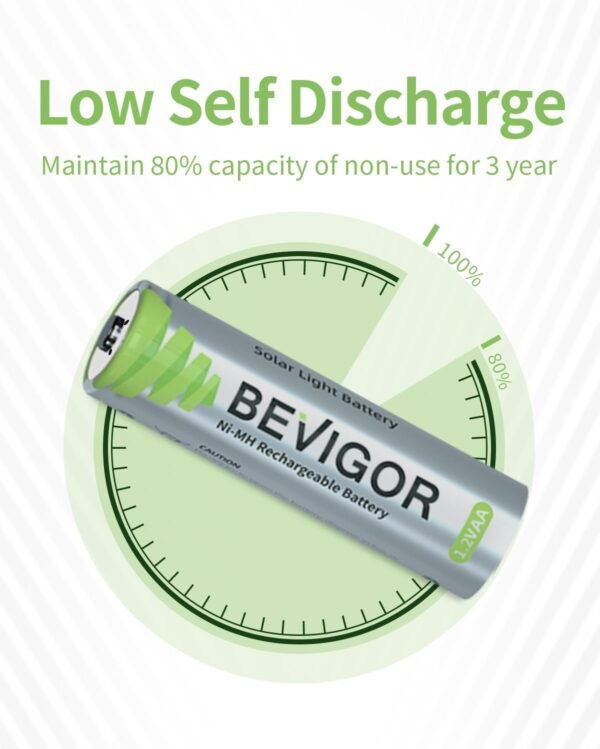
Store spare cells in the pack or a case, at room temperature, out of reach of children and pets. NiMH cells self discharge over months, so a set left in a drawer will need topping up before use. At end of life, take them to a battery recycling point rather than putting them in household trash; rechargeable cells are recyclable and many retailers accept them. Other formats in this catalog follow the same rules, including the Voniko 9 volt batteries, where the exposed terminals on a nine volt make the loose in a drawer scenario more dangerous still.
Cost over time, and what to compare it with
The economics of rechargeables are simple and they favor high cycle applications. A solar garden light runs one charge and discharge every single day, so a set of cells there replaces a great many disposables over a few seasons, and that is the case where a rechargeable pays for itself quickly. A wall clock that eats one AA a year is the opposite case; a disposable is the better purchase there. Twelve cells is a sensible quantity for a run of garden lights, which usually take one or two each.
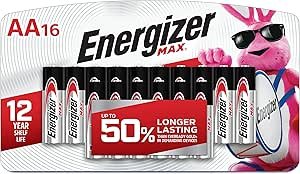
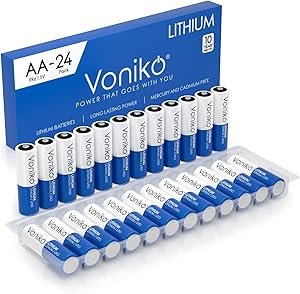
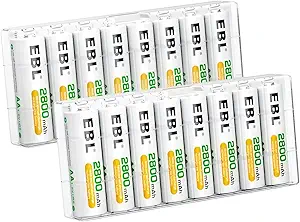
Within this catalog the useful comparisons are on capacity and intended use. The EBL rechargeable AA batteries sit at a higher capacity aimed at general purpose devices, while primary cells such as the Voniko AA lithium cells, the Energizer AA alkalines and the AC Delco AA batteries are one time use and better suited to low drain devices left alone for years. The rest of the size is grouped under AA, with other formats in household batteries.
Several oddities belong in the record. The environmental language is loose: the listing says the cells “do not contain any pollution materials”, a broken phrase with no supporting standard, and calls the product eco friendly on the strength of being rechargeable. The specification block includes a field reading “Batteries: 12 AA batteries required”, which is nonsense on a product that is itself twelve AA batteries. The model number field simply reads AA. And a set of batteries appearing in a household cleaning and laundry catalog is a category placement worth knowing about; this site carries a long tail of battery sizes alongside the cleaning products. The item currently ranks 197th in the retailer’s AA batteries chart, on 231 ratings averaging 4.4 stars.
Who should buy this pack
Buy it if you are refilling solar garden or pathway lights, string lights or another daily cycling low drain application, where 1000 milliamp hours is the right size and the daily recharge makes rechargeables pay. Skip it if you need general purpose AA cells for cameras, high drain toys or bright flashlights, where a higher capacity NiMH or a disposable will serve better, and skip it if your device is sensitive to the 1.2 volt nominal output.