



Description
Lithium primaries, and the devices that justify them
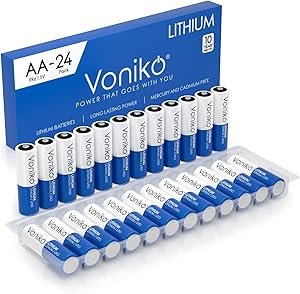
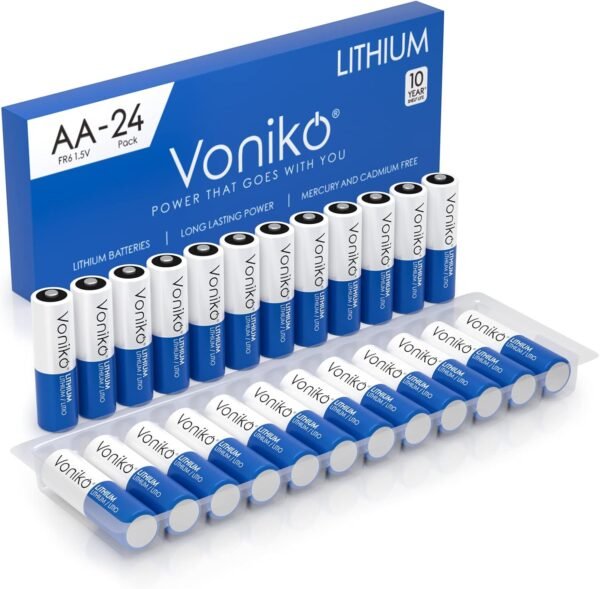
Voniko sells these as a 24 pack of 1.5 volt lithium AA cells, model AA-FR6, explicitly non rechargeable. The FR6 designation is the international code for the lithium iron disulfide AA, which is a different animal from both the alkaline cell most households buy and the rechargeable NiMH cell. The chemistry costs more per cell and buys three specific things: a much wider temperature range, a very long shelf life, and better performance under heavy current draw.
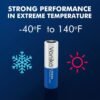
Voniko states the cells work from minus 40 to 140 degrees Fahrenheit, that cold resistance surpasses both alkaline and nickel metal hydride cells, and that they can be stored for up to ten years. Those are the reasons to pay the premium. A trail camera left out through a northern winter, an outdoor security sensor, a garage door remote, a camping lantern, an emergency flashlight in a car, or a smoke alarm in an unheated attic are the cases where an alkaline cell disappoints and a lithium primary does not. For a wall clock in a warm hallway, the premium buys you nothing at all.
The specification, and how lithium behaves differently
The nominal voltage matters here in a way it does not for alkalines. A lithium AA is 1.5 volts, the same as an alkaline, which is why it is a drop in replacement where a rechargeable at 1.2 volts is not. What differs is the discharge curve: a lithium primary holds its voltage nearly flat for most of its life and then falls away quickly at the end, where an alkaline sags gradually from the first day.
The practical consequence of a flat discharge curve
Devices that estimate remaining charge by measuring voltage will read a lithium cell as full almost until the moment it is empty. That is excellent for a camera, which gets full performance to the end, and less convenient for anything whose battery gauge you rely on for warning. It is also why lithium primaries suit high drain devices: they hold voltage under load rather than dropping out, which is the reason a digital camera that gets a dozen shots from an alkaline set will run far longer on lithium. Voniko names digital cameras, radio controlled car toys, LED flashlights, emergency lanterns, portable radios, cassette recorders, solar lights, toys and remote controls among the applications.
Two more properties worth knowing and not mentioned in the listing. Lithium AA cells weigh noticeably less than alkalines, which matters in handheld equipment. And they are far less prone to leaking than alkalines, which is the main argument for putting them in a device you will not open for a couple of years.
Where to use them, and where to check first
Any device that takes a standard AA will physically accept these. The check to make is not about the socket, it is about the manual. Some equipment manufacturers specify alkaline only and state that lithium primaries should not be used, usually because the higher current delivery or the flat discharge behavior interacts badly with the device’s protection or metering. Smoke and carbon monoxide alarms deserve a particular look, since alarm makers are specific about battery type and a life safety device is not the place to improvise. Read the manual before swapping a whole house over.
The other rule is not to mix. Never put a lithium cell in the same compartment as an alkaline, a carbon zinc or a rechargeable, and never mix new and partly used cells. In a series connection the cells discharge unevenly, the weakest can be driven into reverse, and that is the mechanism behind leaks and vent events. Replace every cell in a device at the same time and keep sets together.
Handling, storage and disposal
These are non rechargeable, and the listing says so in the title. Do not attempt to charge them in any charger. Do not short the terminals, do not carry loose cells in a bag or pocket with keys or coins, do not puncture, crush, disassemble or heat them, and never put a battery in a fire. If a cell becomes hot or swollen, stop using it and let it cool somewhere non combustible.
Store the pack at room temperature in its packaging or a case, out of reach of children and pets. Cells of any chemistry should not live loose in a drawer with metal objects. Remove batteries from any device you are storing for a season, since a device with cells left in it is the most common way a battery compartment is ruined.
On disposal, take them to a battery collection point rather than putting them in household trash. Lithium primaries carry a fire risk in waste and recycling streams when crushed, which is a documented cause of fires in collection vehicles and sorting facilities, and it is the reason many municipalities ask for batteries to be handled separately. Tape the terminals of used cells before you take them in. The same applies to every other format in this catalog, including the Voniko 9 volt batteries, where exposed terminals on a nine volt make taping essential rather than optional.
Cost, and when lithium is the wrong purchase
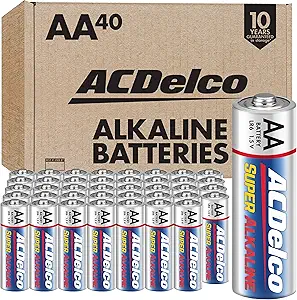
Lithium primaries cost more per cell than alkalines, and 24 of them is a meaningful outlay. The way to judge it is by application rather than by unit price. In a high drain device the cell delivers several times the usable service of an alkaline, so the cost per hour of use can be lower despite the higher shelf price. In a cold location or a device opened once every few years, the value is in not having to deal with a leak or a dead set. In a television remote, an alkaline such as the Energizer AA alkalines or the AC Delco AA batteries is the sensible purchase and lithium is money spent for nothing.
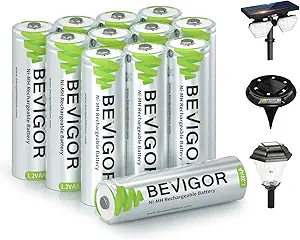
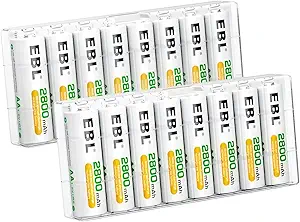
Where a device cycles daily, rechargeables beat both: the EBL rechargeable AA batteries for general use and the lower capacity BEVIGOR rechargeable AA cells for solar garden lights. The rest of the size sits under AA, with other formats under household batteries.
Oddities in the record: the fifth bullet states that “our AA batteries 4-pack contain no lead, mercury and cadmium” while the product being sold is a 24 pack, so that line was copied from a different listing. The description field is empty. The specification block includes a field reading “24 AA batteries required (included)”, which is circular on a product that is itself the batteries. The shelf life claim of ten years comes with no storage temperature attached, and battery shelf life is always a function of storage conditions. And a pack of batteries sitting in a household cleaning and laundry catalog is a category placement worth noting; this site carries a long tail of battery sizes. The item currently ranks 43rd in the retailer’s AA batteries chart on 3,194 ratings averaging 4.2 stars.
Who should buy this pack
Buy it if you have cold weather, high drain or long storage applications, trail cameras, outdoor sensors, emergency lights, camping gear, and you want cells that will not leak in a device you rarely open. Skip it for low drain devices in a warm house, where alkalines cost far less for the same result, and check your device manual first if it specifies a battery type.