
Description
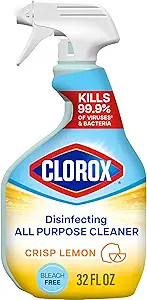
A Clorox product without the bleach
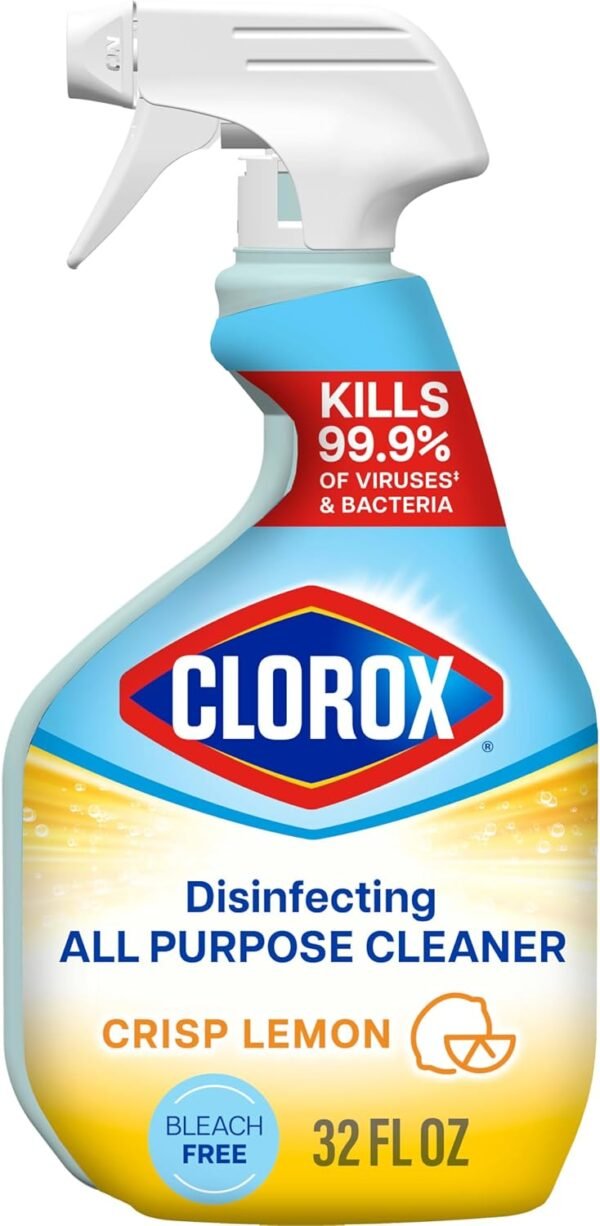
This is a 32 fluid ounce trigger spray sold as a disinfecting all purpose cleaner in a Crisp Lemon scent, and the detail that defines it is stated plainly in the third feature bullet: it is formulated without bleach. That distinction matters more than the scent does.
Clorox as a brand is built on sodium hypochlorite, and a bleach based cleaner such as the CloroxPro Clean-Up with bleach carries a long list of surfaces it will damage: natural stone, aluminum, carbon steel, colored fabric, unsealed grout. A bleach free formulation removes most of that list, and it removes the smell, which the description names as a reason for the product to exist. The trade is that a different chemistry is doing the work, and this listing does not say what it is.
The household this fits is one that wants a single spray for kitchen and bathroom surfaces with a disinfection claim attached, and that has stone or metal finishes making a bleach product awkward.
The claims, and the footnotes that limit them
Clorox makes two antimicrobial claims here and footnotes both, which is to the company’s credit because the footnotes change what the claims mean considerably.
The first is that the product kills 99.9 percent of bacteria and viruses, footnoted as applying when used as directed on hard nonporous surfaces. That is the standard qualification and it rules out soft furnishings, carpet, unsealed wood and anything porous.
The 24 hour claim is narrower than it looks
The second claim is that it stops bacteria growth for 24 hours on nonfood contact surfaces, and it carries two separate restrictions. The double asterisk resolves to odor causing bacteria, so the 24 hour statement is about the organisms responsible for smells rather than about pathogens generally. And the claim is explicitly limited to nonfood contact surfaces, which means it does not extend to a counter where food is prepared, a cutting board or the inside of a refrigerator. Read together, that is a much more specific statement than a casual reading of “stops bacteria growth for 24 hours” would suggest, and anyone buying on the strength of the headline should know both limits.
The description also carries the instruction that matters most on any disinfectant, and it is easy to miss because it is the last three words on the page: allow product to air dry. That is the contact time instruction. The surface has to stay wet and be left to dry on its own for the claim to hold. Spraying and wiping dry immediately is cleaning, not disinfecting. What the listing does not give is a number of minutes, and it does not publish an EPA registration number, which is what you would use to look up the registered label and find the exact contact time for each organism. Read the bottle.
Surfaces, and the word doing the work
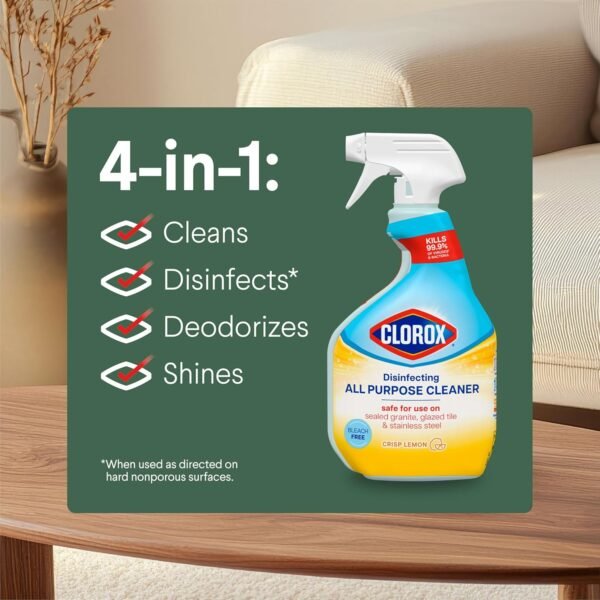
Clorox names a broad list: kitchen sinks, counters, refrigerators, appliances, tubs, toilets, fiberglass, floors, showers and tile, plus sealed granite, glazed tile and stainless steel.
Sealed granite is the entry to read carefully. Sealed is the operative word, and it is not decoration. An unsealed or worn stone surface absorbs whatever is applied to it, and a cleaner that is fine on an intact sealer can mark stone where the sealer has failed. If you do not know whether your counter is sealed, the standard check is to leave a few drops of water on it for several minutes: if the stone darkens where the water sat, the sealer is not doing its job and a dedicated neutral stone product such as the MORE stone and quartz cleaner is the safer choice. Glazed tile is likewise specified rather than tile generally, because unglazed and porous tile behaves differently.
The other point the listing does not make is about food contact. A disinfectant applied to a food preparation surface generally requires a potable water rinse after the contact time unless the registered label says otherwise, and the fact that the 24 hour claim explicitly excludes food contact surfaces is a strong hint that the label has something to say on the subject. Rinse counters and refrigerator interiors after use, or read the label to confirm you do not have to.
Keep it off unsealed wood, waxed surfaces and anything porous, and test any painted or delicate finish in a hidden area first.
Handling, ventilation and mixing
Being bleach free lowers the risk profile but does not remove it. Ventilate the room while working, keep it out of eyes, wear gloves if you are cleaning for any length of time, and wash your hands afterward. Keep the bottle capped, upright and out of reach of children, and do not decant it into an unlabeled container.
The mixing rule applies exactly as it does to any disinfectant, and there is a specific trap here. Because the label says bleach free, it is easy to assume the product is somehow inert and can be combined with something else. It cannot. No ingredient is published, so no interaction can be predicted, and disinfectant chemistries in particular react badly with each other. Never spray it onto a surface still wet with a bleach product, an ammonia based glass cleaner or an acidic descaler. Use one product, let it dwell, rinse the surface with clean water, ventilate, and only then use another.
Never mix it into a bucket with a floor cleaner either, even though floors are on the surface list. A disinfectant works at the concentration it comes in, and diluting it into a bucket of something else defeats both products.
Cost, quantity and the alternatives
A 32 ounce trigger bottle is the standard household format, and ready to use liquids are the most expensive way to buy per treated surface because most of what you carry home is water. The offset is that the concentration is always right, which on a product where the antimicrobial claim depends on concentration is worth more than it would be on a general cleaner. One caution on quantity: the product title ends with “Pack May Vary”, so confirm on the product page whether you are buying one bottle or several.
The comparisons on this site are instructive. The Vital Oxide publishes its EPA registration number on its listing, which is exactly the thing this one does not, and it is the standard to hold any antimicrobial product to. The Lysol disinfecting cleaning spray and the Lysol multi surface cleaner occupy the same shelf from a competitor. Browse the all-purpose cleaners category for general cleaning, and the disinfectant sprays and liquids category where products carrying antimicrobial claims are grouped, which is arguably where this one belongs.
Who should buy it, and who should not
Buy it if you want a disinfecting spray for hard nonporous kitchen and bathroom surfaces without bleach and without the bleach smell, your stone is sealed, and you will let surfaces air dry rather than wiping them immediately. The footnoted claims are more honest than most in this category. Skip it if you need the active ingredient or an EPA registration number before buying, if your surfaces are porous or unsealed, or if you were reading the 24 hour claim as broad protection, since it covers odor causing bacteria on nonfood contact surfaces only.