Description
The listing that publishes its registration number
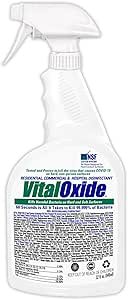
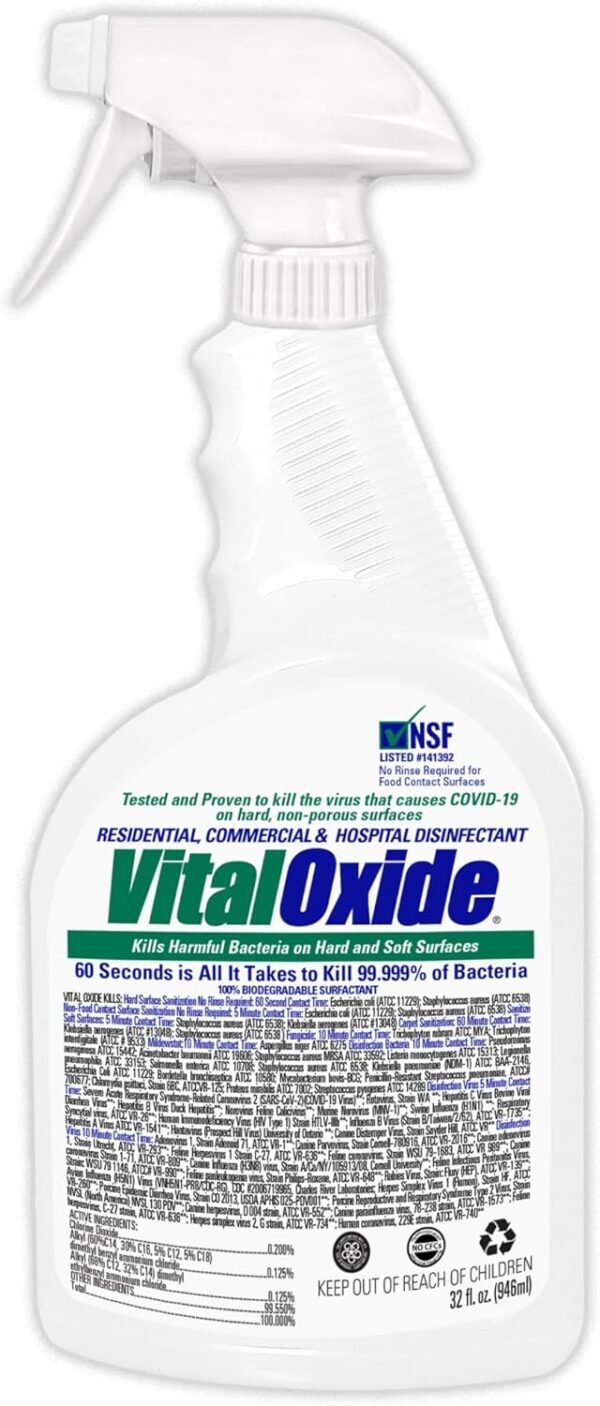
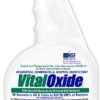
Vital Oxide is a 32 ounce ready to use liquid sold as a disinfectant, deodorizer, cleaner, food contact sanitizer and virucide. It is worth starting with what makes this listing different from almost every other antimicrobial product in this catalog: it publishes its Environmental Protection Agency registration number, 82972-1, in the product title itself, along with an NSF listing number, 141392.
That matters more than any adjective. In the United States, products claiming to kill microorganisms on surfaces are regulated as antimicrobial pesticides, and the claims a product may legally make are fixed by a registered label tied to a registration number. A listing that publishes the number lets a buyer look up what the label actually says rather than taking the marketing copy on trust. Several competing products on this site make comparably strong claims and publish nothing of the sort, which is the whole reason to point this out.
None of the claims below are ours. They are the manufacturer’s, and the registration number is the tool for checking them.
The claims, separated by what they actually mean
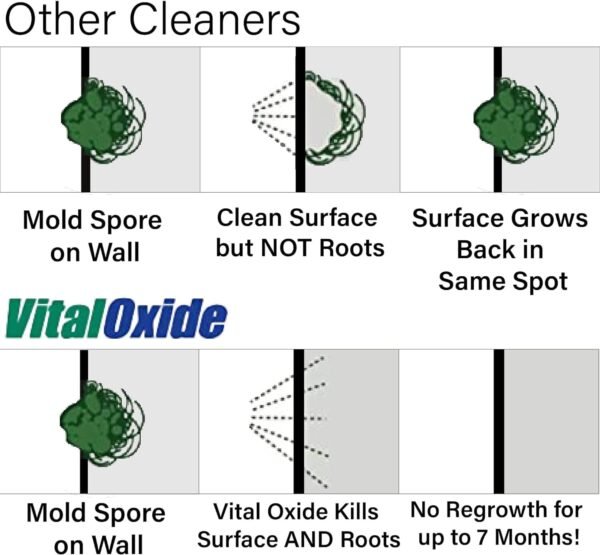
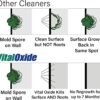
Vital Oxide states that the product kills 99.999 percent of bacteria on hard nonporous surfaces in 60 seconds, that it is a mildewstat that controls and inhibits mold and mildew growth for as long as four weeks on soft surfaces, that it kills and inhibits growth of Trichophyton interdigitale, and that it has been proven to kill H5N1 avian influenza virus on surfaces when the disinfection instructions are followed. It is described as a hospital grade disinfectant cleaner and as fragrance free.
Sanitizing and disinfecting are different claims with different times
This is the detail worth understanding on any antimicrobial product. A 99.999 percent bacterial reduction on hard nonporous surfaces in 60 seconds is a sanitizing claim. A disinfection claim, particularly against viruses, is a higher bar and generally carries a longer contact time on the registered label. This listing gives one time figure and applies two labels to the product, so the 60 second number should not be assumed to cover every claim on the page. The manufacturer’s own wording on the avian influenza claim is careful and points the same way: when instructions for disinfection are followed.
The practical instruction is unchanged from every other disinfectant: read the registered label, note which contact time applies to which claim, and keep the surface visibly wet for that time. A surface sprayed and wiped dry immediately has been cleaned, not disinfected, regardless of what the bottle is capable of.
One thing this listing does not publish is the active ingredient. For a product with a registration number that is an odd omission, since the active is stated on every registered label, and the number at least gives you a way to find it.
Surfaces, and the no rinse claim that is genuinely unusual
The listing states that the formula is non corrosive and non abrasive to most treated articles, and that it is NSF listed under D-2 with no rinse required for food contact surfaces. That D-2 designation is the substantive part. Most surface disinfectants require a potable water rinse after the contact time before a surface can be used for food, and a no rinse food contact listing removes that step. In a kitchen, that is a real practical difference rather than a marketing point.
The soft surface claims are also broader than most. Vital Oxide names carpet and fabric via its stated WoolSafe approval, CleanSeal approval and Carpet and Rug Institute approval, and claims mildew inhibition lasting up to four weeks on soft surfaces. WoolSafe in particular is a wool carpet specific certification, and wool is the material most often damaged by disinfectants, so its presence tells you something concrete.
The listing also covers HVAC systems and air ducts for antimicrobial control of non pathogenic organisms and odor causing bacteria and fungi. Duct treatment is a specialized application and the registered label will set out how it is to be done; do not improvise it by spraying into a return vent.
Despite all of that, test before treating anything valuable. Carpet dye, upholstery and colored grout vary far more than any certification can cover, so apply to a hidden area, let it dry, and check in daylight.
Handling, and one claim to read carefully
Vital Oxide states that the product uses a 100 percent biodegradable surfactant, contains no volatile organic compounds and no dyes, that no personal protective equipment is needed, and that it carries a category IV toxicity rating, which the listing correctly identifies as the lowest of the Environmental Protection Agency’s four acute toxicity categories.
Category IV is a real classification and it is meaningful. It is also a rating of acute toxicity rather than a statement that a chemical is inert, and the no personal protective equipment claim is the manufacturer’s judgement rather than a reason to spray anything into your face. Ventilate the room, keep it out of eyes, avoid prolonged skin contact, and wash your hands afterward. Those cost nothing and remain sensible with any antimicrobial product.
The mixing rule applies here as everywhere, and arguably more so because the active ingredient is not stated on the page. Never combine it with bleach, with an ammonia based glass cleaner, with an acidic descaler or with any other cleaner. Do not spray it onto a surface still wet with something else. Clean first, rinse, let the surface dry, then disinfect. Store the bottle capped, upright, out of direct sunlight and out of reach of children, and do not decant it into an unlabeled container, because a fragrance free clear liquid is exactly the sort of thing that gets mistaken for water.
Cost, format and the comparisons worth making
Thirty two ounces of ready to use liquid is a standard trigger bottle quantity, and ready to use is the more expensive way to buy per treated square foot compared with a concentrate. What you are paying for is that nothing needs measuring and the dilution is always correct, which on a product where the contact time and the concentration both matter is a reasonable trade.
The most useful comparison on this site is with the products making similar claims and publishing far less. The Purefypro sports equipment disinfectant names more organisms than this product does and publishes neither a registration number nor an active ingredient, which is exactly the contrast worth drawing. The Briotech hypochlorous acid spray and the Think Smarter hypochlorous acid cleaner name their chemistry instead. For a conventional bleach based route, the CloroxPro Clean-Up with bleach is the mainstream comparison, with all the surface restrictions bleach brings. For mold staining rather than mold control, a gel such as the Lurongda mold remover gel targets the mark. See the disinfectant sprays and liquids category and the mold and mildew removers category.
Who should buy it, and who should not
Buy it if you want an antimicrobial product whose registered label you can actually look up, you value the no rinse food contact listing and the fragrance free formulation, and soft surfaces such as carpet and upholstery are part of what you need to treat. On documentation this is the strongest listing in this part of the catalog. Skip it if you need the active ingredient named on the page itself, if a concentrate would suit your volume better, or if you were reading the 60 second figure as covering every claim on the listing, since that number is attached to the bacterial sanitizing claim and the label will set out the rest.