Description
A trade chemical on a household shelf
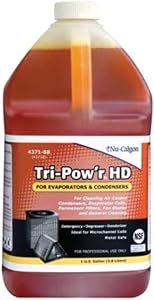
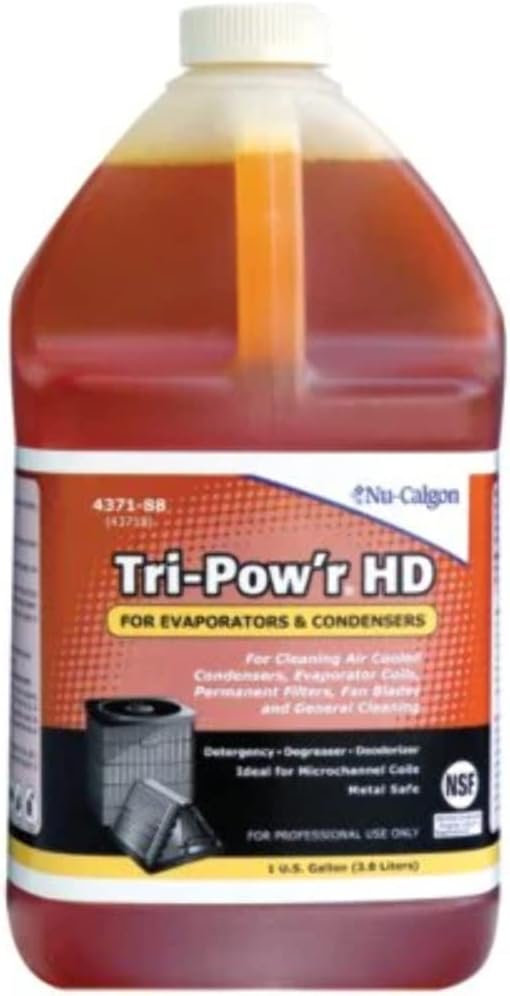
Nu-Calgon Tri-Pow’r HD, part number 4371-88, is a one gallon heavy duty alkaline cleaner sold for air cooled condensers, evaporator coils, permanent filters, fan blades and motors. It weighs 11 pounds, the container measures 6 by 6 by 11 inches, and the listing carries 284 ratings at 4.6 stars, sitting 109,512th in Health and Household and 1,416th among all purpose household cleaners.
Those categories are the first thing to correct. This is a heating, ventilation and refrigeration trade product. It exists to clean the fins of a heat exchanger, which are packed close together, coated in a film of grease, dust and lint, and effectively impossible to clean mechanically. Filed among household all purpose cleaners, it reads like a general spray, and it is not one.
The listing also contains what may be the single clearest data failure in this catalog: the feature bullet section contains one entry, and that entry reads “Bullet1”. It is a placeholder from a template that nobody replaced. Everything usable on this page is in the description field.
How it works, which the description actually explains
To Nu-Calgon’s credit, the description is more technical than most. It describes a heavy duty alkaline detergent built on what the company calls positive emulsion technology: the cleaner emulsifies greasy deposits, converting them into a fluid that can be flushed away, and it includes a surfactant to wet the deposits and corrosion inhibitors to protect equipment surfaces.
That is a coherent account of the chemistry. Alkaline cleaners attack grease by saponification, converting fats and oils into something water soluble. The wetting agent matters because a coil is a maze of narrow channels and a liquid that beads on the surface will never reach the middle of the fin pack. And the corrosion inhibitors matter most of all, which brings us to the reason a coil cleaner is a specialist product rather than a strong degreaser.
Alkaline chemistry and aluminum
Heat exchanger fins are aluminum, usually on copper tubes. Alkaline solutions attack bare aluminum, etching and pitting it, and a coil with etched fins loses efficiency permanently. Inhibited coil cleaners exist precisely to allow alkaline degreasing without that damage, which is what the corrosion inhibitors in this formula are for.
Two consequences follow, and neither is spelled out on the listing. First, this is not a general purpose degreaser that happens to be sold for coils, and it should not be used on unprotected aluminum elsewhere on the assumption that inhibitors make it universally safe. Second, and more important, an alkaline cleaner must never be mixed with or applied on top of an acidic coil cleaner. Acid based condenser cleaners are common in the trade, and combining the two, in a sprayer or on a coil, is a classic and avoidable error.
The safety claims on this page, which go too far
The description calls the product non toxic, very safe to use, safe for the environment and biodegradable, and the specification block repeats non toxic as a Special Feature.
Those claims sit badly on a heavy duty alkaline degreaser. Non toxic is not a category any regulator awards, and it is not a term that belongs on a strongly alkaline chemical. Safe for the environment is a general environmental benefit claim, which the FTC Green Guides expect to be substantiated, and no standard, certification or test appears anywhere here. Biodegradable is the same. Non acid is the only one of the four that is straightforwardly a fact about the chemistry.
What the page does not publish is more telling: no pH figure on a product whose defining property is alkalinity, no ingredient statement, no concentration, no dilution ratio and no safety data reference. Treat this as a corrosive alkaline cleaner until the container label tells you otherwise, and read that label before opening it.
The practical handling that follows: chemical splash goggles rather than glasses, chemical resistant gloves, long sleeves and closed shoes. Work outdoors or with the space well ventilated. Rinse skin immediately and generously on contact, and flush eyes with water and get medical advice rather than waiting to see how it feels.
Using it on equipment, and the step that matters most
Switch off the power at the disconnect or the breaker before spraying anything on a condenser or an air handler. Not the thermostat, the actual power. Wet chemistry, an energized fan motor and a person with a sprayer is the combination to avoid.
The listing names motors and fan blades among the surfaces. Be careful with that: cleaning a fan blade is one thing, and directing liquid into a motor’s windings, bearings or an electrical box is another. Cover the electrical components. Rinse thoroughly afterward, because leaving an alkaline residue on a coil attracts dust and can, over time, undo the protection the inhibitors provide. Let everything dry before restoring power.
With no dilution published, do not guess. A gallon of trade concentrate used neat where it should have been diluted is both wasteful and harder on the equipment.
Store it upright, capped, out of reach of children and pets, away from heat, away from freezing, and above all away from acidic products on the same shelf. Never decant it into an unlabeled container, and never combine it with any other cleaner.
Cost, and the alternatives for household work
For its intended job, a gallon is a sensible trade quantity and the cost per coil cleaned is small. For a homeowner cleaning one condenser unit once a year, a gallon is many years of supply and the more relevant question is whether coil cleaning is a job you should be doing yourself at all, given the electrical and refrigerant hardware involved.
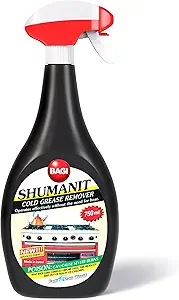
If what you actually wanted was a household degreaser, the alternatives are better suited and much better documented. The Zep multi purpose cleaner is a dilutable household concentrate. The Shumanit cold grease remover is the specialist for cooked on kitchen grease. The MAD XTREME degreaser is the automotive equivalent, with its own documentation problems. For scouring metal rather than degreasing it, the Bar Keepers Friend powder cleanser is the correct tool. Browse the wider selection under all purpose cleaners and the surface finishing products under metal polishes.
Who should buy it and who should not
Buy it if you service heating and cooling equipment, you understand what an inhibited alkaline coil cleaner is for, and a gallon is the right unit for your work. The description explains the chemistry better than most listings in this catalog manage, and the 4.6 star average from a trade audience is meaningful.
Do not buy it as a household all purpose cleaner, whatever the category says. Do not read non toxic and safe for the environment as anything but marketing on a heavy duty alkaline product with no published pH. And never let it meet an acidic coil cleaner, in a sprayer, on a coil, or on a shelf.