Description
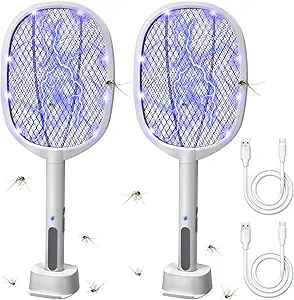
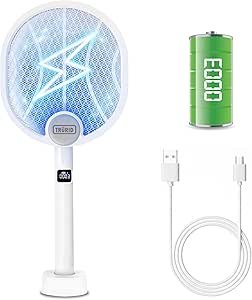
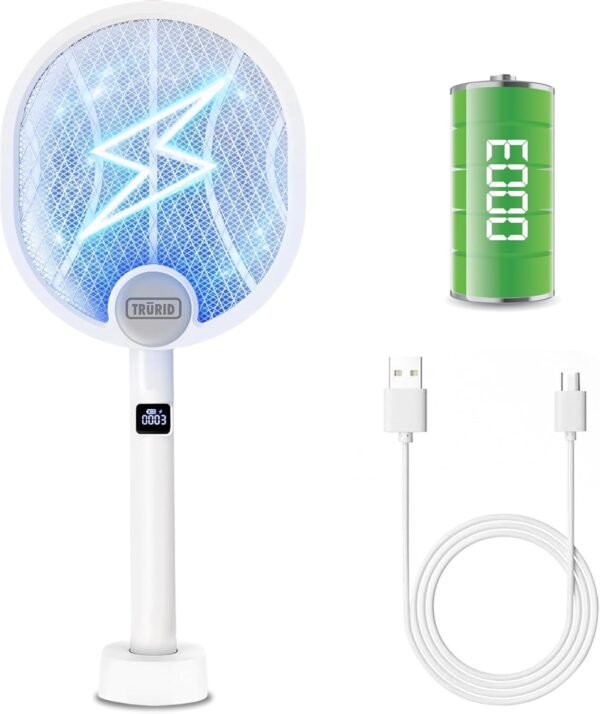
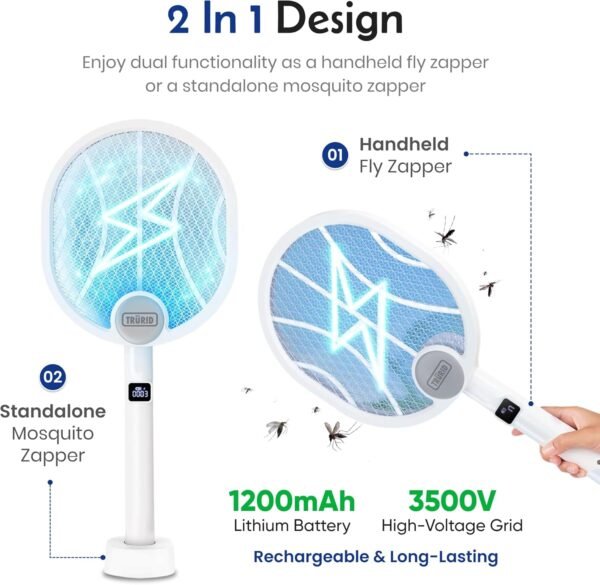
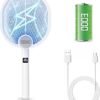
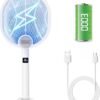
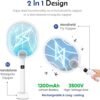
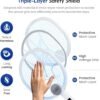
This is a two in one insect device: a handheld electric swatter that also stands on a desk or hangs as a stationary trap when the handle is folded. The listing gives a 3500 volt grid, a 1200 milliamp hour lithium battery rechargeable in about three hours, ultraviolet C emitting LEDs to attract insects, and a counter that tallies how many insects the grid has taken. It is aimed at indoor and outdoor use, in a house, on a patio or at a campsite.
Two devices in one body, and why that matters
A handheld swatter and a standing trap solve different problems. The swatter is active: you see a fly, you swing, and the result is immediate and under your control. The standing trap is passive: it sits with the ultraviolet LEDs running and waits for insects to come to it, which works on insects drawn to light and does very little about anything that is not. Combining both in one body is genuinely useful because most households need both behaviors at different moments, and it saves owning two devices.
The household this fits is one dealing with flying insects indoors or on a patio, wanting something rechargeable rather than battery fed, and happy to point a powered grid at the problem. Where it fits less well is any situation needing continuous unattended coverage of a large outdoor area, since a handheld sized grid with a small battery is not a substitute for a mains powered unit.
The specifications, and what the listing does not include
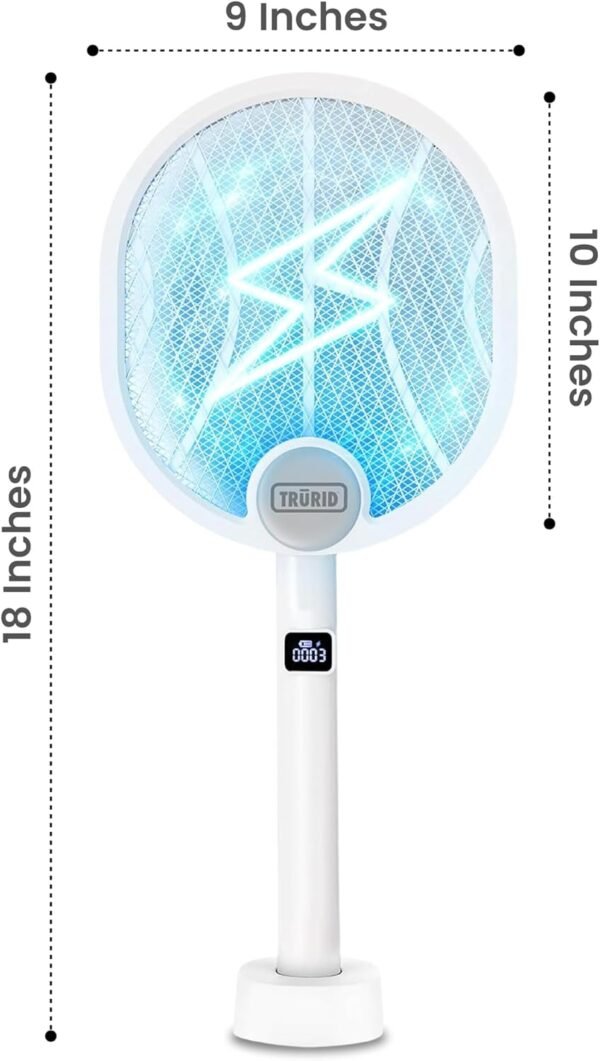
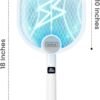
The specification block on this listing is empty. Every number quoted here comes from the marketing bullets rather than from a structured field, which means the 3500 volts, the 1200 milliamp hour capacity and the three hour charge time are the manufacturer’s figures with nothing behind them on the page. There is no run time per charge, no grid dimension, no weight, no charging connector type and no ingress rating, and the last of those matters because the listing recommends outdoor use without saying whether the device tolerates rain or dew.
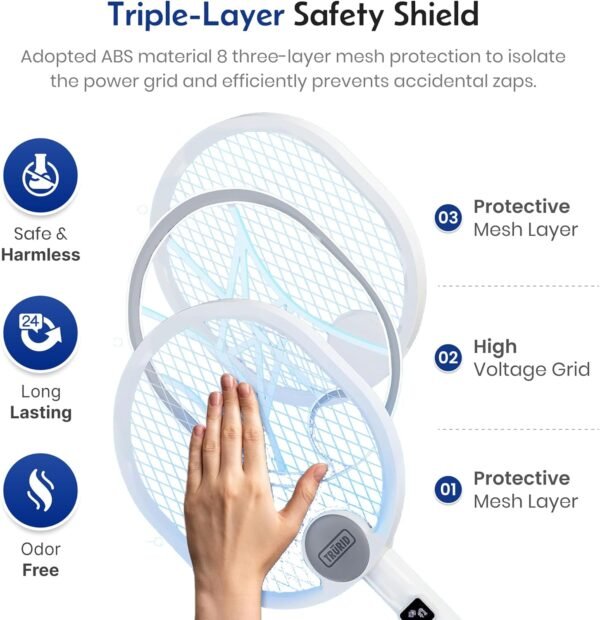
The 3500 volt figure needs context rather than alarm. Swatters of this type operate at high voltage and very low current, which is what allows them to work at all, and the listing states that the device includes residual electricity discharge and child safety protections along with an automatic shutoff. Those features are described but not detailed, and no safety standard or certification is named anywhere on the page.
The ultraviolet C statement deserves attention
The listing specifies UV-C LEDs as the attractant. That is worth pausing on, because ultraviolet C is the shortest wavelength band of ultraviolet light and direct exposure can harm eyes and skin. Insect attraction is conventionally done with UV-A, the longer wavelength band used in the familiar blue insect lamp, so a UV-C specification on a consumer swatter is either a genuine design choice with real handling implications or a specification error in the listing. This review cannot tell which from the page. Treat it seriously either way: do not look directly into the lamps, do not let children play with the device while the light is on, and read the printed manual for any warning about exposure before running it in an occupied room.
Where to use it, and where not to
As a handheld swatter it belongs anywhere you can swing it safely, which means away from faces, away from pets, and away from anything breakable. As a standing trap the same placement logic applies as to any light based device: it draws insects toward itself, so putting it in the middle of a table where people are sitting brings flying insects into the space rather than away from it. Set it at the edge of the area, a few paces from where people are, and let it pull traffic in the other direction.
Keep it out of wet conditions unless the printed manual says otherwise, since no ingress rating is published. Keep it away from curtains, paper and anything flammable when it is stationary and switched on. Do not use it near flammable vapors of any kind, which rules out a garage where fuel or solvent is stored and any area where an aerosol has just been sprayed. That last point is worth repeating: never combine an electric swatter with an aerosol insect spray, because an ignition source in an aerosol cloud is a serious hazard.
Charging, cleaning and battery care
The battery is a 1200 milliamp hour lithium cell, and the listing gives a three hour charge time without stating how long a charge lasts in either mode. Lithium cells last longest when they are neither stored at full charge in a hot place nor left flat for months, so charge it before a season of use rather than leaving it plugged in permanently, and store it indoors at room temperature over winter. At end of life the cell goes to a battery recycling point, not into household trash.
Cleaning is the maintenance step people skip. Insect remains on a grid reduce how well it works and are unpleasant to leave in a kitchen or on a patio table. Switch the device off, wait for the residual discharge function to do its job, and brush the grid clear with a dry brush. Never use water on the grid, never poke at it with anything metal, and never clean it while it is switched on or charging.
Two more handling points. Keep the device out of reach of children when it is not in use, because a folded handle and a counter display make it look like a toy. And do not run the standing mode continuously in a room where someone is sleeping, both because of the ultraviolet question above and because an unattended powered device is best switched off when nobody is present.
Cost of ownership, and the alternatives
The running cost is close to zero after purchase since there is no fuel, no cartridge and no disposable battery, and rechargeability is the main practical advantage over a swatter that eats alkaline cells. The eventual cost is the lithium cell, which in most devices of this type is not user replaceable, so the working life of the battery is effectively the working life of the product. That is the number to weigh, and the listing does not provide it.
For a straightforward handheld with no standing mode, our reviews of the Mosiller electric fly swatter and the Minimoon electric fly swatter cover simpler devices, and the Nymrix electric fly swatter is another comparison in the same family. The bug zappers category lists the handheld and stationary formats side by side.
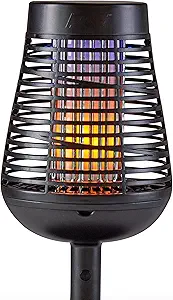
For continuous outdoor coverage rather than handheld use, a dedicated unit is the better fit, and our write up of the PIC solar insect killer torch covers a stationary option. If mosquitoes specifically are the problem, note that a light based device is a weak tool against them regardless of brand, and that removing standing water does more than any device. The repellents category covers the other approach.
Who should buy it, who should not
Buy it if you want one rechargeable device that handles both an individual fly and a quiet evening on a patio, and you are comfortable reading the printed manual for the details this listing leaves out. Skip it if you need documented outdoor weather protection, if you need a certified safety standard named, or if anyone in the household would be uncomfortable with a UV-C emitting lamp running in a living space until the manual clarifies what that specification means.