





Description
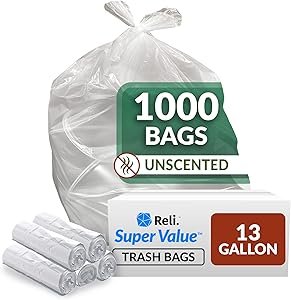
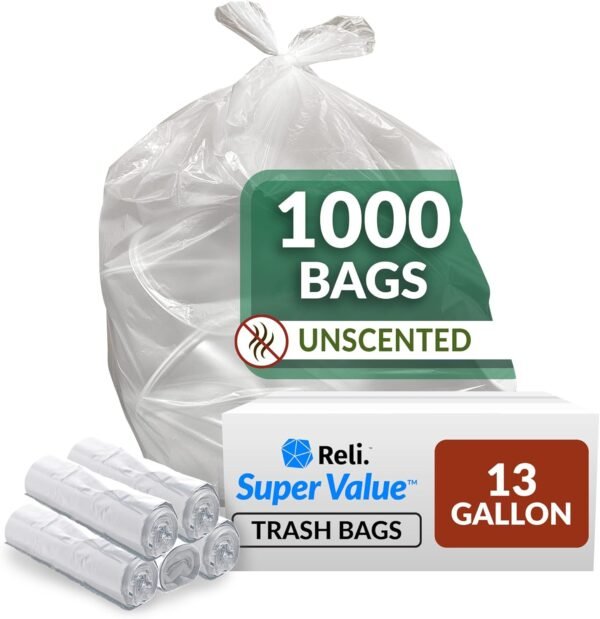
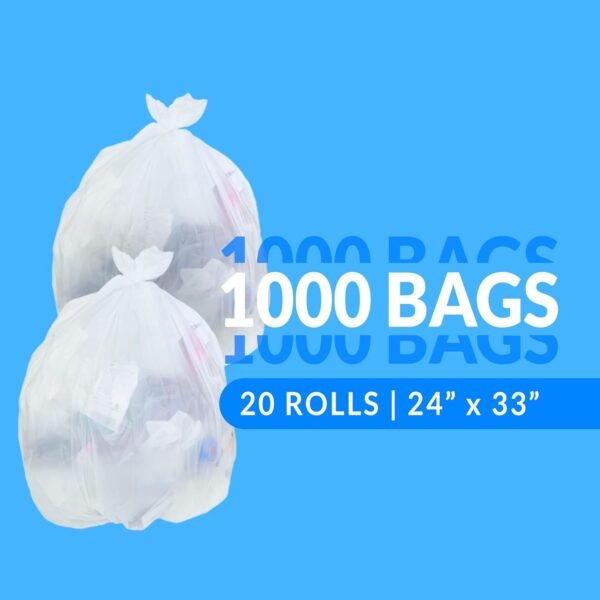
Reli SuperValue 13 gallon trash bags come one thousand to a case, clear rather than opaque, measuring 24 by 33 inches at a stated thickness of 8 microns. That thickness figure is the number that defines this product, and it is the reason the case is as large and as cheap per bag as it is.
What eight microns actually means
Trash bag thickness is quoted two ways. American listings usually give mils, where one mil is a thousandth of an inch, and metric listings give microns. Eight microns is roughly three tenths of a mil, which places this at the light end of the range: a typical everyday kitchen bag sits around 0.7 to 0.9 mil, and a heavy duty contractor bag is two mil or more. This is a high volume, low cost liner rather than a strong one.
That is not a criticism, it is a description of the intended use. Thin clear liners of this type are what offices, break rooms, restrooms, hotels and shops go through in enormous quantities, and where a can is emptied often with light waste in it, paying for extra film is money wasted. A thousand bags is a commercial quantity, and the household this suits is one with a lot of small bins or one buying for a business.
The claims, and where they sit against the specification
Reli describes the bags as tear free and leak proof, and as premium value with tough 13 gallon strength. Those are the manufacturer’s descriptions of its own product, and it is fair to say they read strongly next to a stated eight micron film. Tear free and leak proof are absolute words, and no bag of any thickness is either of those in an absolute sense. Read them as marketing rather than as a specification, and use the micron figure, which is the honest number on the page and the one that lets you compare against any other liner.
The specification block on this listing is entirely empty, so every figure quoted here comes from the description bullets. There is no ply information, no recycled content statement, no material identification beyond the implied polyethylene and no certification of any kind. There is also nothing about whether the bags are clear because that suits recycling sorting, which is the usual reason a facility specifies clear liners so contents can be checked without opening.
The capacity fields do not agree
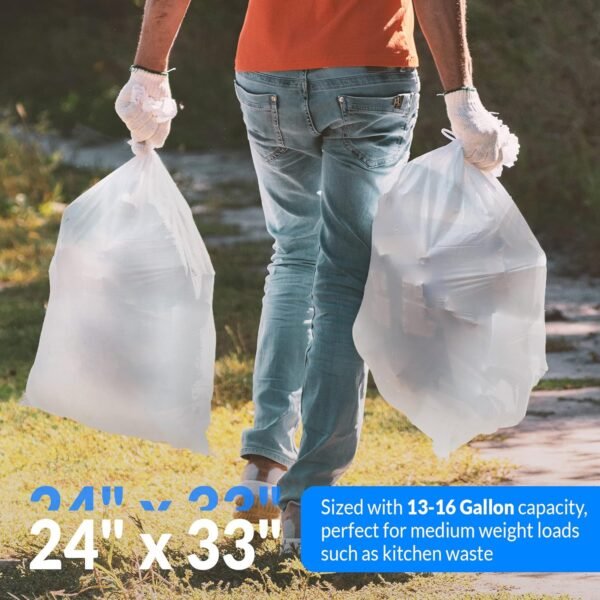
The title and the first bullet call these 13 gallon bags. Another bullet describes them as compactor friendly at 13 to 16 gallons. The flat dimensions of 24 by 33 inches are on the taller side for a 13 gallon rating, which is consistent with a bag that will stretch over a slightly larger can, but the listing states two different capacities and never reconciles them. If you are matching bags to a specific can, work from the flat dimensions rather than the gallon figure, and check them against a bag you already use.
Where these belong, and where they do not
Light waste in frequently emptied cans is the right application: paper, packaging, restroom waste, office bins, break room refuse. Clear film also has a genuine advantage in shared buildings, since anyone emptying the can can see what is in the bag before lifting it, which matters where glass or sharps might have been dropped in.
A thin bag is the wrong choice for kitchen waste with weight in it, for anything wet, for anything sharp, and for garden or construction debris. At eight microns a bag will stretch and split under a concentrated load, and a bag that fails between the can and the curb costs far more to deal with than the film saved. Two bags of this thickness are not equivalent to one thick bag either: doubling helps with puncture resistance and does nothing for stretch. If the waste is heavy or wet, buy a thicker bag rather than more of these.
Using them well, and one safety point
Thin film wants to be supported. Let the bag sit into the can and take the shape of it rather than stretching it tight over the rim, because film held under tension before it is loaded starts closer to its limit. Do not overfill, and do not carry a full bag by pinching one point of the film, since a thin bag concentrates the entire load at whatever you are holding. Gather the top and support the base with the other hand.
These are described as can liners rather than drawstring bags, so closing them means tying the top, which needs enough spare film above the waste to knot. That is another reason not to fill to the rim.
The safety point applies to any plastic film in a home. A loose bag is a suffocation hazard for small children, and a case of a thousand is a lot of loose film to have around, so store the case closed and out of reach and do not leave spare bags lying open. Never put hot ashes, smoldering material, chemicals or broken glass into a thin liner. Glass in particular should be wrapped before it goes into any bag, and at eight microns it will go straight through.
Cost per bag, and the alternatives
A thousand bags gives the lowest cost per bag of any format in this catalog, and that is the entire proposition. The comparison to make is not price per case but price per bag at a stated thickness, because a case that looks expensive at 0.9 mil may work out cheaper in practice if you stop using two bags where one would do. For light waste, thin wins clearly. For anything with weight in it, thin costs more.
For everyday kitchen use at a more normal thickness, our reviews of the Amazon Basics 13 gallon drawstring bags and the Hefty Ultra Strong 13 gallon bags cover bags with drawstrings and heavier film. For another bulk option, the Plasticplace trash bags are worth comparing, along with the AllCleanBags 15 gallon bags if your cans are slightly larger. The trash bags category lists the sizes and formats together.
For garden waste, which is heavy, wet and often sharp, a thin liner is the wrong product entirely and the lawn and leaf bags category covers the correct format.
Who should buy it, who should not
Buy the case if you are lining a lot of office, restroom or break room bins with light waste and you want the lowest possible cost per bag. Skip it if you are bagging kitchen waste with weight or liquid in it, if you need a drawstring closure, or if you want an opaque bag for privacy. The eight micron figure is the honest specification on this page, and the tear free and leak proof language sits some distance from it.