
Description
A large drawstring bag, and a brand name that does not settle
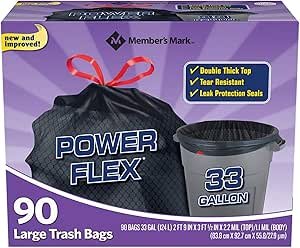
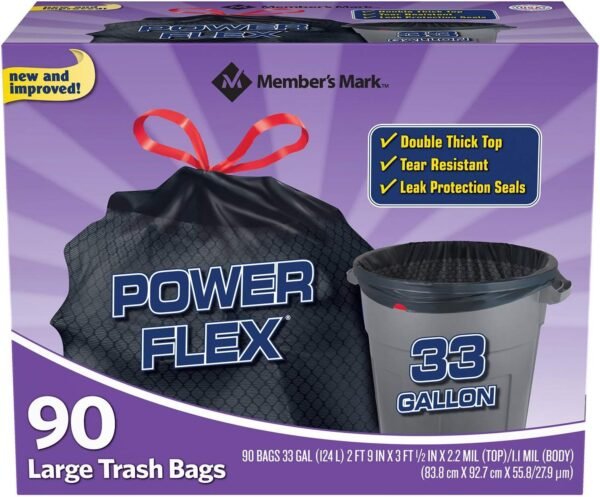
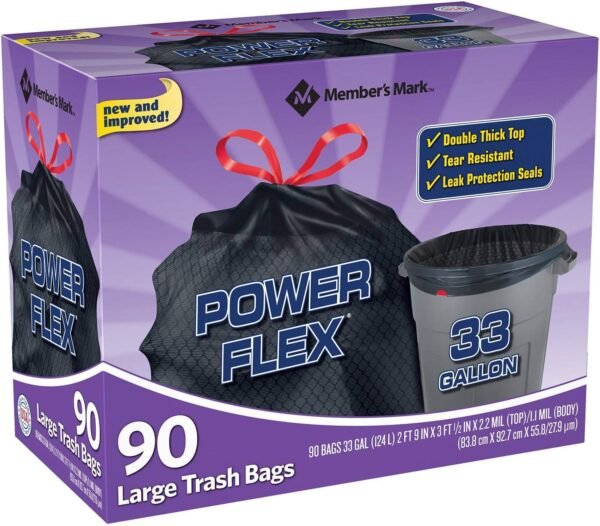
This is a ninety count pack of thirty three gallon drawstring trash bags in blue, listed with model number M201. Before anything else, the identity of the product needs stating, because the listing cannot decide on it. The product title reads Member’s Mark Power Flex 33-Gallon Large Trash Bags, 90 ct. The brand field reads DAONEG. The manufacturer field reads “Product of Member’s Mark”. Member’s Mark is the Sam’s Club private label, and DAONEG appears to be a third party seller reselling it.
That matters for two practical reasons. It means the packaging that arrives may carry a different name from the one on the listing page, and it means that if you want to reorder or to check a specification, you will need to know which of the two names to search under. Nothing about this makes the bags worse, but it is the sort of thing that generates confusion at delivery and it should be flagged rather than smoothed over.
Thirty three gallons is a large bin size. It is the size used in garages, workshops, offices, garden clean ups and utility rooms rather than in a standard tall kitchen bin, which is thirteen gallons. Ninety bags at that size is a substantial quantity, and this is a bulk purchase for a household that generates a lot of waste or for a small business.
Construction, and the number the listing withholds
The feature list is short. Two bullets: thirty three gallon drawstring trash bags, and Power-Guard embossing for improved flexibility. Embossing is a real manufacturing technique in this category. Pressing a texture into the film stretches material in a controlled way, which lets a thinner bag flex and elongate around a corner instead of splitting at a point. It is a way of getting more toughness out of less resin.
What the listing does not give is a mil gauge, and that is the number that lets you compare trash bags honestly. Without it, embossing and the phrase heavy duty in the material feature field are descriptions rather than specifications, and there is no way to weigh this bag against a rival. Check the printed pack for a gauge figure before comparing.
The listed pack weight of 10.52 pounds across ninety bags works out at roughly 1.9 ounces of film per bag, which is at least a consistent figure and gives you something to compare with a competing pack of the same count and size. The package dimensions of 12.71 by 10.04 by 6.65 inches describe the carton.
Recyclability and composting
The listing makes no recyclability claim and no compostability claim, which is the correct position for an ordinary polyethylene liner. Household plastic film is not accepted by most curbside programs in the United States, and a used bag goes to landfill with whatever is inside it. These are not compost bags and should not be substituted for the certified products in the compost bag listings, which are made to a different standard entirely. Amazon ranked this pack three hundred and fortieth in Trash Bags when the data was captured.
What belongs in a thirty three gallon bag and what does not
Large bags invite overloading, and that is the main way people get into trouble with this size. A thirty three gallon bag filled with dense waste is heavier than most people can carry comfortably, and the drawstring is the weakest point on any liner. Fill by weight rather than by volume, tie before the bag is full to the rim, and support the base when lifting rather than dangling the load from the string.
Three categories of waste should never go into a household bag. Hot ashes from a grill, fire pit or fireplace, which melt polyethylene on contact and can start a fire in a bin, and which need a metal container until they are completely cold. Broken glass, blades and anything sharp, which should be boxed or wrapped first, since a large bag is carried against the body. And liquid cleaning chemicals, which is the one that matters most here: never pour leftover bleach, drain opener, oven cleaner, toilet cleaner or an ammonia based product into a bin liner. Different chemical residues meeting inside a warm sealed bag is exactly the mixing scenario every product label warns against, and chlorine bleach with an acid or with ammonia produces toxic gases. Leftover cleaning chemicals go to a household hazardous waste collection point, never into the trash.
Garden waste is heavy and often wet, and a kitchen weight film will fail under it. Yard work is better served by a purpose made product such as the Home Depot lawn and leaf bags.
Keep the carton away from infants and toddlers, since plastic film is a suffocation hazard and a box of ninety bags is easy to reach in a garage.
Using them and keeping the bin manageable
Fit the bag, hook the drawstring over the rim, and press the air out before closing the lid, because trapped air is what lifts a bag off its rim. In a large bin, a liner that slides down the inside is the usual complaint, and the fix is either a can with a proper retaining ring or a bag one size larger than the bin rather than one cut exactly to it.
These bags are unscented. Fragrance in a liner masks odor rather than removing it, and in a large bin the more effective approach is a lid that seals, emptying on a schedule rather than when full, and occasionally washing the can itself with a general cleaner such as the Zep multi purpose cleaner, letting it dry before the next liner goes in.
Cost per bag and the alternatives
Ninety bags at thirty three gallons is a bulk buy, and bulk is where trash bags make sense economically, since the product does not spoil and storage is easy. Compare on cost per bag at a stated gauge, which this listing unfortunately makes impossible by not giving a gauge.
Within the catalog, the Teivio trash bags and the Tasker liners cover nearby sizes, and the Aluf Plastics liners come from the commercial side of the market, which is where large sizes and stated gauges are usually easier to find. The full trash bag listings let you compare counts and capacities side by side.
Who should buy these and who should not
Buy them if you need a large drawstring liner in quantity for a garage, workshop, office or utility bin, you have somewhere dry to keep ninety bags, and you are comfortable ordering a Member’s Mark product through a third party seller listing.
Do not buy them for a standard thirteen gallon kitchen bin, where a thirty three gallon bag wastes film and pools at the bottom. Do not use them for heavy construction debris or wet yard waste, which want a thicker contractor film. And do not compare them on strength against another brand until you have a mil gauge from the pack, because the listing does not provide one.