Description
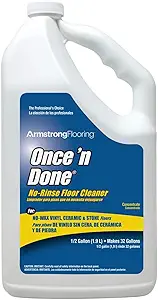
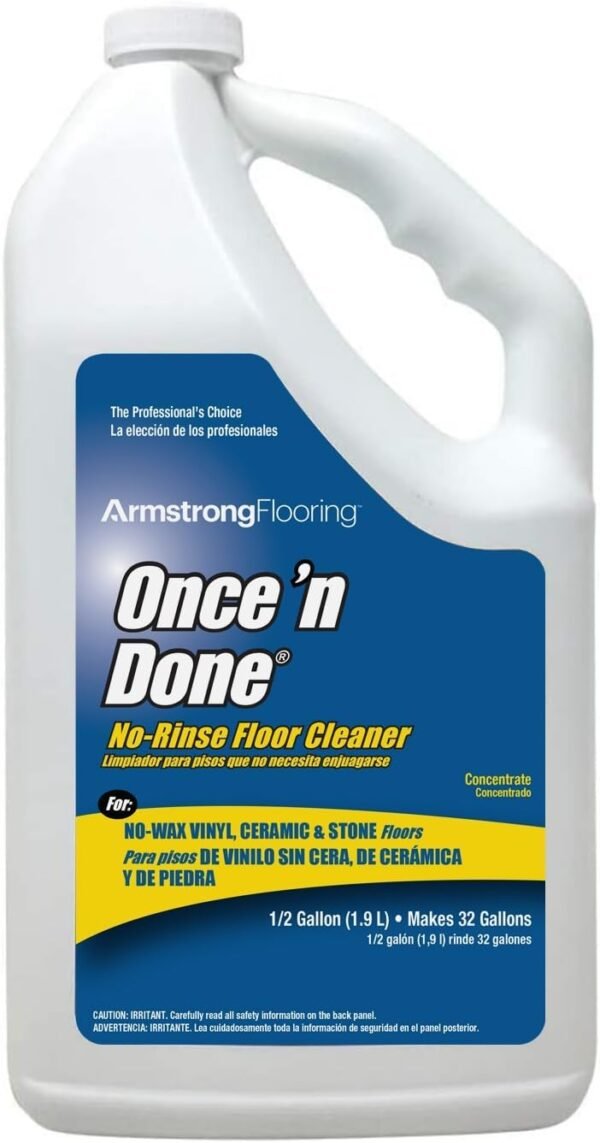
Armstrong Once N Done is a 64 ounce, half gallon bottle of citrus scented floor cleaner concentrate from Armstrong Flooring. The listing has been live since 2006 and it is one of the shortest pages in this catalog: the description is a single line, and that same line is repeated as the only feature bullet. Everything a buyer needs to use a concentrate correctly has to come from the bottle.
What a floor cleaner concentrate is for
A concentrate is bought by the half gallon and used by the capful. Diluted into a bucket or a spray mop reservoir, it goes a long way, which is why concentrates remain the format of choice for anyone cleaning a large area of hard flooring regularly. The saving is real: a ready to use spray is mostly water, and shipping water is the least efficient part of a cleaning purchase.
Armstrong is a flooring manufacturer rather than a cleaning company, and that matters. Cleaners sold by flooring makers are formulated for the finishes those makers put on their own products, which usually means a neutral pH designed not to strip a factory finish or leave a film that dulls it. The household this fits has a large area of sealed hard flooring and cleans it often enough for the arithmetic of a concentrate to make sense.
The dilution ratio is not on the page
This is the gap that matters. A concentrate is defined by its dilution, and no ratio appears anywhere on this listing. There is no capful per gallon figure, no guidance for a spray mop, no instruction on whether the floor should be rinsed afterward, and no ingredient list, pH or surfactant named. This review will not supply a ratio, because getting it wrong in either direction causes a problem: too weak and the floor is not cleaned, too strong and the residue left behind attracts soil and makes the floor look worse after every wash.
Read the label on the bottle before mixing anything, and if the label is unclear, start at the weakest ratio it gives. A useful test with any floor concentrate is to clean a small area, let it dry, and look at it in low angle light. Streaks or a dull film mean you used too much, not too little, and the fix is a rinse with clean water followed by a weaker mix next time.
Two part numbers on one listing
The product title on this listing names Armstrong 330806 while the specification block gives an item model number of TRVAL4344. Those are different part numbers on the same page, and the listing never explains the relationship. It may be a supplier code alongside a manufacturer code, but there is no way to confirm that here. If you are matching a cleaner to a specific floor warranty, check the part number on the bottle you receive against the one your flooring documentation names, since flooring warranties sometimes specify approved cleaners by code. The specification block also carries a department field reading unisex adult, which is a marketplace artifact rather than product information.
Floors it suits, and the ones to check first
The natural range for a neutral floor concentrate is sealed hard flooring: vinyl, luxury vinyl plank, linoleum, laminate, sealed tile and finished hardwood. Those surfaces have a protective layer on top, and the cleaner’s job is to lift soil off that layer without attacking it.
Three cases need checking rather than assuming. Unsealed or oiled wood is the first: an oiled floor needs a product formulated for oil finishes, and a general cleaner can strip and blotch it. Natural stone is the second, since marble and limestone are damaged by anything acidic and the pH is not published here. Waxed floors are the third, because a cleaner that removes wax leaves an uneven finish that has to be stripped and redone. On any of these, check your flooring manufacturer’s own guidance, which overrides a general claim on a cleaner bottle.
Using it correctly and safely
The method that works on hard floors is more water discipline than chemistry. Sweep or vacuum first, because a wet mop drags grit across a finish and grit is what actually scratches floors. Then mop with a well wrung mop rather than a soaking one: standing water finds seams in laminate and plank flooring and swells the core, which is permanent damage no cleaner causes and no cleaner fixes. Work in sections and let each dry.
Handle the concentrate as a concentrate. Keep it off skin and out of eyes, wear gloves when decanting, ventilate the room, and never sniff the bottle to judge strength. Store it upright, closed, at room temperature and out of reach of children and pets, and do not decant it into an unlabeled container or a drink bottle. A citrus scent does not indicate mildness, and fragrance is not an ingredient statement.
The mixing rule applies with particular force to a bucket. Never combine this concentrate with chlorine bleach, with an acidic cleaner, with ammonia or with any other product in the same water. Mixing an unidentified cleaner with bleach or with an acid can release toxic gas, and a mop bucket in a closed room is a bad place for that. If you are switching products, empty the bucket, rinse it, and start again.
Cost per bucket, and the alternatives
The cost case for a concentrate is strong when the dilution is known, since a half gallon covers a great many buckets and the packaging waste is a fraction of buying spray bottles. The case weakens if you have to guess the ratio, because guessing high wastes product and leaves residue. Work out the true cost per bucket once you have the label in hand, and compare that against a ready to use product rather than comparing bottle prices.
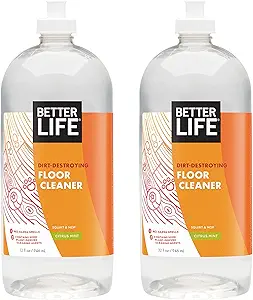
For hardwood specifically, our reviews of the Weiman hardwood floor cleaner and the Murphy oil soap floor cleaner cover two very different approaches to a wood floor, and the Better Life floor cleaner is another general option. The floor cleaners category lists them together.
If a bucket and mop is the part you would rather avoid, a spray mop system puts a measured amount of solution onto the floor and uses a washable pad, which is both less water and less mess. Our write up of the Bona hardwood floor spray mop covers that format, with more in the wet and dry mops category.
Who should buy it, who should not
Buy the half gallon if you have a large area of sealed hard flooring, you prefer a bucket to a spray, and you are happy to work from the printed label. Skip it if you have oiled wood, natural stone or a waxed floor and cannot confirm compatibility, or if you want the dilution ratio and ingredient information settled before you order, because this listing publishes neither and has not been updated in a very long time.