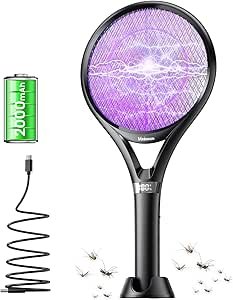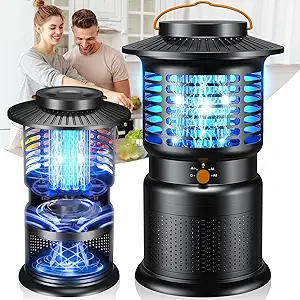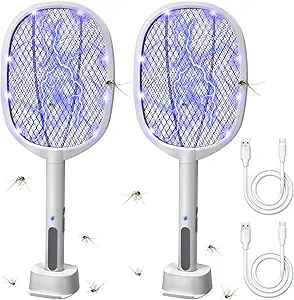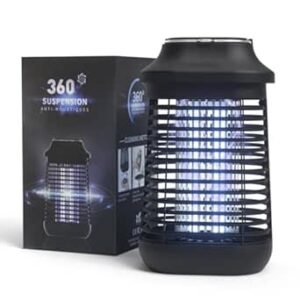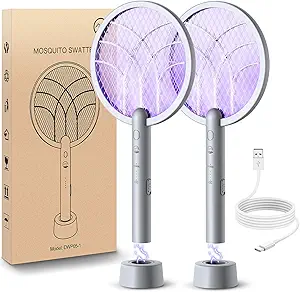
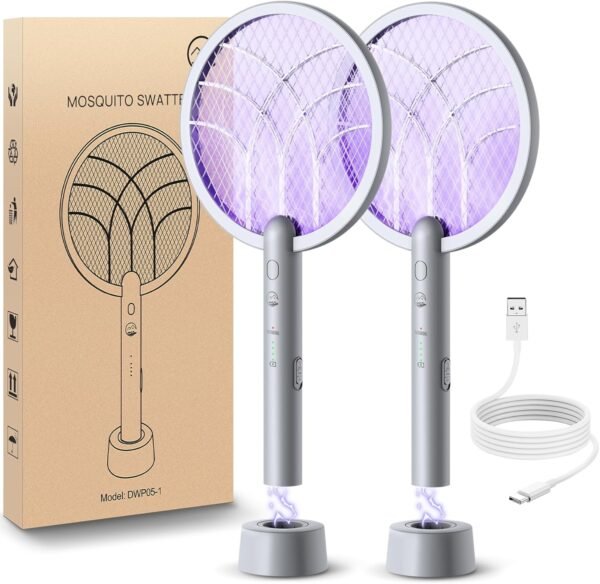

Description
Two devices in one housing, and the job each of them does
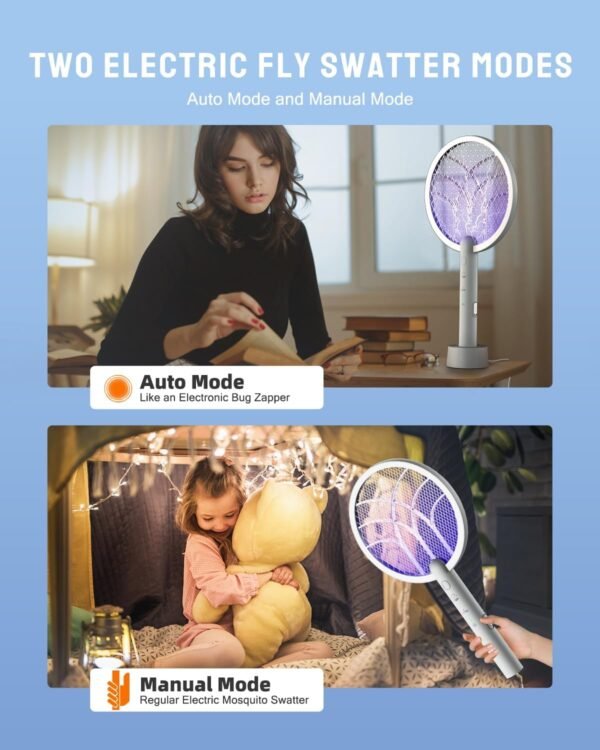
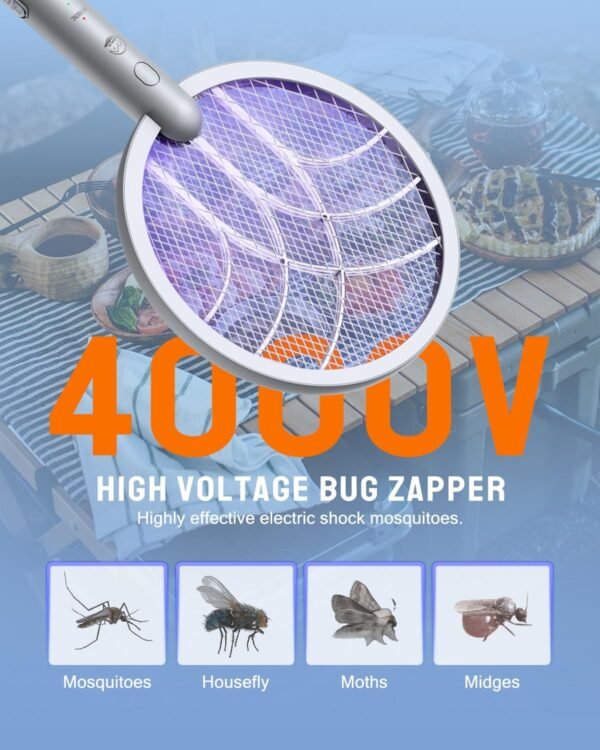
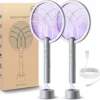
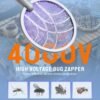
The Mosiller FSAG-01US is sold as a combined electric fly swatter and insect lamp. Used by hand it is a racket with an electrified grid that kills a flying insect on contact. Dropped into its USB charging base and switched on, it becomes a stationary lamp that emits light intended to draw insects onto the same grid. Those are genuinely different jobs and it is worth separating them, because the racket half works on a completely different principle from the lamp half.
The racket half is mechanical targeting. You see a fly, you swing, contact kills it. There is nothing to evaluate beyond grid voltage, swing weight and how well the mesh keeps your fingers off the current. That half of the product is straightforward and reliable in the sense that any electric swatter is.
The lamp half is where expectations need managing. Mosiller states that the lamp releases a 395 wavelength that attracts mosquitoes according to their phototaxis habits. Light based attraction works well on moths and many flies, which navigate by light. It works far less predictably on mosquitoes, which locate people primarily by exhaled carbon dioxide, body heat and skin odor rather than by light. Independent research on the mosquito effectiveness of light based zappers is mixed, and this listing provides no independent data of any kind, no trap counts, no test conditions and no comparison. Treat the mosquito claim as the manufacturer’s, and buy the product for the racket first.
The electrical specification and how the grid works
Mosiller gives the grid as 4000V and states that the design uses three layers of mesh to separate the high voltage grid from your hand and to prevent accidental shock. That layered construction is the standard safety approach for this product type: the outer meshes are grounded or insulated so that a finger cannot reach the live centre layer.
High voltage on its own is not a performance number. What kills a fly is a discharge across a small air gap, and grid spacing matters as much as stated voltage. Mosiller publishes no current rating, no capacitor value and no battery capacity anywhere on this listing, so the 4000V figure sits without context. It also publishes no safety certification mark, no IP rating and no product safety standard reference.
The specification block contradicts itself repeatedly
This listing is unusually messy and the contradictions should be named rather than tidied away. The specification field “Is Electric” reads No, on a mains charged electric fly swatter. “Number of Pieces” reads 1 while “Unit Count” reads 2.0 Count and the style field reads Light Grey 2 Pack, so the page cannot decide whether you are buying one racket or two. The feature bullet describes a “395mm mosquito habit wavelength” while the product excerpt elsewhere gives 395nm, and those differ by a factor of a million, since 395 nanometers is near ultraviolet light and 395 millimeters is not light at all. The product title also contains the phrase “Power Take Off Generators”, which is farm machinery terminology and appears to be keyword padding rather than a description of anything in the box. Check the quantity with the seller before ordering if the count matters to you.
Where to put it, and where never to put it
A zapper attracts insects toward itself, which means placement is the whole game. Put the lamp away from where people sit, not next to them, so that insects are drawn across the room rather than into your dinner. Indoors, a corner away from seating and away from food preparation is the sensible position, since a zapper scatters insect fragments in a small radius when it fires and nobody wants that over a kitchen counter.
The listing does not state an ingress protection rating and describes the product as being for home, bedroom and indoor use. Treat it as indoor and dry only. Do not leave it on a patio in the rain, do not hang it outside overnight, and never rinse it or immerse it in water. Clean the grid only when the unit is off, unplugged and discharged, using a dry brush.
Keep it well away from aerosols. This is the point most listings skip: an electric grid produces sparks, and insecticide sprays, air fresheners, hairspray and solvent based cleaners are flammable in aerosol form. Never spray any aerosol product near a live zapper, and never use one in a room where a solvent bearing product such as an aerosol spray starch has just been used. Ventilate first.
Safe handling, charging and storage
Treat the grid as live at all times, including after the switch is off, because these devices store charge in a capacitor and can discharge for a period after power is removed. Do not poke the grid with a finger, a screwdriver or anything metal. Do not let children use it as a toy, which is exactly what a racket shaped device invites, and store it out of their reach along with the base. It should not be used near anyone with a cardiac implant, and it should not be swung at insects on a person or a pet.
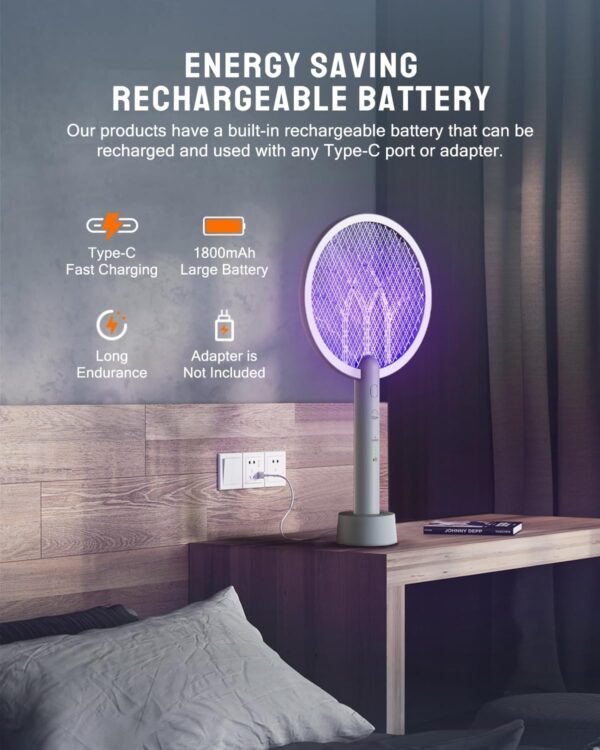
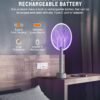
The unit charges over USB. Charge it with the supplied lead on a standard USB power source, not on a high output fast charger, do not charge it unattended overnight on a soft surface, and stop using it if the housing gets hot, swells or smells. A rechargeable device with an internal cell should not be thrown in household waste at the end of its life. Take it to an electrical recycling point, because internal cells are a fire risk in a compactor.
Wipe the exterior with a dry or barely damp cloth only. Never use a household cleaner on the grid, never spray anything into the housing, and never combine cleaning products anywhere near the unit.
Running cost and the alternatives
The cost structure of a rechargeable racket is favorable: there is no consumable at all, and Mosiller explicitly positions the USB base against disposable batteries. That is a genuine advantage over battery powered swatters, provided the internal cell lasts. Against it, a device with a sealed rechargeable cell has a finite life and cannot be revived with new batteries when the cell fails.
Within the catalog, the Minimoon electric fly swatter and the Nymrix electric fly swatter cover the same racket format, while a fixed unit such as the Reogle bug zapper is the comparison if you want a lamp that stays in one place. For mosquitoes specifically, exclusion and repellents are more reliable than attraction, and the ultrasonic repeller listings and the wider bug zapper listings let you see the alternatives side by side. Amazon ranked this unit seventh in Bug Zappers when the data was captured.
Who should buy it and who should not
Buy it if you want a rechargeable racket for flies and moths indoors, and you treat the lamp function as a bonus rather than the reason for buying. For that use it is a sensible, consumable free tool.
Do not buy it expecting documented mosquito control, because the listing offers no evidence and the wider evidence for light based mosquito trapping is mixed. Do not buy it for outdoor use, since no weather rating is published. And do not buy it into a home with young children unless you can store it out of reach, because a shockable racket left within reach is an accident waiting to happen.