Description
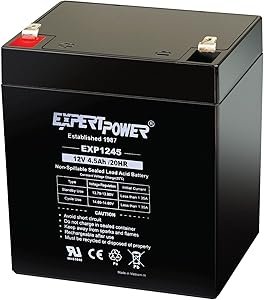
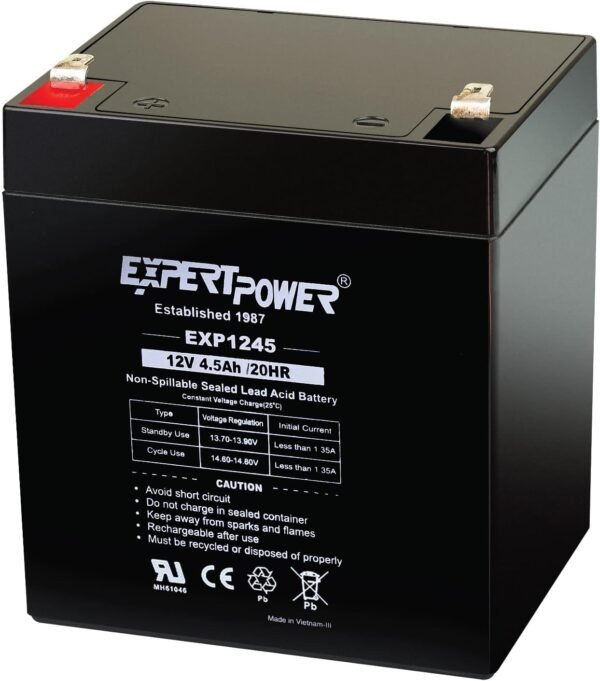
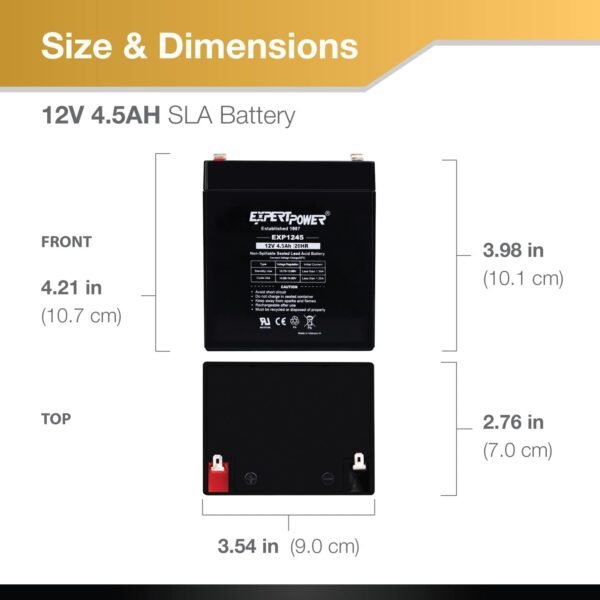
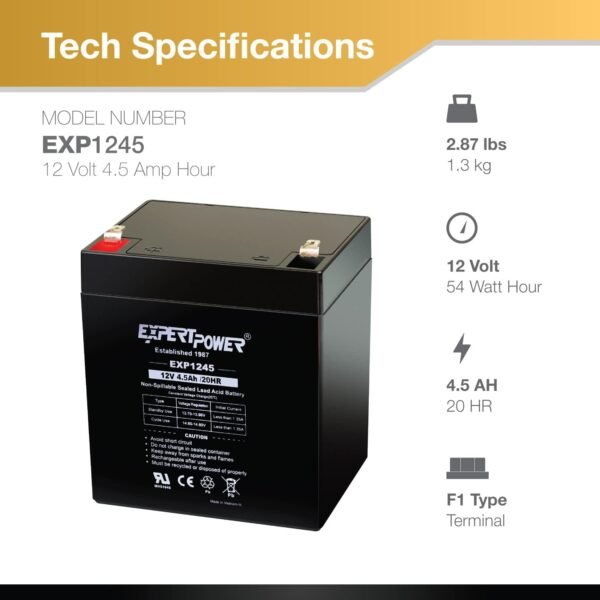
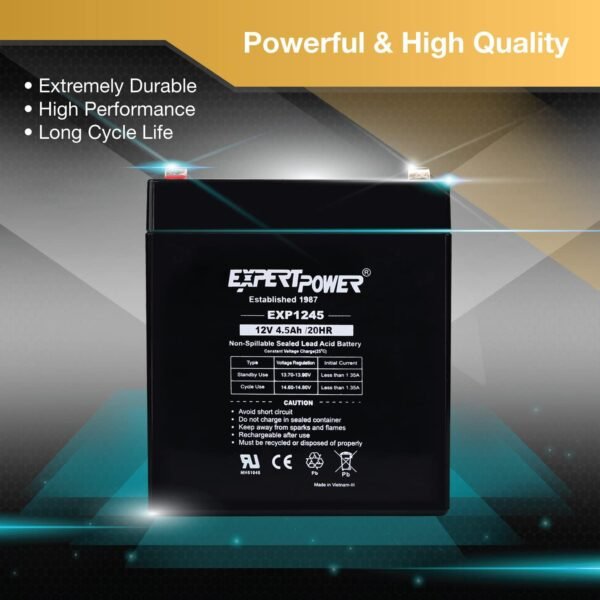
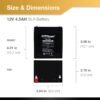
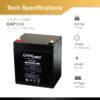
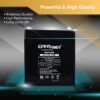
The ExpertPower EXP1245 is a sealed lead acid battery, twelve volts, rated at 4.5 amp hours over a twenty hour discharge, weighing 3.2 pounds in a case measuring roughly three and a half by two and three quarters by four inches. It uses absorbed glass mat construction, which means the acid is held in a fiberglass separator rather than sloshing about as free liquid. It is a component rather than a household consumable, and it belongs in equipment rather than in a drawer.
Where a battery like this is used
The classic application is standby power. Home alarm panels, fire panels, uninterruptible power supplies, emergency lighting, medical devices and access control systems all carry a small sealed lead acid battery that sits on a float charge for years and only does anything on the day the mains fails. ExpertPower also names electric scooters and portable speakers, which are cyclic uses where the battery is repeatedly discharged and recharged.
Those two duty types matter, because a battery in standby service is charged continuously and rarely discharged, while a battery in cyclic service is worked hard every day. Sealed lead acid cells generally last several years in standby duty and far fewer cycles in deep discharge duty. The listing does not state a cycle life or a design life for either case, which is the specification a buyer replacing an alarm battery would most want.
What the specifications say, and one that is mislabeled
The useful figures are the voltage and the capacity. Twelve volts and 4.5 amp hours at a twenty hour rate means the battery can deliver roughly a fifth of an amp continuously for twenty hours before reaching its cutoff. Lead acid capacity falls as the discharge rate rises, so drawing four and a half amps does not give you an hour: it gives considerably less. That is normal behavior for the chemistry rather than a fault, and it is why the twenty hour rate is always quoted.
One specification field is wrong. The block lists amperage as 4.5 amps, which confuses capacity with current. Amp hours measure stored energy and amps measure flow, and the battery’s actual current capability is not published anywhere on the page. Neither is the terminal type, which is the detail most likely to cause a wrong purchase: sealed lead acid batteries use several different tab and terminal styles, and a battery that fits the tray but not the connectors is no use. Measure your existing battery and check its terminals before ordering.
What absorbed glass mat construction gives you
ExpertPower describes the acid as absorbed between the plates and immobilized by a fine fiberglass mat, with valve regulated, spill proof construction allowing operation in any position. That is an accurate description of the technology, and it is the reason this format can live inside an alarm panel on a wall. The case is described as high impact ABS with resistance to shock, vibration, chemicals and heat, and the battery is described as maintenance free, meaning there is no electrolyte to top up. What spill proof does not mean is that the battery contains nothing hazardous. It contains lead and sulfuric acid, and a cracked case is a chemical hazard as well as an electrical one.
Charging, installation and compatibility
Sealed lead acid batteries need a charger matched to the chemistry. The float and absorption voltages for this type are specific, and a charger designed for lithium or for flooded automotive batteries can overcharge a sealed cell, which dries out the electrolyte permanently because there is no way to replace it. If the battery is going into an alarm panel or a similar device, the equipment’s own charger is designed for the job and no separate charger is needed. If you are building something, use a charger explicitly rated for sealed lead acid or absorbed glass mat.
Observe polarity, connect the terminals firmly, and do not reverse them. Do not short the terminals with a tool: a small sealed battery can deliver a very high current into a dead short, which melts metal and starts fires. Keep the battery the right way up during installation even though the design permits other orientations, and do not install it where it will sit against a heat source, since heat is the main thing that shortens the life of this chemistry.
Safety, storage and disposal
Never open, puncture, crush or incinerate a sealed lead acid battery. The case contains sulfuric acid, and burning one releases lead. If a case is cracked or leaking, handle it with gloves and eye protection, keep it away from skin, and do not attempt to seal or reuse it. Charging any lead acid battery can release hydrogen, so charge in a ventilated space and never in a sealed box, and keep the battery away from open flame and from anything that sparks.
For storage, lead acid batteries self discharge and are damaged by being left flat. If the battery is not going into service immediately, keep it cool, dry and charged, and top it up periodically rather than leaving it for a year. Store it out of reach of children, upright, and never with loose metal objects that could bridge the terminals.
Disposal is regulated and straightforward. Lead acid batteries are widely recycled and should be taken to a battery collection point, an auto parts retailer that accepts them, or a household hazardous waste facility. They do not go in household trash. This is one of the few consumer items where recycling is both legally expected and genuinely effective.
Cost, and where this sits against other formats
The economics of a sealed lead acid battery are about replacement intervals rather than purchase price. The battery is inexpensive, and the cost that matters is the alarm that failed to sound or the emergency light that did not come on because a cell reached the end of its life unnoticed. Alarm batteries are conventionally replaced on a schedule rather than on failure, and a spare on the shelf is a reasonable thing to keep. The claim on the page that these are the most trusted and highest reviewed sealed lead acid batteries is ExpertPower’s own statement about itself rather than a measurement.
For household electronics the formats are entirely different, and our reviews of the Streamlight rechargeable battery and the Bevigor rechargeable AA cells cover the rechargeable options most homes actually need. The household batteries category lists the formats together.
For the disposable cells that go into smoke alarms, remotes and clocks, our write ups of the Voniko 9 volt cells and the Duracell Procell AA cells are the relevant comparisons, with more in the AA battery category.
Who should buy it, who should not
Buy it if you are replacing a twelve volt 4.5 amp hour sealed battery in an alarm panel, an uninterruptible supply or similar equipment, and you have checked the terminal type and the physical dimensions against the one you are removing. Skip it if you need a deep cycle battery for repeated heavy discharge, if you cannot confirm the terminal style, or if you were looking for household batteries, since this is equipment hardware sold in a household category.