



Description
The job a cleaning vinegar does around the house
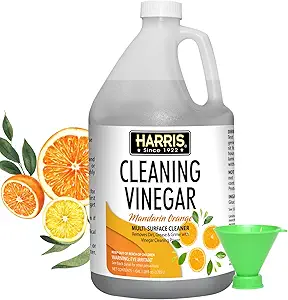
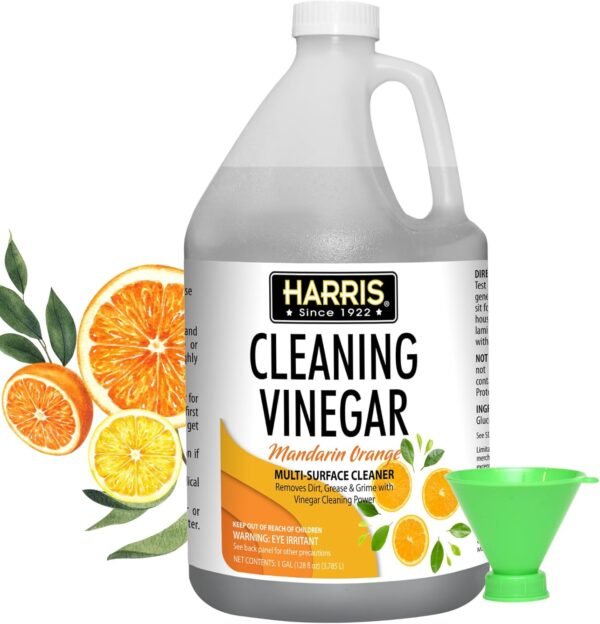
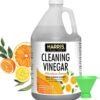
Harris sells this as a 128 ounce jug of cleaning vinegar with orange oil, supplied with a pour funnel, under ASIN B089WHYXM1 and first listed in June 2020. Amazon places it 11,376th in Health and Household and 158th among all purpose household cleaners.
Acetic acid is the working ingredient in any cleaning vinegar, and what it is genuinely good at is mineral scale. Hard water deposits on a faucet, the chalky film on a shower screen, the ring inside a kettle, soap scum where the soap has reacted with calcium in the water: those are alkaline mineral salts and an acid dissolves them. It is also useful for cutting light grease on glass and stainless steel, and for deodorizing where the smell is alkaline in origin.
What it is not good at deserves the same directness. Vinegar is a weak acid and a poor surfactant. It will not lift heavy kitchen grease the way an alkaline degreaser will, it does not carry a soil away in the manner of a built detergent, and it is not a disinfectant. Harris makes no disinfection claim here and neither should anyone repeating this listing. A household buying a gallon of this to replace every cleaner in the cupboard will be disappointed at the first baked on oven tray.
What the listing tells you about the formula, and what it leaves out
The description field on this product is empty. Everything available comes from the title and five feature bullets, and there is no ingredient statement, no acetic acid percentage, and no pH figure. That is the single most important gap in the listing, because the strength of a cleaning vinegar is the whole question. Cleaning vinegars are sold at a range of concentrations and the number changes both what the product will remove and how carefully it has to be handled. This review will not put a percentage on it. Read the label on the jug before the first use.
The concentrate and ready to use contradiction
Two feature bullets on this listing describe two different products. One says “No Rinsing and No Residue, easy to use, simply wipe surfaces clean after spraying”, which describes a ready to use spray. Another says “Concentrated, simply dilute with water according to label directions and spray as needed”, which describes a concentrate. Those cannot both be true of the same liquid. The product also ships as a 128 ounce jug with a pour funnel rather than in a trigger bottle, which fits the concentrate reading and does not fit the spray and wipe reading at all. Take the label directions on the jug as the authority, decant into your own trigger bottle, and treat the no rinse bullet with suspicion until the label confirms it.
The orange scent comes from orange oils according to the listing, which also states that the oils neutralize odors. That is Harris’s claim. A fragrance masks an odor by definition, and no mechanism for neutralizing anything is given.
Surfaces this belongs on, and the ones it will damage
Harris names glass, stainless steel and ceramic as safe, and then says most household surfaces, which is where a buyer can get into trouble. An acid is not a neutral cleaner and the exclusions matter more than the inclusions.
Keep it off natural stone entirely. Marble, travertine, limestone and many granites are calcium based or have calcium based veining, and acid etches them permanently, leaving a dull patch that no amount of polishing recovers. For those surfaces use a product formulated for stone such as the More stone and quartz cleaner.
Keep it off unsealed grout and unsealed concrete, which are cementitious and dissolve slowly under repeated acid exposure. Keep it off waxed or oiled wood and off hardwood floor finishes, where it strips the finish and raises grain. Keep it off cast iron, off bare aluminum and off soft metals like brass and copper unless you are deliberately stripping a patina. Keep it away from rubber gaskets and hoses, since prolonged acid contact hardens them, which matters if you are tempted to run it through an appliance. Electronics screens, phone or television, should never see it.
Using it safely, and the mixture never to make
The rule that matters most has nothing to do with surfaces. Never mix vinegar, or any acid, with chlorine bleach. The reaction releases chlorine gas, which is dangerous in an enclosed bathroom at household concentrations. That includes using vinegar on a surface a bleach product was just used on without a thorough water rinse in between, and it includes pouring both into the same bucket or the same toilet bowl. Never combine any two cleaning products in a container.
Beyond that: ventilate, because concentrated acetic acid vapor is a respiratory irritant, and the smell of a gallon jug being decanted is not trivial. Wear eye protection while pouring, which is exactly the moment the supplied funnel is for. Rinse skin with water after contact. Store it upright, capped, out of reach of children, and away from bleach, ammonia and drain openers on the same shelf. Do not store a diluted mix in an unlabeled bottle.
What it costs to run, and the alternatives
The cost argument for a gallon jug is dilution. If the label directions genuinely allow dilution, one 128 ounce jug makes several times its own volume of working solution and the cost per bottle of spray falls sharply. That is the entire reason to buy this format rather than a ready to use trigger bottle. If it turns out to be ready to use, the value proposition is much weaker and you are shipping a gallon of water.
Consider the alternatives by the job. For heavy kitchen grease an alkaline cleaner is the correct chemistry, and something like the Zep multi purpose cleaner concentrate is built for that. Where a disinfection claim is actually needed, a registered product such as the Clorox disinfecting all purpose cleaner is the right aisle, and vinegar is not a substitute. For a dilutable concentrate with a published dilution system, the Branch Basics concentrate is the comparison. Browse the wider selection under all purpose cleaners or, for the specific job of streak free glass, under glass cleaners.
Who should buy it and who should not
Buy it if you have hard water, you clean a lot of glass, tile and stainless steel, and you are comfortable decanting from a gallon jug into your own sprayer after reading the label. On scale and soap film it does a job that alkaline cleaners do badly.
Do not buy it if your counters are marble, granite or any natural stone, or if your floors are finished hardwood. Do not buy it if you want one product that also disinfects, because this makes no such claim. And do not buy it if you keep chlorine bleach products in regular use in the same small bathroom, unless you are confident everyone in the house understands why the two must never meet.