



Description
What a wax repair kit can and cannot do
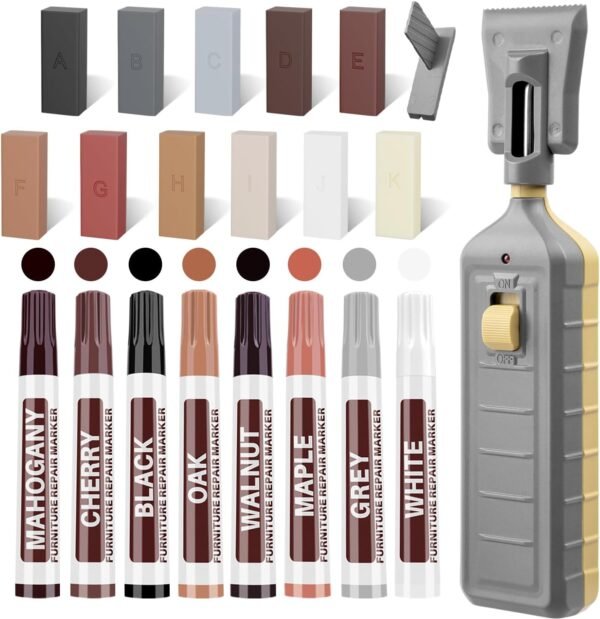
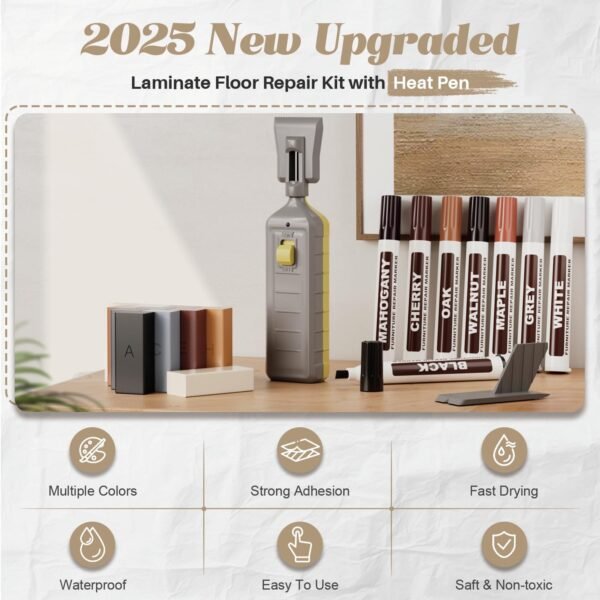
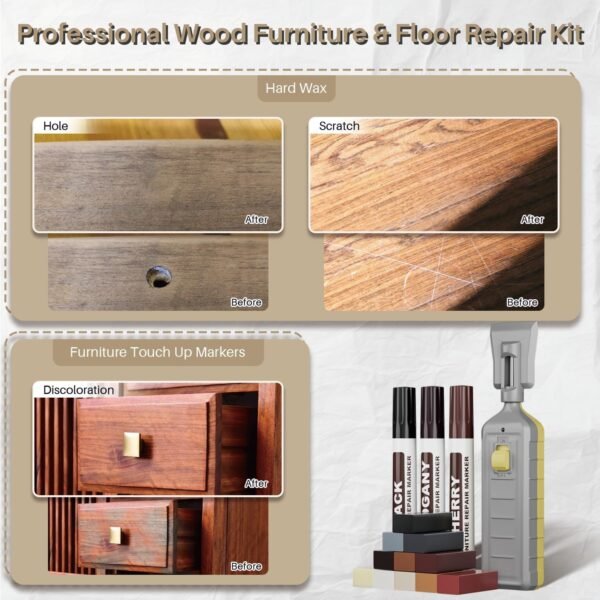
The PUYD kit is a cosmetic repair set for hard flooring and furniture. It contains eleven hard wax blocks in common wood colors, eight wood touch up markers, and a heat pen that PUYD says reaches working temperature in ten seconds. You melt wax into a gouge, level it, then use the markers to redraw grain across the fill so the patch reads as wood rather than as a plug.
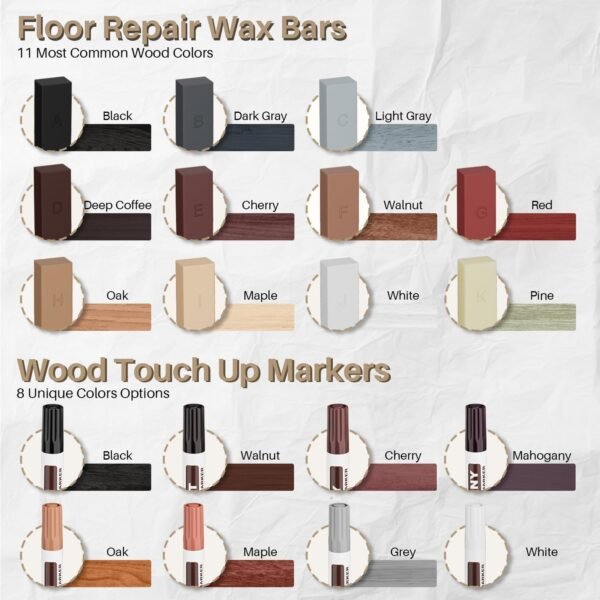
Being clear about the ceiling on this technique saves disappointment. Wax filling is a surface repair. It hides damage, it does not restore strength, it does not bond structurally to the board, and it does not accept a stain or a finish coat the way wood does. It is genuinely good at what it is for: a dent from a dropped pan, a deep scratch from a chair leg, a chip at a board edge, a screw hole in a cabinet. It is the wrong answer for water damage, for a cupped or lifting board, for a laminate plank whose core has swollen, or for anywhere the damage is a symptom of something structural. The eleven wax colors are listed as black, dark gray, light gray, dark coffee, cherry, walnut, red, white, oak, maple and pine, and the eight markers as mahogany, walnut, cherry, oak, black, gray, maple and white.
The materials, and the one specification the listing withholds
PUYD does not say what the wax is made from, gives no melting point, and states no chemical composition for the markers. Hard wax repair sticks are generally blends of waxes and resins with pigment, and hardness varies a great deal between products; a softer wax is easier to work and marks more easily afterward, a harder one is more durable and needs more heat. Without a specification you find out which you have after it arrives.
The heat pen is the part with no data at all
The listing calls the heat pen upgraded and says it heats in ten seconds. It does not say whether it runs on batteries, on a USB cable or on mains power, what wattage it draws, what temperature the tip reaches, whether the temperature is regulated, or whether the unit carries any electrical safety certification. For a handheld heating tool that a buyer will hold against a floor in a living room, that is a real gap. Treat it as you would any hot tool: work on a heat resistant surface, never leave it unattended while it is hot, let it cool fully before packing it away, keep it away from children and pets, and keep flammable material well clear. Do not use it near a solvent, a finish or an aerosol; molten wax and an open heat source do not belong in the same space as anything that gives off vapor.
Surfaces it is offered for, and where to be careful
PUYD names laminate, vinyl, hardwood, linoleum and furniture, along with doors, tables and cabinets. In practice the technique works best on finished, hard, dimensionally stable surfaces where a filled area will not flex.
Several cautions do not appear on the page. Heat plus vinyl is the first: luxury vinyl plank and sheet linoleum are thermoplastic, and a hot tip held too long against them can scorch, gloss or deform the wear layer. Work quickly, keep the heat on the wax rather than on the plank, and test on an offcut or in a closet if you have one. Second, high wear areas are a poor bet; wax in a doorway or a kitchen work triangle will scuff and pick up dirt at the fill line within months, which is why professionals use wax on furniture and low traffic floors far more readily than on entryways. Third, do not use wax on anything that will be sanded and refinished later, since wax contamination in the grain causes finish adhesion problems. For light surface scratches that have not broken into the wood, a rub on product such as the Galitoon wood scratch cover is a faster and lower risk option, and a marker only fix like the Daixism furniture markers handles hairline damage with no heat at all.
The method PUYD publishes, and how to get a decent result
The published sequence is: clean the repair area, choose the right wax color, melt the wax with the heat pen, fill the crack or scratch making sure the wax is liquid and flows into the damage, allow it to cool before sanding and buffing the repair, then use the markers to touch up the surface or draw grain.
Two refinements matter more than the kit you buy. Overfill slightly and level down rather than trying to fill flush in one pass, because wax shrinks a little as it cools and an underfilled repair leaves a visible dip that catches light. And mix colors rather than searching for a single match; real wood is never one color, and blending two waxes gets closer than any single block. Work in daylight if you can, since color judgments made under warm indoor lighting rarely survive the morning. Clean the area first so the wax bonds to the substrate and not to dust, and remove any loose splinters before you start.
On storage, keep the wax blocks somewhere cool. They soften in a hot car or a sunlit window and can fuse together in the tray. Store the heat pen with its cable or batteries removed, and keep the whole kit out of reach of children, since the wax blocks look like crayons and the markers look like pens.
Cost against the alternatives, and against doing nothing
A kit like this is inexpensive relative to a floor sander rental, a board replacement or a professional touch up visit, and that is the comparison the format is built on. It is also a set of consumables that will outlast the job you bought it for; eleven wax blocks is more material than a typical household repair needs, which makes the kit reasonable value if you own furniture and floors you intend to keep.
Judge it against the neighboring approaches. A filler stick such as the Seisso wood filler stick works without a heat source but generally produces a softer fill. For furniture where the finish is dulled rather than gouged, a polish like the Mohawk finishing wood polish or the Howard orange oil wood polish restores appearance without any filling at all, and is the right first attempt on an antique. Related products sit under scratch covers and removers and under wood polish.
Oddities in the record are worth naming. The product dimensions field reads 1 by 1 by 1 inches at 14.11 ounces, which is a placeholder rather than a measurement, since a kit containing nineteen sticks and a pen cannot fit in a one inch cube. The bullets promise an invisible result twice and a color match to any original finish, neither of which any wax kit can guarantee across every wood species and finish. And the claim that the kit prevents further damage is not supported by anything in the listing; a wax fill protects nothing structurally. The item currently ranks 31st in the retailer’s wood scratch covers and removers chart.
Who should buy this kit
Buy it if you have gouges, dents or chips in furniture, cabinets or low traffic flooring and you want a cosmetic repair you can do yourself, and you are comfortable handling a hot tool. Skip it if the damage is structural or moisture related, if the floor is due to be sanded and refinished, if the area sees heavy traffic, or if you want to know the wattage and safety certification of an electrical tool before it enters the house.