


Description
Fifteen mesh discs, and why the shape matters
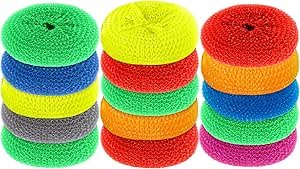
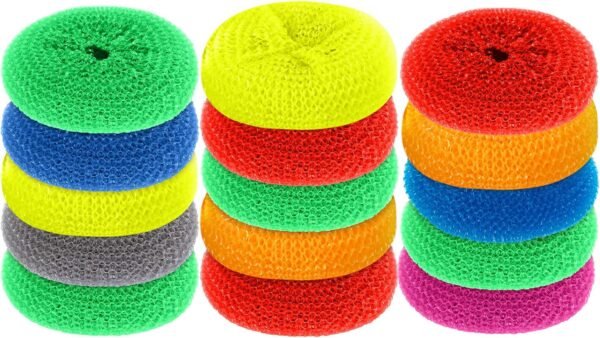
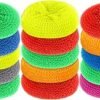
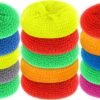
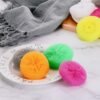
Blulu sells these as 15 round plastic dish scrubbers in assorted colors, woven from mesh rather than moulded as foam, with a hole through the center. They are the kind of thing that looks like an afterthought in a kitchen drawer and turns out to be the most used item in it, because a mesh disc does one job well: it scrubs baked and dried food off hard cookware without the sponge holding onto the mess afterward.
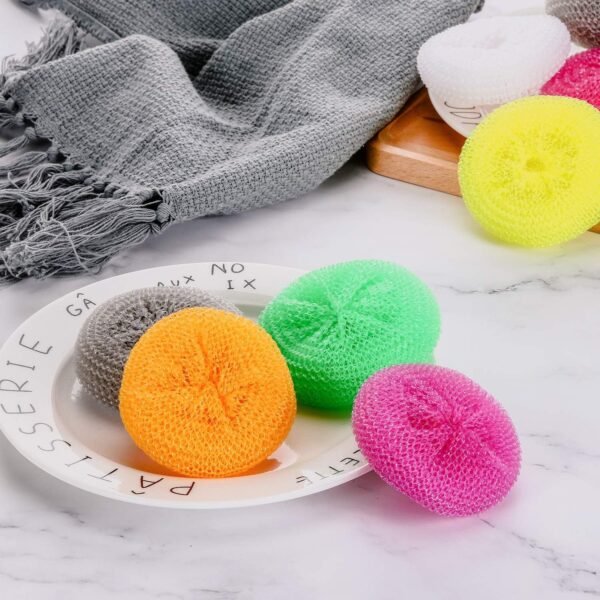
The center hole is a deliberate design feature rather than decoration. Blulu says it lets you fit the disc onto cleaning handles of various styles, which turns a hand held pad into a long handled scrubber for a deep pot or an oven tray. It also gives you somewhere to hang the disc, which matters more than it sounds: a scrubber hung up dries in an hour, and a scrubber left flat in a wet sink does not.
Material, and a contradiction in the listing
The listing states the pads are made of polypropylene, and describes them as flexible, soft and tightly woven so they do not tear or fall apart. The product title, however, calls them a round nylon pad. Polypropylene and nylon are different polymers with different hardness, different heat tolerance and different water absorption, and the listing never resolves which one you are buying. That is worth naming rather than smoothing over, because the answer affects how they behave near heat.
Why a mesh scrubber outlasts a sponge
The practical difference between a woven mesh disc and a cellulose or foam sponge is water retention. A sponge is built to hold liquid, and a sponge left damp in a sink stays damp for a very long time, which is what produces the sour smell every household knows. A mesh scrubber holds almost no water in its structure, so it drains and dries quickly, and it does not develop that odor in the same way. It also releases trapped food when rinsed instead of packing it into a foam matrix. Against that, a mesh disc holds no soap and gives you no soft face for a wine glass, which is why most kitchens end up with a mesh scrubber, a soft cloth and a brush such as the Full Circle bamboo dish brush for bottles.
What it is safe on, and where non scratch has limits
Blulu says the pads are flexible and soft and will not leave scratches on pots and pans even when you scrub hard, and offers them for tableware, pots, plates, bowls, kitchen extractor hoods, sinks, ovens and refrigerators.
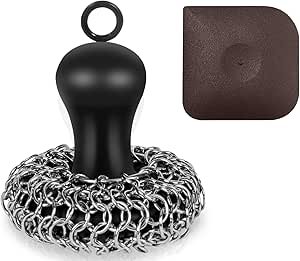
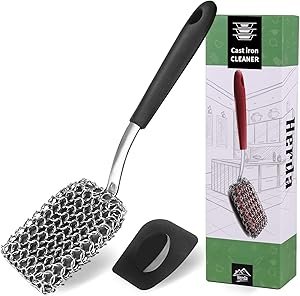
Non scratch is a relative term in this category, not an absolute one, and the honest reading is that a plastic mesh is far gentler than steel wool but is still an abrasive. Treat the following as test first surfaces regardless of the claim: nonstick coated pans, where any abrasive shortens the life of the coating and the pan maker’s guidance always wins; anodized aluminum; brushed and mirror polished stainless, where fine scratches show; glass cooktops; acrylic sinks; and anything with a printed or glazed decoration. Enameled cast iron is another case for caution. Where you actually want abrasion, on seasoned cast iron for example, a purpose made tool such as the Herda chainmail scrubber is built for it, and for genuinely burnt on residue a steel product like the Brillo steel wool pads does the work faster while doing exactly the damage the mesh avoids.
One more compatibility note the listing does not give. Keep plastic scrubbers away from hot surfaces. A polypropylene disc left on a warm hob or used on a pan straight off the heat will deform or melt, and melted plastic on cookware is much harder to remove than the food you were scrubbing.
Using them, cleaning them and replacing them
Use them with dish soap rather than dry, since mesh carries very little detergent by itself, and let the soap do the chemistry while the mesh supplies the mechanical action. Rinse the disc under running water while flexing it to release trapped particles, then hang it to dry rather than leaving it in the sink or under a soap bar.
No care instructions are published in this listing at all: no dishwasher guidance, no maximum temperature and no replacement interval. As a general rule for plastic mesh, a top rack dishwasher cycle is a reasonable way to clean one, hot water and soap works as well, and boiling is unnecessary. Replace a disc when the weave has opened up or when it stops rinsing clean, and with 15 in the pack there is no reason to keep a tired one in service.
Two safety points. Do not use these with any household chemical the manufacturer has not named, and never soak a scrubber in a mixture of cleaners. In particular, do not combine a bleach product with an acidic descaler or an ammonia cleaner in a sink where a scrubber is sitting; the reaction is between the products, not the pad, but a sink is exactly where that mistake happens. And keep the pack away from small children, since colorful discs are attractive and the hole through the middle does not make them a toy.
Cost, and where they sit against the alternatives
Fifteen pieces is a supply that lasts most kitchens a year or more, and cost per disc in this format is negligible, which is the main argument for buying them by the bag. The comparison worth making is against a multipack sponge: sponges cost about the same per unit and are replaced far more often because of odor, so a mesh scrubber usually works out cheaper over a year despite doing a narrower job.
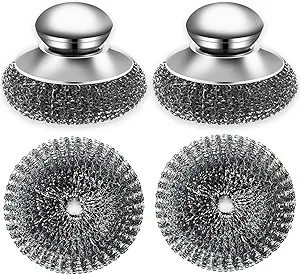
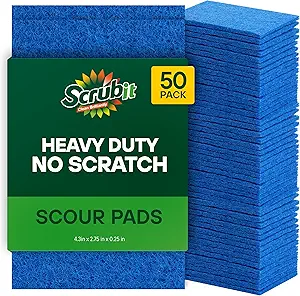
Within the category, the ScrubIt scouring pads cover the same territory in a rectangular format, and stainless options such as the YZRIZX stainless steel wool scrubbers are the aggressive end of the same shelf. Everything comparable is under dish scouring pads, and the detergents that do the chemical half of the job are in dish soap.
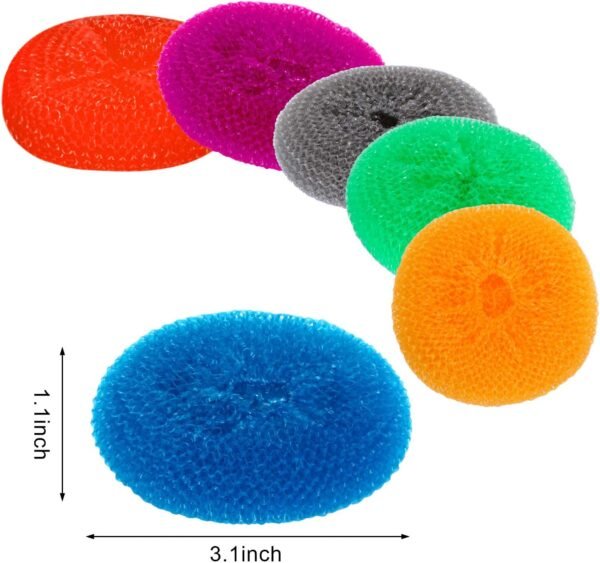
Contradictions in the record: the bullets give the diameter as about 3.1 inches while the product dimensions field reads 2.36 by 2.36 by 0.79 inches, so the listing states two different sizes. The weight of 0.32 ounces appears to describe one disc rather than the pack of fifteen. The material is given as nylon in the title and polypropylene in the bullets. And no dishwasher, temperature or replacement guidance is given anywhere. The item currently ranks 23rd in the retailer’s dish scouring pads chart and has been listed since 2021.
Who should buy this bag
Buy it if you want a large supply of quick drying mesh scrubbers for everyday cookware, and you like the option of fitting them to a handle for deep pots. Skip it if your cookware is nonstick, if you need something soft enough for glassware, or if the job is genuinely burnt on carbon, where a steel or chainmail tool works and a plastic mesh will not.