

Description
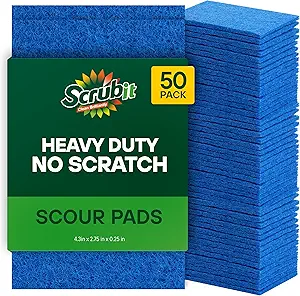
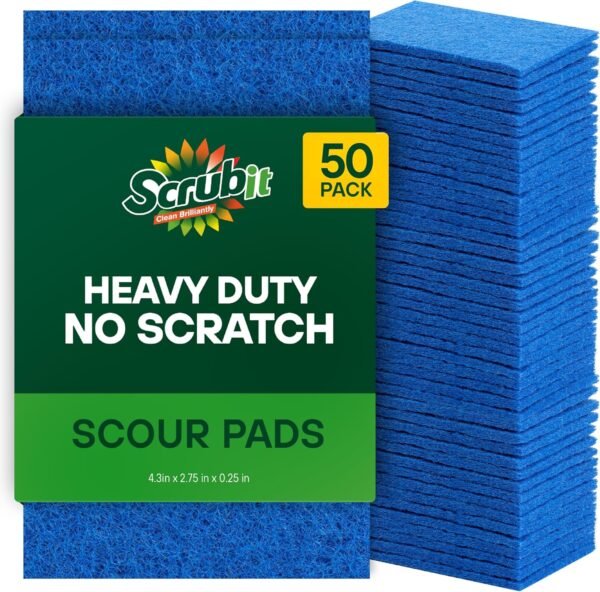
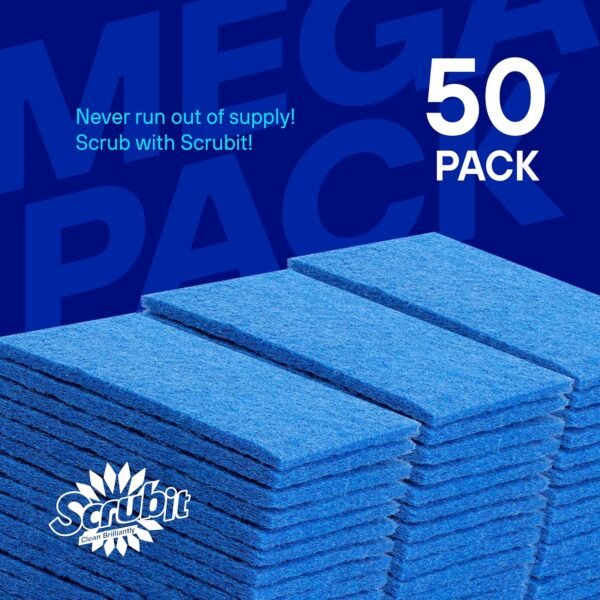
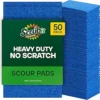
The SCRUBIT scouring pad set is a fifty pack of blue synthetic pads, listed at seven and a half ounces for the whole package and recommended by the manufacturer for stainless steel and dishes. Buying scouring pads fifty at a time changes how you use them, and that is the most useful thing to understand before ordering: a pad you paid almost nothing for gets thrown away when it is dirty, which is exactly what a kitchen sponge should be but rarely is.
The kitchen job these pads are meant for
A scouring pad is a mechanical cleaner. There is no chemistry in it. It works by dragging an abrasive surface across baked residue until the residue gives up, and its performance is a function of how stiff the fibers are and how much pressure your hand can apply. That makes it the right tool for cooked on food in a pan, dried sauce on a plate that has sat overnight, and the ring around a stainless steel sink, and the wrong tool for anything you would rather polish than sand.
The fifty pack format is aimed at a household that goes through pads and does not want to keep buying them, or at a small commercial kitchen where the pad by the sink is replaced constantly rather than nursed along. That volume is only an advantage if you actually discard pads. A single pad kept in service for a month is a damp fiber pad holding food residue, which is the situation the bulk pack lets you avoid.
What the pad is made of, and where the description overreaches
The listing describes the pads as made from premium quality resilient synthetic fibers and states that they never rust, unravel, fall apart or tear. No fiber type, no abrasive mineral, no bonding resin and no density rating appears anywhere on the page. That is a thin specification for an abrasive product, because the grade of abrasive is the whole difference between a pad that cleans a pan and a pad that ruins it. The manufacturer also states that the pads guarantee years of continuous use, which is a durability claim from SCRUBIT with nothing behind it on the page and which sits oddly against a fifty pack sold as a consumable.
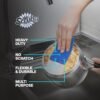
The special feature field lists the pad as abrasive, flexible, heavy duty and non scratch in the same line. Abrasive and non scratch are not opposites in industry terms, since a pad can be abrasive enough to remove soil while being soft enough to leave no visible mark on a hard surface, but the listing never explains which surfaces the non scratch description was tested against. Treat it as a claim about typical dishware rather than a guarantee about your particular cookware.
The anti grease claim, unexplained
SCRUBIT states that an anti grease technology keeps the pads clean and fresh with no lingering odor. The page gives no mechanism, no treatment name and no ingredient for this, and it is worth being clear that a pad which stays odor free is usually one that dries quickly rather than one carrying an additive. If an antimicrobial treatment were present it would normally have to be identified, and no such identification appears here. Rinse pads properly and let them dry standing up, because that habit does more for odor than any claim on a package.
Surfaces this belongs on, and the ones it does not
The manufacturer names stainless steel and dishes. In practice that covers stainless pans, ceramic and glass dishware, glazed tile, sinks and enameled steel where the enamel is intact. Those surfaces are hard enough that a synthetic pad removes soil without leaving a visible pattern, provided the pad is kept flat and moving rather than ground in one spot.
Keep the pads off nonstick coatings, anodized aluminum, glass cooktops, acrylic tubs, plated or coated faucets, and anything with a printed pattern or a polished mirror finish. On those, an abrasive pad leaves fine scratches that are invisible on day one and obvious after a month, and the damage is permanent. Cast iron is a separate case: a pad can be used on bare cast iron to clear residue, but doing so removes seasoning that then has to be rebuilt, so a chainmail scrubber is usually the better tool. Our review of the Herda chainmail scrubber covers that case.
Using them well, and keeping them sanitary
Two habits get the most out of an abrasive pad. First, let hot water and dish soap do the softening before the pad touches the pan, because five minutes of soaking removes more baked residue than five minutes of scrubbing and costs no effort. Second, work with the flat of the pad and moderate pressure rather than a corner and full force, since concentrated pressure is what turns cleaning into scoring.
Hygiene is where the fifty pack earns itself. Rinse the pad after every use, squeeze it out, and stand it somewhere with airflow rather than leaving it in a puddle in the sink. Then throw it away far sooner than instinct suggests. A pad is a consumable, and at fifty in a pack the cost of replacing one weekly is trivial next to the cost of scrubbing a clean plate with a dirty pad. Keep separate pads for dishes, for the sink and for the bathroom, and never let one cross between them.
One chemical point is worth stating even though the pad itself is inert. If you use a pad with a bleach based cleaner, rinse it thoroughly before using it again with anything else, and never soak pads in a mixture of two cleaning products. Combining bleach with an acidic or ammonia based cleaner produces toxic gas, and a sink is exactly where that mistake happens. One product in the water at a time.
What fifty pads cost you, and the alternatives
The cost structure of a bulk pad pack is the simplest in the cleaning aisle: it is fixed at purchase, there is nothing to dose and nothing to waste, and the only variable is how quickly you replace pads. The saving over buying two at a time is real, and the storage requirement is modest since the pack is flat. Set against that, fifty pads of one grade means you are committed to one abrasiveness level for a long time, so a household with delicate cookware may prefer smaller packs of two different grades.
For a different mechanical approach, our reviews of the Blulu plastic dish scouring pads and the Yzrizx stainless steel wool scrubbers cover stiffer options for heavier residue, while the Brillo steel wool scrub pads carry soap in the pad itself. The full dish scouring pads category lays the grades out side by side.
Remember that a pad is only half the system. The detergent doing the chemical work matters as much as the abrasive doing the mechanical work, and a good dish soap reduces how hard you have to scrub, which is what protects your pans. The dish soap category covers that side of the sink.
Who should buy it, who should not
Buy the fifty pack if you cook often, wash by hand, use stainless and ceramic rather than nonstick, and want the freedom to throw a pad away without thinking about it. Skip it if most of your cookware is coated, if you need a specific abrasive grade for a delicate finish, or if you would rather buy two grades in smaller quantities. The listing is honest about what the pads are for and vague about what they are made of, and that is the tradeoff you are accepting.