

Description
A cleaning wax, not an all purpose cleaner
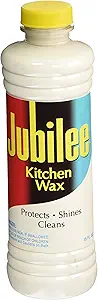
Jubilee Kitchen Wax is sold by Malco Products as a fifteen fluid ounce bottle under model number TV182620. The name tells you most of what you need: it is a wax, and the job it is bought for is leaving a thin protective film on hard kitchen surfaces after cleaning them. It is filed on this site under All-Purpose Cleaners and Amazon ranks it four hundred and seventy first in All-Purpose Household Cleaners, but a wax and an all purpose cleaner are different tools. An all purpose cleaner is meant to lift soil and be rinsed or wiped away. A wax is meant to stay behind.
That difference decides who should buy it. Households that like the look of a satin sheen on cabinet fronts, appliance panels, laminate counters and painted woodwork are the audience. Households looking for a general degreaser to spray on a stovetop before dinner are not, and buying this as a substitute for a cleaner will end in a surface that looks smeared rather than clean.
Jubilee is an old product. The listing shows it first available on Amazon in April 2013 and it has been sold in various forms for far longer, which is worth knowing because much of the enthusiasm attached to it online is about a formulation history that this listing does not document.
What is in it, and why nobody can tell you from this page
Here is the blunt version: this listing publishes no ingredient information at all. The description field simply repeats the product name. There is no wax type named, no solvent named, no silicone declared, no concentration given, and no safety data sheet linked. Any claim you read elsewhere about what Jubilee contains did not come from here, and this review will not invent one.
What can be said generally is that a cleaning wax of this type works by combining a mild cleaning component with a wax or polymer that dries to a thin film. The film fills microscopic scratches, so light scuffs become less visible, and it gives a surface a low gloss that resists fingerprints for a while. It also builds up. Each application adds material, and if the surface is not stripped occasionally, the film eventually looks cloudy or yellow. That is the normal life cycle of any wax finish and it is the main reason people either love a product like this or give up on it.
The feature bullets are packaging data, not product data
The bullet list on this listing consists of “Package dimensions 7.6cm L x 7.6cm W x 20.3cm H”, “Country of origin China”, “Package weight 1.0 pounds” and “Product type TOOLS”. None of that describes the product. The specification block separately gives product dimensions of 2.69 by 2.69 by 8 inches and a weight of fifteen ounces, so the same package is described once in centimeters and once in inches, and the weight is given once as one pound and once as fifteen ounces. The product type is listed as TOOLS for a bottle of liquid wax, and the department field reads Unisex-Adult, which is apparel metadata that has no meaning here. This is a listing assembled by an import feed rather than written by anyone who handled the item.
Surfaces it suits, and surfaces to keep it off
A cleaning wax of this kind is aimed at sealed, non porous, non food contact surfaces: cabinet doors, appliance fronts, laminate and sealed counters, painted trim, and vinyl or metal fixtures. Because the listing gives no compatibility guidance at all, treat every surface as untested and try a hidden corner first.
Three exclusions are worth stating plainly even though the listing does not. Do not use a wax on a floor. A wax film on a kitchen floor is a genuine slip hazard, and floors want a product formulated for the purpose such as those in the floor cleaner listings. Do not use it on any surface that gets hot, including cooktops, oven doors in use, or the area immediately around a burner, because wax films smoke and discolor with heat. And do not use it on a surface that will later be painted, glued or refinished, because wax residue is one of the classic causes of paint and finish failure. If you plan to refinish woodwork, use a wood specific product like the Howard Products wood polish or the Cargen beeswax furniture polish only where you understand what is already on the surface.
Natural stone deserves a separate warning. Sealed granite, marble and quartz have their own care requirements and a wax can trap haze in the pores or interfere with an existing sealer. For stone, a stone specific product such as the Bar Keepers Friend stone cleaner is the safer route.
Using it correctly and storing it safely
The method with any cleaning wax is the same. Clean the surface first and let it dry, because wax over grease traps the grease. Shake the bottle. Apply a small amount to a soft cloth rather than pouring it onto the surface. Work a section at a time. Let it haze, then buff with a second clean dry cloth until no drag remains. Too much product is the usual mistake and it shows up as streaks that reappear every time light hits the surface.
On safety, this listing carries no hazard statement, no first aid guidance and no ingredient list, which means the printed label on the bottle is your only source. Read it before opening. Until you have, treat the product as you would any solvent bearing household chemical: work in a ventilated room, keep it away from open flame and hot surfaces, avoid skin and eye contact, and wash your hands afterward. Store it upright, capped, out of reach of children and away from heat. Do not decant it into an unlabeled container, and do not mix it with any other cleaning product, either in a bottle or on a surface. Combining household chemicals is how avoidable poisonings happen, and it is never necessary.
Buffing cloths that hold solvent bearing wax should be spread flat to dry rather than balled up in a bin, as a general precaution with any oil or solvent soaked textile.
What it costs to run, and what else to consider
Fifteen fluid ounces applied thinly with a cloth is a lot of surface area, so the consumable cost per use is low and the real cost is time. Waxing is a slow, manual, two cloth job. Compare that with a spray and wipe cleaner, which is faster per session but leaves nothing behind and has to be repeated as often as the surface gets dirty. Which is cheaper depends entirely on whether you want the film.
If protection is the goal but the surface is wood, look at the dedicated wood polish listings instead. If the goal is simply a clean, non greasy kitchen surface with nothing left behind, a general cleaner such as the Zep multi purpose cleaner concentrate costs less per wipe and involves no buildup to manage later.
Who this is for and who should skip it
Buy it if you specifically want a wax film on kitchen cabinetry, appliance panels or painted trim, you accept the buffing labor, and you understand that the finish needs stripping and redoing rather than endless topping up.
Skip it if you want a cleaner rather than a coating, if the surface is a floor, a cooktop or unsealed stone, or if anything in the room is due to be repainted or refinished. Skip it too if you need to know what you are putting on a kitchen surface before you buy, because this listing will not tell you.