

Description
What the product is, and the household it targets
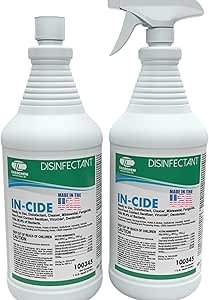
Purefypro Sports Equipment Disinfectant Spray is sold as two 16 ounce bottles aimed at gym and sports gear: sports pads, yoga mats, shoes, boxing gloves and general gym equipment. That is a genuine gap in most cleaning cupboards. Shared and worn equipment holds sweat, and the surfaces involved are exactly the ones that a strong disinfectant tends to damage: closed cell foam, rubber matting, leather and synthetic padding, and the inside of footwear.
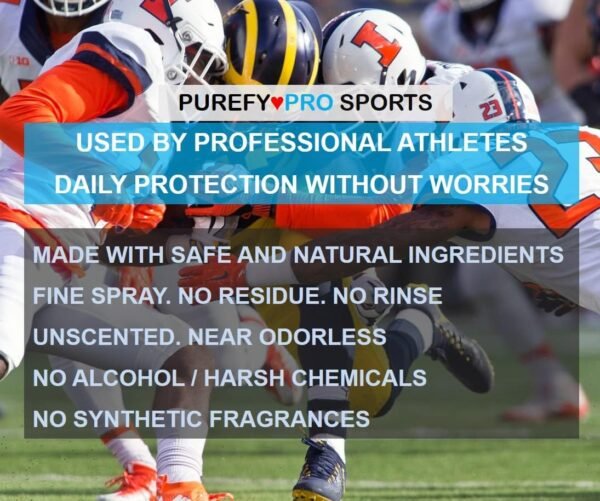
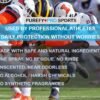
Purefy addresses that directly, describing the product as noncorrosive, pH balanced and safe for sensitive materials such as rubber gym mats, free of alcohol, synthetic fragrance and volatile organic compounds, and leaving no harsh chemical residue because it turns into water. Those are the manufacturer’s own statements, and the material compatibility part is the reason someone would choose this over a general disinfectant.
The claims on this listing need reading with care
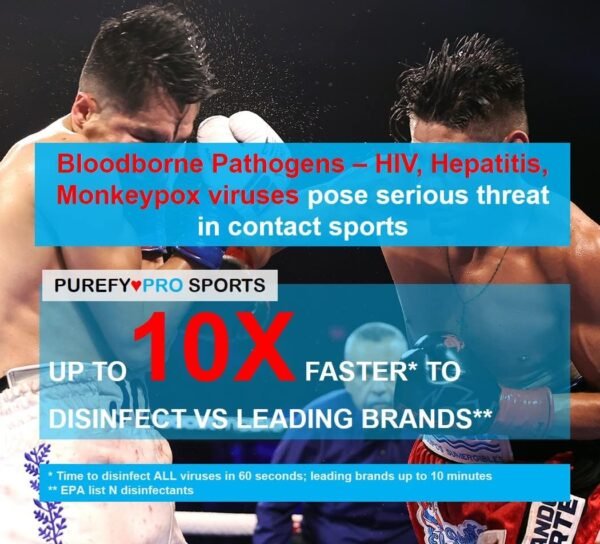
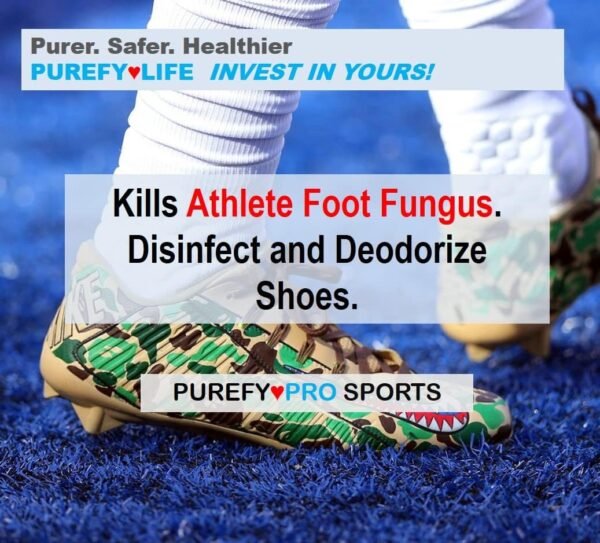
This listing carries the most aggressive claim set in this part of the catalog, and we are going to lay it out plainly rather than repeat it as fact. Purefy states in the product title that the spray kills 99.9999 percent of MRSA, HIV, athlete’s foot fungus, virus and fungi. The feature bullets add that it kills drug resistant MRSA and VRE, kills norovirus, HIV, influenza and hepatitis in as short as 60 seconds, prevents the growth of mold and mildew, and eliminates odors and allergens. A further bullet states that the product is recommended by doctors for sensitive populations including people with allergic asthma, atopic dermatitis and immunodeficiency, and another states that it is proven by hospitals, senior care and childcare facilities.
What is missing behind those claims
Every one of those statements is a manufacturer claim, none of them is ours, and none of them can be verified from this page. In the United States, a product claiming to kill named organisms on surfaces is regulated as an antimicrobial pesticide by the Environmental Protection Agency, and the specific organisms it may name are fixed by a registered label carrying a registration number and organism specific efficacy data. This listing publishes no registration number.
It also publishes no active ingredient. Nothing on the page says what does the killing. The phrase about turning into water narrows the possibilities but does not identify anything, and we will not guess at a chemistry on a product making claims of this weight. The claim of a doctor recommendation for immunodeficient users is a health claim with no named source, no study and no organization behind it, and it is the kind of statement a reader should treat with more skepticism than the product’s material compatibility claims, not less. One bullet lists norovirus twice, which is a small sign of how carefully the copy was assembled.
The one genuinely useful number is the contact time. Purefy states 60 seconds. If you use this product, that is the figure to work to: the surface must stay visibly wet for the stated time, and the printed label may specify different times for different claims. Check it.
Materials, and what to test
The material compatibility claims are the practical reason to consider this. Rubber gym matting, foam padding, neoprene and synthetic leather all degrade under alcohol based sanitizers and under bleach, going hard, tacky or crazed over repeated use, and a noncorrosive pH balanced product that leaves no residue is a sensible thing to want for them.
Test anyway. Apply to a hidden corner of a mat, the inside of a glove cuff or the underside of a pad, let it dry fully, and check for color change, stickiness or a change in surface feel. Do this even where the manufacturer names the material, because gym equipment is made from an enormous range of coated synthetics and no listing can cover all of them.
Two practical restrictions. Do not spray it into the electronics of a machine, a heart rate grip or a console: the treatment is for surfaces, and liquid in a control panel is a repair. And do not treat this as a substitute for washing. Sweat soaked fabric wraps, shirts and socks belong in a machine, and a surface disinfectant sprayed onto saturated fabric does neither job well. For hands and wipe down between sets, a wipe format such as the Wipex gym wipe is the more practical tool and produces no overspray.
Using it, ventilating and storing it
Clean visible soil off first. Every disinfectant works better on a clean surface, and a spray applied over dried sweat or dirt is spending its activity on the soil rather than on the surface. Then apply enough to wet the surface properly, leave it for the stated contact time, and let it air dry unless the label says to wipe.
Ventilate the space. A product described as free of volatile organic compounds still becomes an inhalable aerosol when sprayed, and gyms and home workout rooms are frequently small and poorly ventilated. Avoid spraying toward the face, keep it out of eyes, and keep it away from anyone with a respiratory condition during application, whatever the listing says about sensitive populations.
Never combine it with another cleaner. Do not spray it onto a mat still wet with a general purpose cleaner, do not follow it with bleach, and do not mix it into a bucket. The chemistry is undisclosed here, which makes any interaction unpredictable, and disinfectant chemistries in particular react badly with each other. Store the bottles capped, upright, out of direct sunlight and out of reach of children. Products that break down into water often break down on a shelf too, so check whether the label gives a shelf life or an expiry date and do not stockpile beyond it.
Cost, and the alternatives worth comparing
Two 16 ounce trigger bottles is a modest quantity for a home gym and a small quantity for a shared facility. The economics of a specialist disinfectant are poor if you use it as a general cleaner and reasonable if you confine it to the equipment it was bought for. The listing also carries a package weight of one pound for what should be two pounds of liquid across two 16 ounce bottles, so the recorded data is not internally consistent.
The alternatives worth setting beside it are the products that do state their chemistry. The Briotech hypochlorous acid spray and the Think Smarter hypochlorous acid cleaner name their active ingredient on the listing, which is exactly what this one does not do. The Vital Oxide all purpose cleaner is another option in the same space, and the Wipex isopropyl alcohol wipe takes the opposite approach with a named alcohol, which is effective but hard on rubber and foam. Compare across the disinfectant sprays and liquids category and the disinfectant wipes category.
Who should buy it, and who should not
Buy it if you need something for rubber mats, foam padding and sports gear that harsher chemistries damage, and you are prepared to work from the printed label. Skip it if you want to verify the organism claims before buying, because the registration number and the active ingredient are both absent from this page, and those are the two things that would let you check. Skip it too if you were reading the doctor recommendation and the hospital proven wording as evidence: neither is sourced, and neither should be the reason to choose a disinfectant for anyone with a health vulnerability. If those claims matter to you, buy a product whose registered label you can look up.