
Description
Small bags for a countertop caddy, and what compostable means
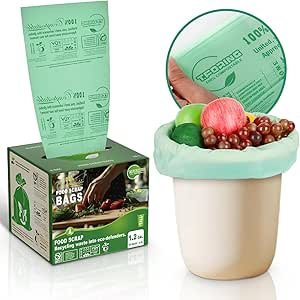
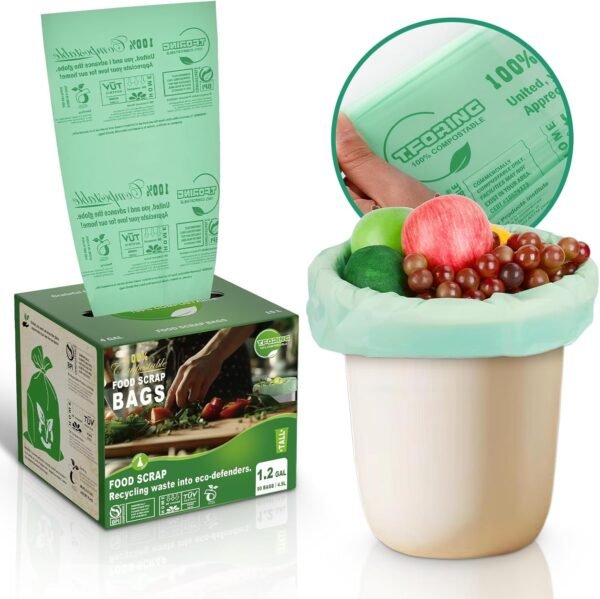
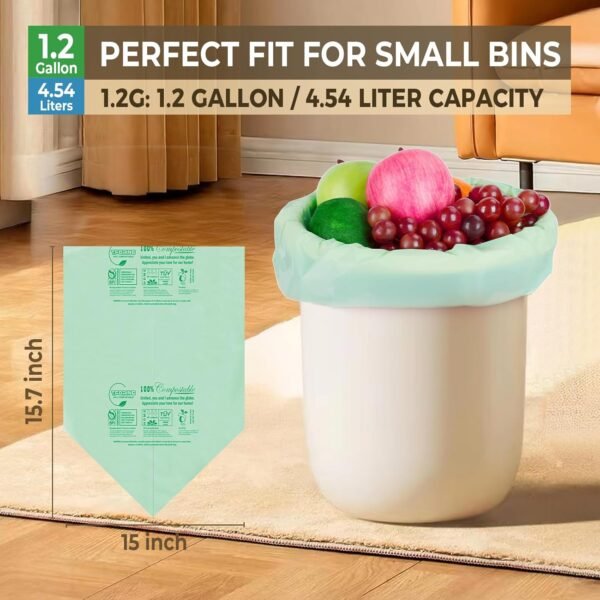
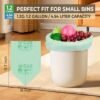
T.FORING sells these as 80 compostable bags on a roll, sized 1.2 gallons or 4.5 liters, measuring 15 inches wide by 15.7 inches high at 0.8 mil thickness. That size is not a general purpose bin liner. It is the caddy size: the small lidded container that sits on a kitchen counter or under the sink and collects peelings, coffee grounds, eggshells and plate scrapings between trips to a compost bin or a municipal food waste collection.
The material is the point. T.FORING states the bags are made from corn starch and plant based materials with no polyethylene, and that they break down into carbon dioxide, water and organic biomass over six to twelve months, leaving no plastic behind. A conventional plastic liner in a food waste stream is a contaminant that has to be removed at the facility, which is why compostable liners exist as a separate product from the ordinary small bags in our trash bags section.
The certifications, which are the most substantial part of this listing
This is one of the better documented items in the catalog, and the certifications are worth reading carefully because they are not interchangeable.
Industrial compostable and home compostable are different standards
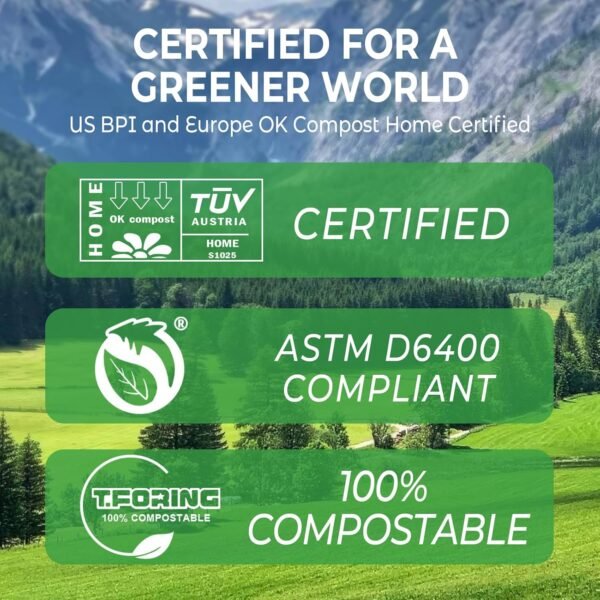
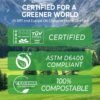
T.FORING states certification by the Biodegradable Products Institute under the United States standard ASTM D6400, which is the industrial composting standard: it assumes the sustained high temperatures of a commercial facility. Separately, the bags are stated as certified OK Compost Home under the European standard EN 13432 by Vinçotte and TUV Austria, which is the harder of the two to achieve, because a home compost heap never gets as hot or as consistently managed as an industrial windrow. Holding both is a meaningful claim. The listing adds approval from the Compost Manufacturing Alliance, which verifies real world disintegration through field testing rather than laboratory conditions.
What none of that guarantees is that your local program will accept them. Many municipal food waste collections specify paper liners or no liner at all, because facilities running short composting cycles cannot break down even certified bags in the time available and sorting staff cannot tell a certified bag from an ordinary one at a glance. Check your collection’s own rules before buying a roll, since a rejected bag contaminates a load regardless of what it is made from.
What to put in them, and the storage catch nobody mentions
Food scraps are the intended contents: vegetable peelings, fruit, coffee grounds and filters, tea, eggshells and plate waste. The listing also offers the bags for offices, bathrooms, bedrooms and baby diapers, which is where a caution belongs. A compostable bag used as a general trash liner ends up in landfill, where it will not compost in any useful way because landfills are anaerobic, and you will have paid a premium for nothing. Diapers are not compostable in any home or municipal system.
The practical limitation of starch based film is that it starts breaking down when it is wet and warm, which is exactly the condition inside a food caddy. Expect a bag to soften and weaken after a couple of days with wet scraps in it, and empty the caddy every two or three days rather than every week. A newspaper sheet in the bottom of the caddy absorbs liquid and extends the bag’s life considerably.
Storage matters more than for ordinary plastic. Keep the unused roll somewhere cool, dry and dark, and do not stockpile more than a few months’ supply, because compostable film degrades on the shelf in heat and humidity and a roll left in a warm garage will tear when you unroll it. At 0.8 mil these are thin to begin with, so they have less to give.
Handling, and the rules that go with any bag
Do not put these in plastic film recycling. A compostable bag in a plastic recycling stream is a contaminant in the same way a plastic bag is a contaminant in a compost stream, and the two materials cannot be processed together.
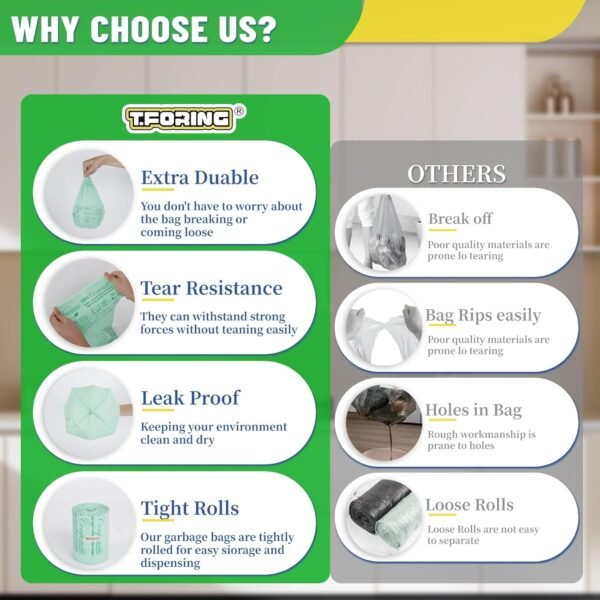
Never bag hot ashes, embers or cigarette ends in any bag, and less so in a thin starch film. Do not use these for liquids, for cooking oil, or for anything sharp, and do not expect the tensile strength claim in the bullets to translate into puncture resistance; those are different properties and the listing only claims the first.
Keep the roll away from infants and small children, since thin film is a suffocation hazard whatever it is made of. Store it separately from cleaning chemicals: a caddy bag that has absorbed a spill from a bottle of household cleaner is not compostable any more and should go in the trash, and the same applies to any bag that has held a chemical soaked cloth. Do not use a compost bag to dispose of leftover cleaning products of any kind.
Cost, and the honest comparison
Compostable bags cost several times what a conventional bag of the same size costs, and 80 bags at caddy size is roughly six months for a household emptying twice a week. The premium buys a material that leaves the food waste stream clean, and it is only worth paying if the contents are actually going to a compost heap or an accepting collection. If they are going to landfill, the cheaper bag is the honest choice and the environmental claim is moot.
Within this catalog, the direct alternatives are the Raytid compostable trash bags and the Ayotee small compost bags, both in compost bags. If what you actually need is a small conventional liner for general waste, the VOK 4 gallon drawstring bags or the Daoneg trash bags cost far less, and for outdoor volumes the Tasker 55 gallon bags are the other end of the range.
Two record problems. The third bullet refers to “T.FORING 2.6 gallon trash bags” decomposing fully, while the product being sold is the 1.2 gallon size; that sentence was carried over from the larger listing. The specification block is completely empty for this item, so there is no manufacturer field, no package weight, no dimensions and no listing date, and the only technical data comes from the bullets and the title. The listing also describes the bags as nontoxic and great for the environment without qualification, which is looser language than the specific certifications it holds actually warrant.
Who should buy this roll
Buy it if you compost at home or your municipal program accepts certified compostable liners, and you want a caddy sized bag holding both industrial and home compostable certifications. Skip it if the bag will end up in landfill, if your collection requires paper or no liner, or if you need a bag that will sit full for a week, because starch film weakens once it is wet.