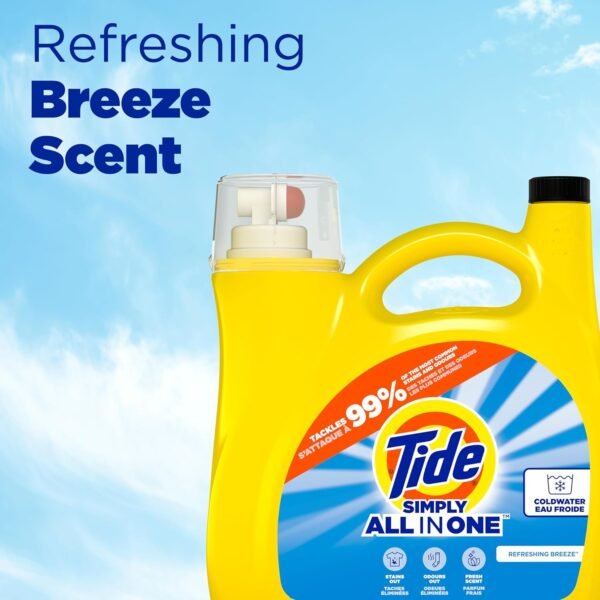


Description
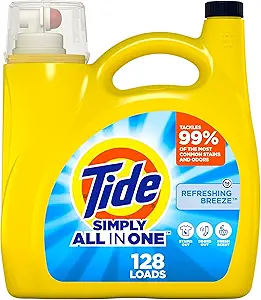
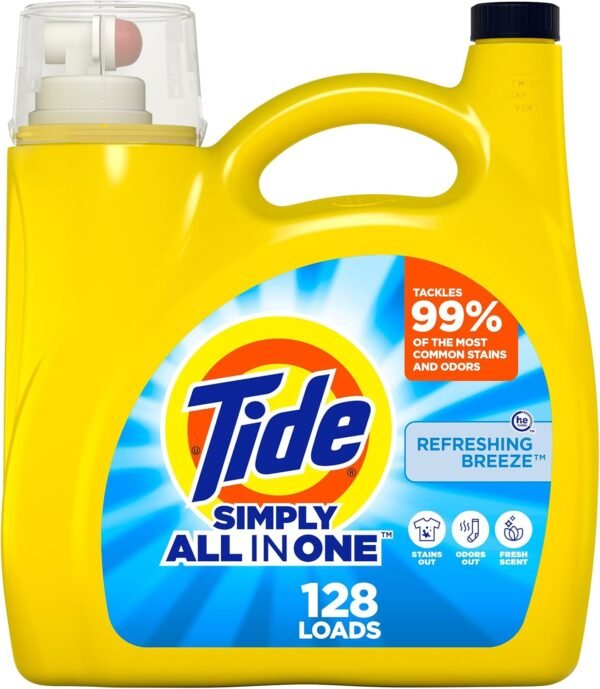
Tide Simply Liquid Laundry Detergent in Refreshing Breeze arrives as a 168 ounce bottle rated by Procter and Gamble at 128 loads. That pairing is the number to hold on to, because it sets the dose at roughly one and a third ounces per load, which is a small pour from a large bottle. Everything else about this product follows from the fact that it is the value tier of a well known detergent line rather than the concentrated one.
The laundry this detergent is built for
Tide Simply is positioned as an everyday detergent for ordinary soil: worn once clothing, bedding, towels, school uniforms, the loads that are dirty rather than damaged. Procter and Gamble describes it as tough on stains and odors while being easy on the wallet, and the honest reading of that sentence is that it is the lower priced line in the range and is not the same formulation as the premium bottles above it. For a household running several loads a week of unremarkable laundry, that is often the correct choice, because the extra performance of a premium formula only shows on the loads that need it.
What is in it, and how much the listing actually says
The listing publishes no ingredient statement, no surfactant, no enzyme and no builder. The specification block contains package dimensions, a shipping weight of ten and a half pounds, a model number, a first availability date of December 2023, the manufacturer name, and ranking data placing it 12th among liquid laundry detergents. That is the whole of the technical content. Procter and Gamble publishes ingredient information for its detergents through its own channels and on the bottle, and that is where to look, because this page does not carry it.
The central performance claim on the page is that the detergent tackles 99 percent of common stains and odors. That is Procter and Gamble’s claim, repeated in four of the five feature bullets and in the description. It is worth reading carefully: common stains is the manufacturer’s own category, not a defined list, and the figure is not tied on this page to any test method, soil type or wash condition. Treat it as marketing language from the brand rather than as a measured result you can plan a wash around.
Where the value tier normally differs
Detergent lines are usually tiered by how much active material sits in each ounce and by how many enzyme types are included. The listing does not state which of those levers has been pulled here, and this review will not guess at an enzyme count or a surfactant percentage that Procter and Gamble has not published. What the listing does give you is the ratio of volume to loads, and 168 ounces across 128 loads is a useful signal on its own: a heavily concentrated detergent delivers many more loads per ounce than this. That is not a criticism, it is a description of the tier.
Machines, water and fabrics
The listing states the detergent is suitable for all washing machines and works in all water conditions including cold water. Cold water compatibility is the more meaningful half of that sentence, because cold washing saves the energy used to heat water and most of the energy a washing machine consumes goes on heating. A detergent that performs acceptably at low temperature is what makes that saving available, and Procter and Gamble states this one does.
High efficiency machines deserve a note. Suitable for all machines covers front loaders and high efficiency top loaders, where excess suds are the failure mode: too much detergent produces foam that cushions the tumbling action, and the machine then runs extra rinses to clear it. The remedy is never more detergent. Measure to the cap marking, and if you see suds still present at the end of a cycle, reduce the dose rather than adding a rinse.
On fabrics, an everyday liquid handles cottons, synthetics and blends. The listing makes no claim about wool, silk or anything requiring a specialist wash, and it makes no dye safety statement, so a colored garment you care about deserves the usual caution of not pouring detergent directly onto the fabric. Pour into the dispenser or into the water, not onto clothes, because concentrated detergent sitting on a dyed fiber is the common cause of a pale patch that appears after drying. The listing also makes no fragrance free claim: Refreshing Breeze is a scented product, and households avoiding fragrance need a different variant.
Dosing, storage and safety
The dose is the part that decides both cost and result. At 128 loads from 168 ounces the intended pour is small, and the cap is marked for it. Overdosing wastes detergent, leaves residue in fabric that can feel stiff, and in a high efficiency machine causes the suds problem described above. Underdosing on a heavily soiled or very full load produces gray results over time. Load size and soil level are the two variables, and the cap marking is the reference point. Store the bottle closed and upright at room temperature, out of direct sun, and out of reach of children as with any household chemical.
One safety rule applies to every laundry product without exception: do not combine it with chlorine bleach in the same measured pour, and do not mix detergents with other cleaning chemicals in a bucket. Bleach belongs in the machine’s bleach dispenser or added to the water separately, following the bleach label, and never poured onto detergent. Ordinary detergent is a low hazard product, but the general rule of one product at a time in the water avoids every version of this problem.
Cost per load, and the alternatives
The right way to compare detergents is cost per load rather than cost per bottle, and the load count on the label is the number that makes that comparison possible. A 168 ounce bottle rated at 128 loads only delivers 128 loads if the dose is measured, which is why the cap discipline above is also a cost control. A household that pours generously turns a 128 load bottle into an 80 load bottle without noticing.
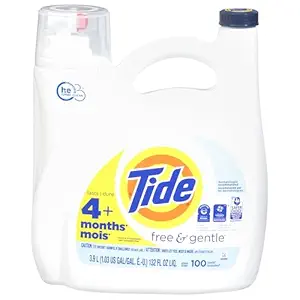
Within liquids, the comparison worth making is between value and specialist tiers. Our review of the Tide Free and Gentle laundry detergent covers the option for households avoiding dyes and fragrance, and the Purex liquid detergent sits in the same value part of the shelf for a direct comparison. The full liquid detergent category lists the bottles side by side.
If measuring is the part you would rather avoid, a dosed format removes the decision. Our write up of Tide Pods laundry detergent covers that route, with the important caveat that pacs must be stored out of reach of children and handled only with dry hands. Powder remains a strong option in hard water, and the Gain lavender powder detergent is a useful comparison there, with more of the format explained in the powder detergent category.
Who should buy it, who should not
Buy the large bottle if you run frequent ordinary loads, wash cold, and want one detergent that covers most of the laundry without further thought. Skip it if you need a fragrance free product, if you want published ingredient detail before buying, or if you wash rarely enough that a 168 ounce bottle would sit unused for a year. Anyone buying on the strength of the 99 percent claim should note that the figure is the manufacturer’s own and is not tied to a stated test method anywhere on this page.