


Description
What a CR2016 is for, and why the pack size matters
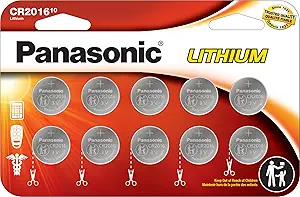
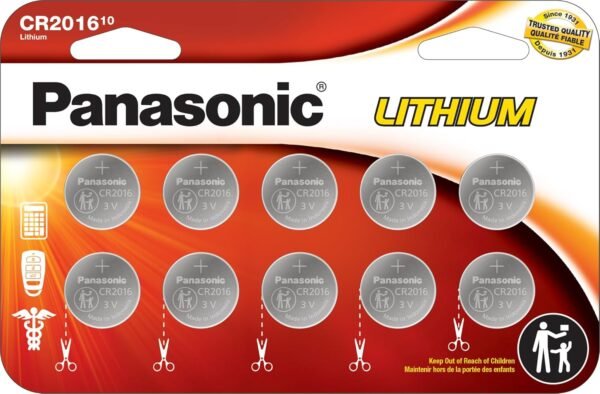
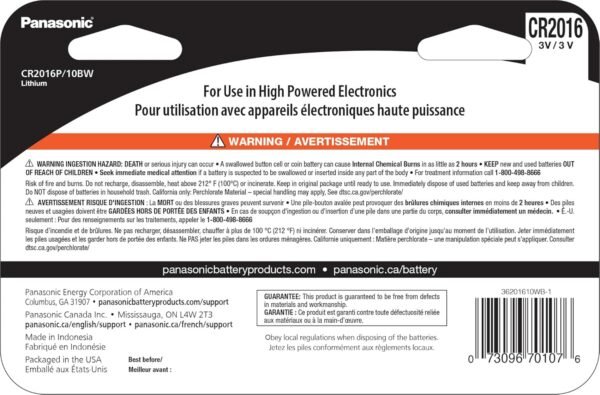
The CR2016 is a lithium coin cell measuring 20 millimeters across and 1.6 millimeters thick, and the number is the size. The listing gives the physical dimensions as 0.78 by 0.78 by 0.06 inches and a weight of 0.06 ounces per cell, and specifies a nominal 3.0 volts. Panasonic sells this one in a ten cell pack under model number CR2016P/10BW.
Panasonic names the devices it expects these to go into: car key fobs, watches, calculators, garage door openers, toys, LED lights, games, MP3 players, digital voice recorders, remotes, door chimes, sporting goods, calorie counters, stopwatches and glucometers. That is a wide list, and it points at the household this pack fits. A single coin cell purchase makes sense when one device has died. A ten pack makes sense when you have accepted that a house contains a dozen of these and you would rather find one in a drawer than order again. Panasonic states a storage life of up to eight years when unused and properly stored, which is what makes buying ahead reasonable.
Check the number stamped on the old cell before ordering. A CR2016 is not interchangeable with a CR2025 or a CR2032 even though all three are 20 millimeters wide, because they differ in thickness and therefore in capacity and in fit. If your device takes the thicker cells, the LiCB CR2025 covers that size, and the smaller PGSONIC CR1220 covers a common watch fitment.
The chemistry and the standards Panasonic cites
This is a lithium manganese dioxide primary cell, which is a single use chemistry rather than a rechargeable one. Panasonic attributes the performance to proprietary sealing technologies covering both structure and materials, and states that the cells are reliable across an operating range of 14 degrees Fahrenheit to 140 degrees Fahrenheit. The cells are made in Panasonic’s Indonesia factory and packaged in the company’s United States facility.
Standards compliance is the substantive part of this listing
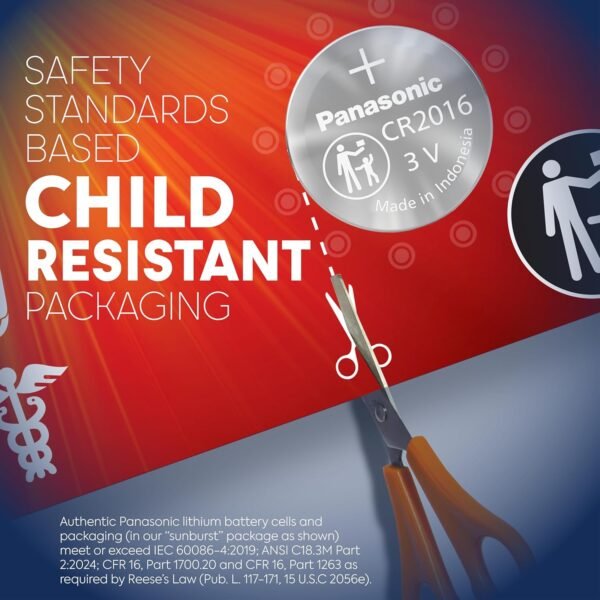
Panasonic states that the cells and packaging meet or exceed IEC 60086-4:2019, ANSI C18.3M Part 2:2024, CFR 16 Part 1700.20 and CFR 16 Part 1263. The product description separately names IEC 60086-4, ANSI C18.3M Part 2 and UL 1642, so the two passages on the page do not list an identical set of standards, which is worth noting rather than smoothing over. IEC 60086-4 is the safety standard for lithium primary cells. CFR 16 Part 1700.20 is the child resistant packaging test procedure. CFR 16 Part 1263 is the coin cell battery packaging and warning rule.
Panasonic explicitly ties that packaging compliance to Reese’s Law, citing Public Law 117-171 and 15 U.S.C. 2056e. That is a real United States statute enacted after a series of child injuries and deaths caused by swallowed button cells, and it requires child resistant packaging and specific warnings on these products. A listing that names the statute it complies with is giving a buyer something checkable, which is rare in this catalog.
Devices, fit and what to keep the cells away from
Physical fit is the whole compatibility question with a coin cell. The cell must match the device on diameter and thickness, and the holder must make contact on both faces. Do not stack a thinner cell with a spacer, and do not force a thicker one into a shallow holder, because a deformed cell can vent.
The critical safety point on a coin cell is not the device at all. A swallowed lithium coin cell can cause severe internal injury within hours through an electrical reaction with body tissue, and this is the hazard Reese’s Law was written to address. Keep the pack in its child resistant packaging until the moment a cell is needed, keep loose cells out of drawers that children reach, and dispose of used cells immediately rather than leaving a dead one on a counter. A partly discharged cell is still capable of causing injury. If a cell is swallowed or placed in a nose or ear, treat it as an emergency and seek medical help straight away rather than waiting for symptoms.
Beyond ingestion, the standard lithium cell handling rules apply. Do not attempt to recharge a primary lithium cell, do not heat it, do not puncture it, and do not carry loose cells in a pocket or bag with keys or coins, because a short across both faces can heat the cell rapidly. Store spares in the original packaging rather than loose.
Installing them correctly, and disposal
Handle coin cells by the edge rather than by the flat faces. Skin oils on the contact surfaces raise resistance and can shorten the working life in a low drain device such as a watch or a key fob. If a cell has been handled, wipe both faces with a dry lint free cloth before installing. Observe polarity: on a coin cell the entire flat side carrying the printed model number is the positive terminal, and the smaller opposite face is negative.
Do not mix a fresh cell with a partly used one in a device that takes two, and do not mix brands or chemistries. For disposal, lithium cells should go to a battery recycling point rather than into household trash, and taping over both faces before transport prevents accidental shorting in the collection bin. That last step costs nothing and removes the most common cause of battery fires in waste streams.
Cost over time, and the alternatives
The cost structure of a ten pack is simple: the per cell cost falls sharply against single cell purchases, and the eight year storage life Panasonic claims means the surplus is not wasted. The counterweight is that a ten pack of one size is only economical if you actually use that size repeatedly, and many households own exactly one CR2016 device. Before buying ten, check what the rest of the house takes.
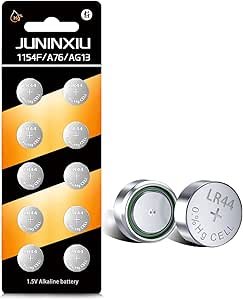
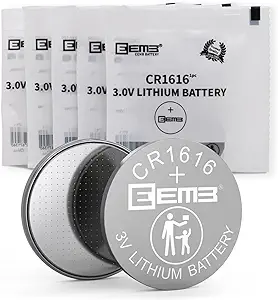
Within the coin cell family, the EEMB CR1616 and the Energizer 357 and 303 button cell cover other common fitments, and the Juninxiu L1154 is an alkaline rather than lithium button cell, which is a different chemistry with a different voltage and is not a substitute. The full coin and button cell category and the 3V battery category list what else is available in this voltage class.
One data note on this listing: the customer feedback block records 2,137 ratings at 4.6 stars, while a separate rating field on the same record reads 4. Those two figures come from different fields and do not agree, so treat the 4.6 star average as the one with a sample size attached. The listing also carries a Language specification reading English, which is a field with no meaning for a battery.
Who should buy this pack
Buy it if you have confirmed your device takes a CR2016, you want a branded cell with named standards compliance and child resistant packaging, and a ten cell pack matches how many of these your household goes through. Skip it if you need a different diameter or thickness, if you want a rechargeable cell, or if you only need one and have nowhere secure to keep the other nine. If there are small children in the house, the child resistant packaging is a reason to prefer this listing over a loose bulk pack, and the surplus cells still need to be stored where children cannot reach them.