
Description
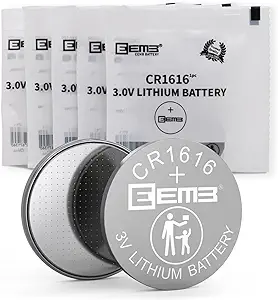
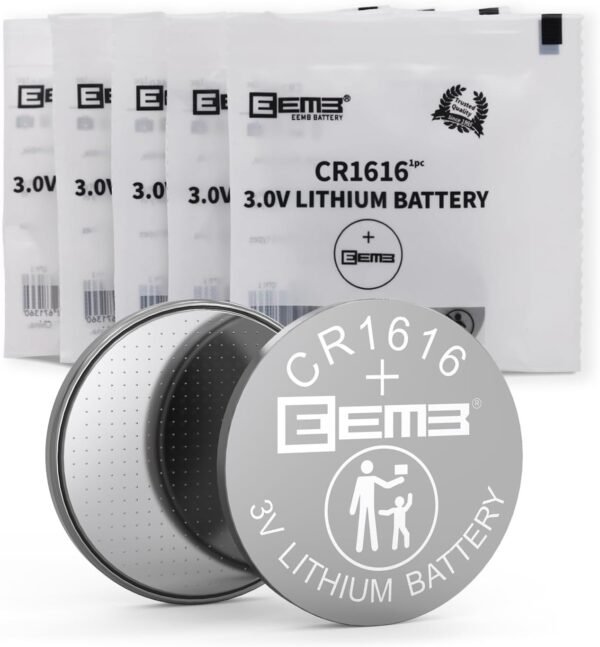
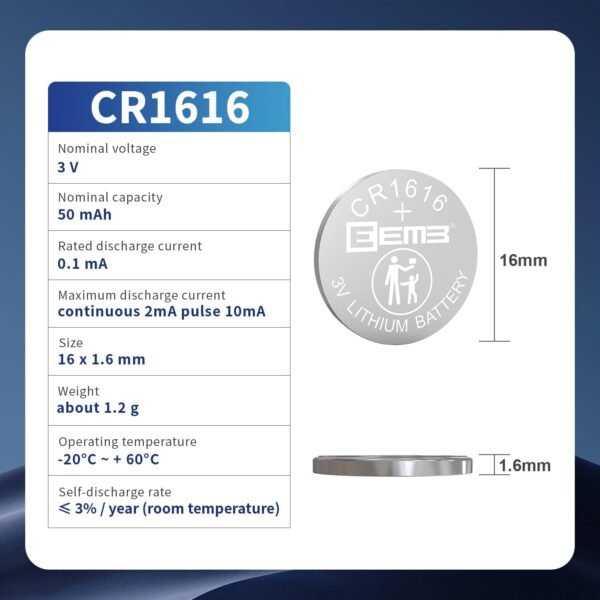
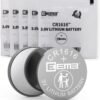
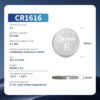
This is a five pack of EEMB CR1616 lithium coin cells, three volts each, sixteen millimeters across and 1.6 millimeters thick. The listing is unusually detailed by the standards of battery pages, giving an operating temperature range, a self discharge figure, a transport safety compliance statement and a cross reference list. That makes it easier to judge than most, and there is still one line worth arguing with.
Where a CR1616 is used
Lithium coin cells power devices that draw a very small current for a long time and need a stable voltage while doing it. EEMB names car key fobs, calculators, watches, fitness devices, toys, clocks, computer motherboards, remote controls, digital memory backup and various medical devices. The motherboard case is the one people forget: a small coin cell keeps system settings and the clock alive when a computer is unplugged, and when it fails the symptom is a machine that loses the date rather than one that will not start.
The CR1616 sits between the smaller CR1220 and the very common CR2032 in the same family. All three share a chemistry and a voltage and differ in diameter and thickness, and the number encodes exactly that: sixteen millimeters wide, 1.6 millimeters thick. A cell of the wrong thickness either rattles in the holder and loses contact or has to be forced in, which damages the contacts. Read the number printed on the old cell rather than judging by eye.
What the listing actually publishes
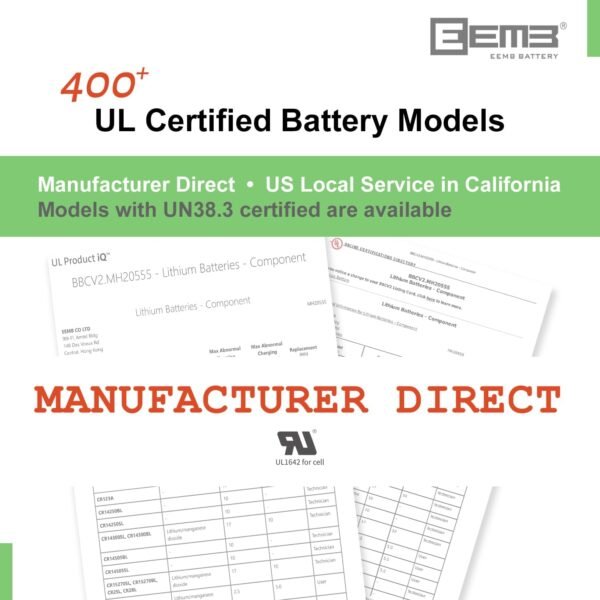
The useful figures are all here. EEMB gives an operating range of minus twenty to plus sixty degrees Celsius, which matters in a car key fob in either a hot summer or a cold winter, and states self discharge of less than three percent per year at room temperature, which is the figure that makes a five pack sensible to keep in a drawer. It states the cells are free of mercury, that they are UN 38.3 compliant, which is the transport safety test standard for lithium cells, and that more than four hundred EEMB models carry UL certification under file MH20555, which is a checkable reference rather than a vague assurance.
The leak statement is phrased carefully and deserves reading as written. EEMB says the cells will not leak in equipment during use and for two years after being placed in equipment. That is a bounded claim with a time limit attached rather than an open promise, and it is a more honest formulation than the blanket leak proof language many battery listings use. What is missing is a capacity figure in milliamp hours, which is the number you would use to compare this against another brand of the same size, and there is no manufacture date on the page.
One cross reference that is not equivalent
The replacement list includes BR1616 alongside the CR designations. Those are not the same chemistry. CR indicates lithium manganese dioxide, while BR indicates lithium carbon monofluoride, which has a lower nominal voltage, a flatter discharge and a wider temperature tolerance. In many low drain devices a substitution passes unnoticed, but in equipment specified for one or the other, particularly instruments and some medical devices, it is not a like for like swap. Buy the letter your device asks for. Every other entry on that list, including DL1616, ECR1616, L1616 and the various KCR and GPCR codes, is a conventional cross reference for the same cell.
The safety point that outranks the specifications
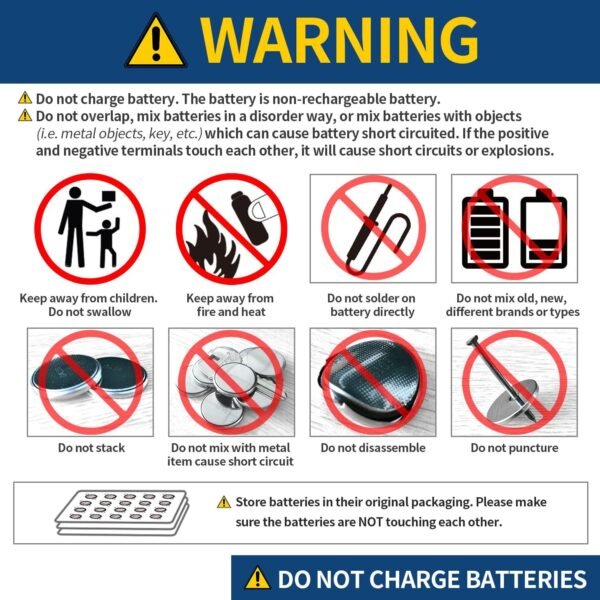
Lithium coin cells are a severe ingestion hazard for young children and for pets. A swallowed cell lodged in the throat or the gut can cause serious internal injury very quickly, and a three volt lithium cell is more dangerous in this respect than the smaller alkaline button cells it sits beside in a drawer. This matters more than any figure above it on the page, and a five pack means five opportunities for one to go astray.
Handle the pack accordingly. Keep cells in their individual blisters until the moment they are needed, store the pack high and out of sight rather than loose, and never leave a removed cell on a table while you fit the replacement. Check that battery compartments on remotes, key fobs, novelty items and children’s toys close securely with a screw or a firm catch, and stop using any device whose compartment no longer stays shut. If a cell is swallowed, treat it as a medical emergency immediately rather than waiting for symptoms.
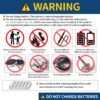
EEMB states directly that this is not a rechargeable battery and that it must not be charged, and that instruction should be followed exactly: charging a primary lithium cell can cause venting, leakage or rupture. Do not heat, crush, puncture or short one, keep cells away from coins and keys that could bridge the terminals in a bag, do not mix old and new cells in a device, and take used cells to a battery collection point rather than putting them in household trash.
Fitting them and making them last
Handle a coin cell by its edge rather than pressing a finger across both faces. Skin oils and moisture across the terminals make a poorer contact and can start a slow discharge before the cell is even in the device. Wipe it with a dry cloth before fitting, and check the orientation, since the positive face is the larger flat side and a shallow holder makes it easy to insert upside down.
Storage decides how much of that five pack you actually get to use. Room temperature, dry, away from heat and out of direct sun is what the stated three percent per year self discharge assumes, and a pack left in a hot car or a damp garage will not meet it. Keep the cells in their packaging until use, both for the contact protection and because loose coin cells are the version of this product that becomes a hazard.
Cost per cell, and the alternatives
The cost structure of a multipack is straightforward: price per cell falls with quantity, and the only waste is a cell that ages out unused. With a low self discharge figure, five cells is a sensible horizon for a household with two or three devices in this size. For one device it is not, and buying more coin cells than you need also means storing more of a genuine child hazard than you need.
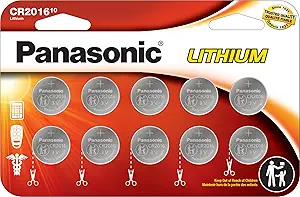
For the neighboring sizes in the same chemistry, our reviews of the PGSONIC CR1220 cells, the Panasonic CR2016 cells and the LICB CR2025 cells cover the sizes most often confused with this one. The coin and button cell category lists the format together and the three volt battery category groups them by voltage.
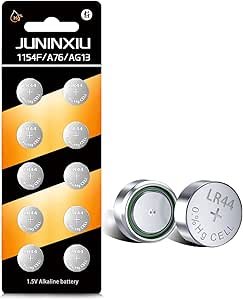
If your device takes a 1.5 volt button cell rather than a three volt coin cell, that is a different product entirely, and our write up of the JUNINXIU L1154 alkaline button cells covers that group.
Who should buy it, who should not
Buy the five pack if you have confirmed your device takes a CR1616 and you have somewhere secure to store spare cells away from children and pets. Skip it if your equipment specifies a BR1616 or a different number, or if you need a published capacity figure to compare brands, because this listing does not give one. The disclosure here is better than most, and the safety requirement is the same as for every coin cell on the market.