
Description
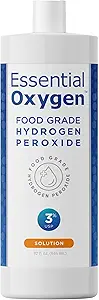
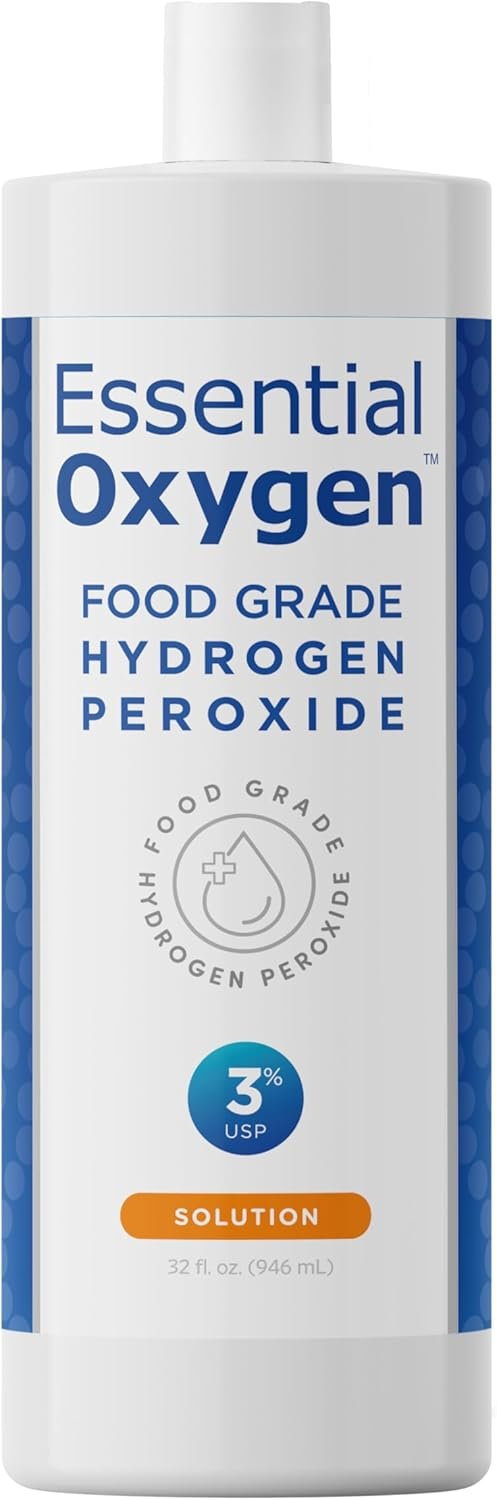
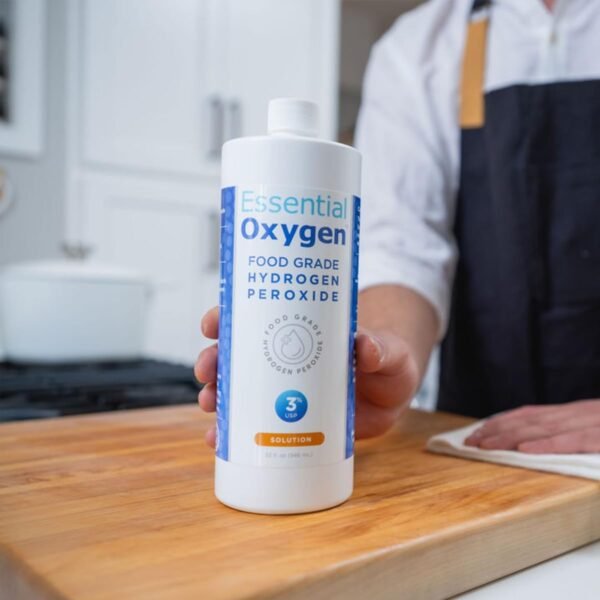
Essential Oxygen Food Grade Hydrogen Peroxide is a 32 fluid ounce refill bottle of a three percent solution, sold as a household cleaner. Three percent is the familiar drugstore strength, and food grade in this context means the solution is made without the stabilizers added to the brown bottle product most people know. The manufacturer’s directions on the listing are a single line: spray or wipe to beautify and cleanse.
What three percent peroxide does around a house
Hydrogen peroxide is an oxidizer that breaks down into water and oxygen, which is why it leaves no residue and why it appeals to households that want a short ingredient list. At three percent it is mild enough for general surface work: counters, sinks, cutting boards after washing, refrigerator interiors and similar hard surfaces. It also has a bleaching action, which is what makes it useful on stains and what makes it a risk on anything colored.
The household this fits wants one simple bottle rather than a shelf of specialized sprays, and the 32 ounce refill format suits someone already using the product and topping up a smaller sprayer. What it is not is a degreaser. There is no detergent here, so it will not cut cooking fat on a stovetop, and pairing it with an actual cleaner is more realistic than expecting it to replace one.
The claims on this listing go a long way beyond cleaning
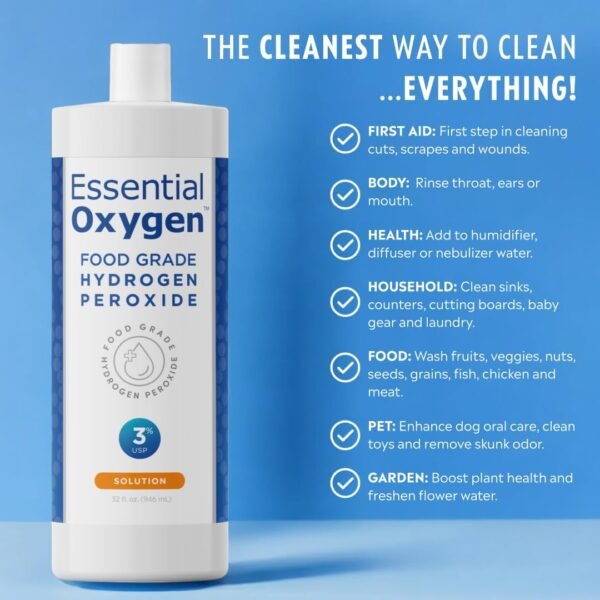
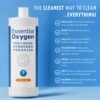
This is where the page needs reading carefully. Essential Oxygen lists uses across six areas: first aid on cuts and scrapes; body use including ears, throat and diffusers; household surfaces, cutting boards, laundry and baby gear; food including nuts, seeds, grains, vegetables, fruit, meat, fish and chicken; pets including oral care and skunk odor; and plants.
Those are the manufacturer’s statements, and this review repeats none of them as advice. Several sit squarely in territory this site does not cover: anything applied to a wound, put in an ear or a throat, used in a nebulizer or diffuser, given to an animal by mouth, or used to treat food you intend to eat is a health decision, not a cleaning decision. A doctor, a pharmacist or a veterinarian is the right authority, and the printed label with its own directions and warnings is the only instruction set. Do not extrapolate from a product page. The company also describes the product as planet positive and as making grass greener and oceans cleaner, which is a marketing statement with nothing behind it on this page.
Food grade, and what it actually means
The one technical claim worth unpacking is the food grade description. Standard three percent peroxide sold in brown bottles typically contains stabilizers to extend shelf life, and Essential Oxygen states its product is free of those. That is a real formulation difference and it is the brand’s main point of distinction. It also has a consequence the listing does not spell out: a solution without stabilizers is less stable, so light, heat and time degrade it faster. Keep the bottle closed, cool and out of the light, treat an old bottle as weaker than a new one, and do not decant it into a clear sprayer that lives on a sunny windowsill.
Surfaces, fabrics and what to test
Hard, non porous surfaces are the natural range: sealed counters, ceramic, glass, stainless steel, plastic and tile. On fabric and carpet, remember that peroxide bleaches. Three percent is mild compared with a concentrate, but on a dark or dyed fabric it can still lighten, so test on a hidden area, let it dry completely, and check the result in daylight before treating anything visible.
Be cautious on natural stone and on grout, both of which are porous, and on bare or plated metals, where an oxidizer accelerates corrosion if it is left standing. Do not store it in a metal container. On counters used for food preparation, a rinse with clean water after cleaning is a sensible habit regardless of what any product claims about residue.
Handling it safely
Three percent is a mild solution and it still deserves the standard precautions. Keep it out of your eyes, avoid prolonged skin contact, and ventilate the room if you are spraying a large area. Store the bottle upright, closed, cool, out of direct sunlight and out of reach of children and pets. Never decant it into an unlabeled bottle or a drink container, which is exactly how a clear liquid becomes a hazard under a sink.
The mixing rules for peroxide are absolute and they matter more than the concentration. Never combine hydrogen peroxide with chlorine bleach. Never combine it with vinegar or any other acid, because that mixture forms peracetic acid, which is corrosive and hazardous to breathe, and the fact that both ingredients are common household items makes this a genuinely frequent mistake. Never combine it with ammonia or with a drain opener. Do not spray it onto a surface that still holds another cleaner. Use one product at a time, rinse, then use another if you need to.
Because there are no stabilizers, expect the shelf life to be shorter than a stabilized product. If the solution no longer fizzes on contact with an organic surface, it has degraded and is doing nothing useful. Buy a size you will get through rather than the largest available.
Cost, and the alternatives
A 32 ounce refill is an economical way to buy this chemistry if you already use it, since you are not paying for a sprayer every time and the concentration means no dilution is needed. Against that, a ready to use three percent solution is mostly water by weight, and shipping water is the least efficient part of any cleaning purchase. The other cost is degradation: a bottle that sits for a year at three percent is not three percent any more, so buy to your usage rate.
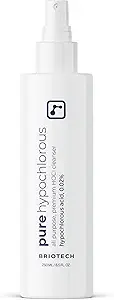
For a concentrated version of the same chemistry, our review of the MAXTITE 12 percent hydrogen peroxide covers a gallon that has to be diluted, and it is a considerably more hazardous product to keep in a house. For a different oxidizing route at consumer strength, the Briotech hypochlorous acid spray is worth comparing, and the disinfectant sprays and liquids category covers products whose labels carry stated germ claims and contact times, which this listing does not.
If you want another single ingredient cleaner for the same kind of light duty work, our write up of the Harris cleaning vinegar covers an acidic option, and it is precisely the product that must never be mixed with this one. The Vital Oxide all purpose cleaner and the wider all purpose cleaners category cover formulated alternatives that include detergents.
Who should buy it, who should not
Buy the refill if you already clean with three percent peroxide, you want a version without added stabilizers, and you will store it somewhere cool and dark. Skip it if you need a degreaser, if you want a stated germ claim with a contact time, or if you are buying it for the first aid, body, food or pet uses listed on the page, because those are health decisions and this site takes no position on them. Read the bottle, and ask a professional about anything that goes on a person or an animal.