

Description
Reading the number before you order
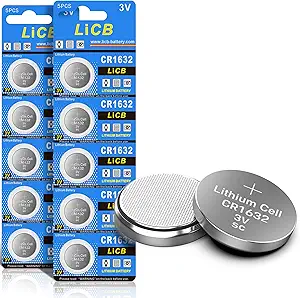
LiCB sells the CR1632 as a ten pack of 3 volt lithium coin cells, ASIN B0797PLSV4, listed since January 2018. The product dimensions field gives 0.63 by 0.63 by 0.13 inches at 0.06 ounces per cell, which is the standard CR1632 format. It carries a strong position in its niche, 2,054th in Health and Household and 7th among 3V batteries.
The most useful thing to understand about any of these cells is that the number is a measurement, not a model name. In the CR series, the first two digits are the diameter in millimeters and the last two are the thickness in tenths of a millimeter. A CR1632 is therefore 16 millimeters across and 3.2 millimeters thick. A CR1620 is the same diameter and 2.0 millimeters thick. A CR1616 is 1.6 millimeters thick. A CR2032, the most common cell in the house, is 20 millimeters across and 3.2 thick.
That system is why ordering by memory goes wrong. Two cells that look almost identical in the palm can differ by a millimeter of thickness, and a holder designed for one will either refuse to close on a thicker cell or make intermittent contact with a thinner one. Read the number printed on the flat face of the old battery, or the number in the equipment manual, and match it exactly.
Where CR1632 cells turn up
The CR1632 is a thinner cousin of the CR2032 and it lives in devices where the housing is shallow. Car key fobs are the most common use by far, particularly on a number of Japanese and Korean models, along with garage and gate remotes, some watches, small medical and measurement devices, tire pressure displays and a scattering of toys and electronic notebooks.
Because it is thinner and smaller in area than a CR2032, it holds less energy. That is worth knowing when a fob seems to need a new battery more often than a neighbor’s: it may simply be a smaller cell doing the same job. It also means that a device designed around a CR2032 will not run as long on a CR1632, quite apart from whether the cell physically fits.
Replacing a key fob cell without ruining it
Two practical points that no listing mentions. First, avoid handling the flat faces with bare fingers. Skin oils and moisture leave a film that raises contact resistance and, over months, can create a slow discharge path across the cell. Hold it by the edge, or use a clean cloth. Second, note the orientation before removing the old cell, because a fob will not tell you politely when it is in backward, and prying a wrongly seated cell back out is how contacts get bent.
The safety issue with any coin cell
A cell this size is small enough to swallow, and a swallowed coin cell is a medical emergency rather than an inconvenience. Current passing through moist tissue generates a caustic reaction at the battery surface, and serious internal injury can occur quickly. This applies to a spent cell as much as a fresh one.
Keep the blister pack, loose spares and used cells completely out of reach of children. Do not leave a cell on a table while you work on a fob. If a child may have swallowed one, seek emergency medical care immediately rather than waiting to see whether symptoms appear.
United States law has required child resistant packaging and warning labels on button and coin cell batteries since 2022. This listing states only that the cells arrive in a blister pack. It does not say whether that packaging meets a child resistant standard, and no warning text appears anywhere on the page. That is a gap worth naming.
The other handling rules are short. Never try to recharge a CR cell, which is a primary chemistry and can vent or rupture if charged. Never carry loose cells in a pocket or bag with coins or keys, where the two faces can bridge and heat the cell. Do not heat, pierce or incinerate them. Store the pack in a cool, dry place away from metal objects.
What LiCB claims, and how the claims hold together
The listing states a full 3 volt charge, a three year shelf life, zero mercury content, CE and RoHS compliance, grade A cells, strict quality control and eighteen years of battery specialization. It also says the cells are designed not to leak during use and for up to three years after being left in a device, and offers an eighteen month warranty.
Two things sit oddly. The warranty period is half the claimed shelf life, which is a curious pairing on a product whose main selling point is longevity. And no capacity figure in milliamp hours appears anywhere, which is the one number that would let a buyer compare these cells against another brand’s CR1632. Grade A is a seller’s term with no external definition, and CE and RoHS are compliance marks about market access and restricted substances rather than performance ratings. The description field is empty.
One equivalence in the compatibility list needs a note. BR1632 is listed alongside DL1632, ECR1632, KCR1632 and LM1632. The DL, ECR, KCR and LM codes are other manufacturers’ part numbers for the same CR chemistry. BR is not: the BR series uses a carbon monofluoride lithium chemistry with a different discharge curve and a wider operating temperature range, specified where a device needs stable output over years or in extreme heat. If your manual calls for BR, buy BR.
Disposal, cost and the neighboring sizes
Do not put lithium cells in household trash where local rules prohibit it, and never in curbside recycling, where a shorted cell is a fire risk in a collection truck. Tape over both faces of a spent cell and take it to a battery collection point.
On cost, a ten pack brings the price per cell far below a single blister at a checkout, and a three year stated shelf life makes stocking up reasonable if you have more than one device on the size. If you own exactly one key fob, most of the pack will sit in a drawer slowly aging.
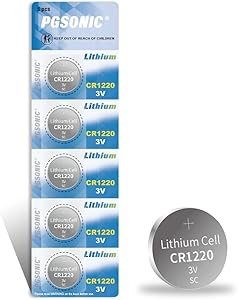
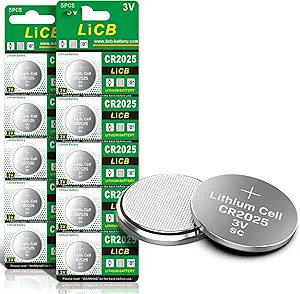
Check the neighboring sizes before ordering, since this is where mistakes happen. The LiCB CR2025 is 20 millimeters across, the Panasonic CR2016 is the same diameter and thinner again, the EEMB CR1616 shares this cell’s diameter at half the thickness, and the PGSONIC CR1220 is smaller in both directions. The catalog groups them under 3V batteries and coin and button cell.
Who should buy it and who should not
Buy it if you have devices on CR1632 and want a low cost per cell with a long shelf life, and you have somewhere secure to keep them. LiCB is a high volume seller in this size and the pack format is the sensible way to buy a cell you will need again.
Do not buy it without checking the number on your existing cell, since a millimeter of thickness decides whether it fits. Do not buy it if you cannot store batteries out of reach of children, given the ingestion risk and the absence of any warning on this listing. And do not expect a capacity specification, because the page does not publish one.